For many years now the self-destructive peasantry within Armenia's
so-called political opposition
have been telling us that large numbers of Armenians are seeking
to leave Armenia today primarily due to the lack of "democracy" and widespread "corruption" that goes on in the country. Well, based on
this very formula put forth by our Washington-led nutjobs in and out of
Armenia, Uzbekistan, followed by Azerbaijan must then be two of the least corrupt and most democratic nations on earth! Allow me to explain:
A recent Gallup International study has revealed - somewhat unsurprisingly - that a whopping 40% of Armenians want to leave Armenia. I personally think that the percentage of Armenians prone to abandoning their homeland is actually higher. Nevertheless, what's interesting here is that the same study also reveals that a mere 5% of Uzbeks want to leave Uzbekistan, 11% of Tajiks want to leave Tajikistan and 14% of Azeris want to leave Azerbaijan. Unbeknownst to us, did Azerbaijan, Uzbekistan and Tajikistan all of a sudden turn into Democratic wonderlands... or are Azeris, Uzbeks and Tajiks very attached to their homelands despite its problems? According to the same study, the percentage of Turkmens wishing to leave Turkmenistan is 6%; the percentage of Ukrainians wishing to leave Ukraine is 21%; and the rate for Georgians is 14%. For additional details on this Gallup International study, please see the full report at the bottom of this commentary.
Now, a logical question that we should all be deriving from these statistics (assuming that they are accurate of course) is the following: Are Tajiks, Turkemens, Uzbeks, Azeris, Ukrainians and Georgians living THAT MUCH better than Armenians? A well informed, honest and an objective answer to this question is a resounding - NO!
Why Armenians want out
In the big picture, the aforementioned nations - including the darling of many Armenians, Georgia - are doing just as bad if not worst than Armenia. In fact, corruption, injustice, crime and economic problems in most other countries around the world is much worst than in Armenia. But why aren't we seeing other people rushing to leave their homelands en-masse due to domestic problems? What do people who want to remain in their underdeveloped and/or troubled homelands have that we Armenians who are constantly seeking to abandon our homeland don't? Why do so many Armenians want out of Armenia? In my opinion, there are unfortunately a few major disadvantages unique to Armenia, flaws that the other nations in question do not have. The following are the eight fundamental reasons behind why Armenians want out of Armenia:
Interestingly, "dictator" Lukashenko's Belarus and "former KGB head" Putin's Russia have also been the targets of a major, multi-pronged and very sophisticated Western Psychological Operations campaign for many years, and their populations have gone through extreme difficulties during the past one hundred years. But, according to the same Gallup study, Belarus and Russia continue to have relatively low numbers of people wishing to leave their homeland. The figures are 17% and 14% respectively. Are Belarus and Russia that much more "democratic" and/or less "corrupt" than Armenia? No, they are not. Have these people suffered less than Armenians? No, they have not. Is the typical Belarusian or Russian living that much better than the typical Armenian? No. Then why don't more of their people want out? Well, you see, they are a Slavic people and unlike us semi-nomadic Armenians who are more concerned about filling our bellies with "խորոված " and driving shiny black German cars than building our nation, Slavs have much more pride in their nationality and, as many powerful invading armies have found out much to their dismay, they are much-much more attached to their land of birth.
Once again, Armenia's problems are cultural, economic, genetic, geographic, geopolitical and a simple matter of perception (i.e. Western and opposition propaganda).
The fact that even wealthy Armenians as well as those living decent, middle-class lives in Armenia are also seeking to move abroad is actually a very good indicator that the political opposition's dissemination of mass hysteria and the systematic mental conditioning of Western propaganda organs is at play behind their decision. Western propaganda outlets and Armenia's political opposition are the primary guilty parties in creating a very toxic sociopolitical environment. Their political experiments will destroy Armenia if they are not held in check. Incidentally, this overall situation is also breaking the emotional bonds that traditionally existed between the Armenian Diaspora and the Armenian homeland.
As a result of all the doom-and-gloom rhetoric and anti-government propaganda in recent years, more-and-more Armenians today want less-and-less to do with Armenia. This is the mass hysteria I referred to above. This is what's breaking the Armenian spirit. This is the existential threat Armenia faces in the world today.
Armenia is not the only nation with problems
Because they are so busy with trying to paint Armenia in the most horrible of colors, what our Western activists and opposition peasantry conveniently forget to tell us is that in this day in age people are seeking to leave all kinds of countries, including Western ones. I'm not talking about Greece, Italy, Bulgaria, Romania, Spain or Portugal, I'm actually talking about the US, Britain and France -
Nations that are immensely wealthy, located in peaceful
regions of the world and have hundreds of years of independence under
their belts are having tough times today? And our idiots are
complaining that our tiny, landlocked, remote and blockaded nation
surrounded by enemies in the volatile south Caucasus is doing bad?!
What our Western-led whores are not telling us is that relatively speaking Armenia is doing quite well despite is many-many problems. What our Western-led whores are not telling us is that Armenia should in fact be doing much-much worst, considering its dire circumstances in the south Caucasus. What our Western-led whores are not telling us is that most countries on earth are in fact worst off than Armenia. What our Western-led whores are not doing is giving us hope. What our Western-led whores are not doing is giving us rational/realistic solutions to our problems. What our Western-led whores are not telling us is that most of Armenia's woes today are a direct result of the blockade the country is placed under by NATO forces and because of Saakashvili's obsessively Russophobic government. What our Western-led whores are not telling us is that Armenians are panicked, demoralized and hopeless today primarily because of their 24/7 attacks against the country's leadership.
Armenia is going through natural, albeit severe growing pains. Armenia is slowly developing, evolving, progressing. Armenia's most severe problems are external, geopolitical in nature. Therefore, no folks, regime change or an "Arab Spring" type uprising in Armenia is very dangerous not only because there are regional predators ready to pounce on a weakened Armenia - but also because those waiting on the political sidelines in Yerevan to take advantage of any political turmoil in the country (you know who they are) are those who directly and indirectly serve Anglo-American-Zionist interests.
Even with all their faults (and there are many), today's government in Armenia is the only viable, logical and practical alternative for the Armenian nation. Anyone today that thinks Armenia's problems can be fixed merely by toppling "Serjik's" government is either an absolute idiot or a Western agent.
A recent Gallup International study has revealed - somewhat unsurprisingly - that a whopping 40% of Armenians want to leave Armenia. I personally think that the percentage of Armenians prone to abandoning their homeland is actually higher. Nevertheless, what's interesting here is that the same study also reveals that a mere 5% of Uzbeks want to leave Uzbekistan, 11% of Tajiks want to leave Tajikistan and 14% of Azeris want to leave Azerbaijan. Unbeknownst to us, did Azerbaijan, Uzbekistan and Tajikistan all of a sudden turn into Democratic wonderlands... or are Azeris, Uzbeks and Tajiks very attached to their homelands despite its problems? According to the same study, the percentage of Turkmens wishing to leave Turkmenistan is 6%; the percentage of Ukrainians wishing to leave Ukraine is 21%; and the rate for Georgians is 14%. For additional details on this Gallup International study, please see the full report at the bottom of this commentary.
Now, a logical question that we should all be deriving from these statistics (assuming that they are accurate of course) is the following: Are Tajiks, Turkemens, Uzbeks, Azeris, Ukrainians and Georgians living THAT MUCH better than Armenians? A well informed, honest and an objective answer to this question is a resounding - NO!
Why Armenians want out
In the big picture, the aforementioned nations - including the darling of many Armenians, Georgia - are doing just as bad if not worst than Armenia. In fact, corruption, injustice, crime and economic problems in most other countries around the world is much worst than in Armenia. But why aren't we seeing other people rushing to leave their homelands en-masse due to domestic problems? What do people who want to remain in their underdeveloped and/or troubled homelands have that we Armenians who are constantly seeking to abandon our homeland don't? Why do so many Armenians want out of Armenia? In my opinion, there are unfortunately a few major disadvantages unique to Armenia, flaws that the other nations in question do not have. The following are the eight fundamental reasons behind why Armenians want out of Armenia:
- Global economic crisis: Economic hardship brought upon Armenia's remote, resourceless, landlocked and politically volatile geographic location; its twenty year old blockade by NATO member Turkey; and of course the global economic crisis... thereby making economic opportunities in Armenia very limited.
- Affluent yet very self-centered and politically illiterate Diaspora: An affluent worldwide Diaspora that seems to be in the business of luring Armenians out of their homeland and expecting Armenia to meet their Diasporan/Western expectations... thereby compelling Armenians of Armenia to constantly consider moving abroad and joining their relatively speaking better off compatriots.
- Cultural and genetic traits unique to Armenians: Armenians are overly ambitious, self-righteous, arrogant, controling, egotistic, apolitical, suspicious, energetic, restless, clannish, ostentatious, individualistic, never satisfied, conniving, envious, materialistic, independent, competitive, proud, aggressive, possessive, temperamental, emotional, intelligent and օտարամոլ... thereby making Armenia simply too small for the Armenian.
- Destructive Western-funded political opposition: A Western-led, Wetern-financed, shortsighted, destructive and always hysterical political opposition that is primarily in the business of saturating the atmosphere in the tiny and embattled country with poison... thereby making living in Armenia psychologically unbearable for the average Armenian.
- Nearly one thousand years of not having national independence: Armenians have been living as subjects of various empires since 1045 AD. Consequently, Armenians today do not have a strong sense of belonging to an "Armenian" state; Armenians are not very concerned about nation building; Armenians are primarily interested in personal survival.
- Prevailing Bolshevik mentalities: Seventy years of Bolshevik indoctrination deeply corroded spirituality and nationalism within Armenia... thereby making matters of community, nationalism and morality a none-issue for the typical Armenian trying to attain a better life.
- The curse of geography: Armenia is a tiny, remote, resourceless, landlocked and blockaded nation surrounded by hostile neighbors in one of the most dangerous political environments in the world... thereby making Armenians insecure about their existence and seeing no future for their ever-embattled nation-state.
- Finally, perception: Propagandists know that perception is often more important than reality. With their constant pessimism, hostility and exaggerations, Armenia's political opposition and Western propaganda outlets that provide them support have gotten Armenians to believe that Armenia is hell on earth. Therefore, if Armenia is hell... then anywhere else must be heaven!
Interestingly, "dictator" Lukashenko's Belarus and "former KGB head" Putin's Russia have also been the targets of a major, multi-pronged and very sophisticated Western Psychological Operations campaign for many years, and their populations have gone through extreme difficulties during the past one hundred years. But, according to the same Gallup study, Belarus and Russia continue to have relatively low numbers of people wishing to leave their homeland. The figures are 17% and 14% respectively. Are Belarus and Russia that much more "democratic" and/or less "corrupt" than Armenia? No, they are not. Have these people suffered less than Armenians? No, they have not. Is the typical Belarusian or Russian living that much better than the typical Armenian? No. Then why don't more of their people want out? Well, you see, they are a Slavic people and unlike us semi-nomadic Armenians who are more concerned about filling our bellies with "խորոված " and driving shiny black German cars than building our nation, Slavs have much more pride in their nationality and, as many powerful invading armies have found out much to their dismay, they are much-much more attached to their land of birth.
Once again, Armenia's problems are cultural, economic, genetic, geographic, geopolitical and a simple matter of perception (i.e. Western and opposition propaganda).
The fact that even wealthy Armenians as well as those living decent, middle-class lives in Armenia are also seeking to move abroad is actually a very good indicator that the political opposition's dissemination of mass hysteria and the systematic mental conditioning of Western propaganda organs is at play behind their decision. Western propaganda outlets and Armenia's political opposition are the primary guilty parties in creating a very toxic sociopolitical environment. Their political experiments will destroy Armenia if they are not held in check. Incidentally, this overall situation is also breaking the emotional bonds that traditionally existed between the Armenian Diaspora and the Armenian homeland.
As a result of all the doom-and-gloom rhetoric and anti-government propaganda in recent years, more-and-more Armenians today want less-and-less to do with Armenia. This is the mass hysteria I referred to above. This is what's breaking the Armenian spirit. This is the existential threat Armenia faces in the world today.
Armenia is not the only nation with problems
Because they are so busy with trying to paint Armenia in the most horrible of colors, what our Western activists and opposition peasantry conveniently forget to tell us is that in this day in age people are seeking to leave all kinds of countries, including Western ones. I'm not talking about Greece, Italy, Bulgaria, Romania, Spain or Portugal, I'm actually talking about the US, Britain and France -
In the U.S. 49.7 Million Are Now Poor, and 80% of the Total Population Is Near Poverty: http://politicalblindspot.com/us-poor/
Young talent quits UK for warmer economic climes: http://rt.com/news/brain-drain-britain-immigration-546/
Une majorité de jeunes Français souhaite s’exiler: http://etudiant.lefigaro.fr/les-news...s-exiler-1602/
Jews flee from Israel? 'Right papers' save from danger zone: https://www.youtube.com/watch?v=RuDZYXyhD3U
What our Western-led whores are not telling us is that relatively speaking Armenia is doing quite well despite is many-many problems. What our Western-led whores are not telling us is that Armenia should in fact be doing much-much worst, considering its dire circumstances in the south Caucasus. What our Western-led whores are not telling us is that most countries on earth are in fact worst off than Armenia. What our Western-led whores are not doing is giving us hope. What our Western-led whores are not doing is giving us rational/realistic solutions to our problems. What our Western-led whores are not telling us is that most of Armenia's woes today are a direct result of the blockade the country is placed under by NATO forces and because of Saakashvili's obsessively Russophobic government. What our Western-led whores are not telling us is that Armenians are panicked, demoralized and hopeless today primarily because of their 24/7 attacks against the country's leadership.
Armenia is going through natural, albeit severe growing pains. Armenia is slowly developing, evolving, progressing. Armenia's most severe problems are external, geopolitical in nature. Therefore, no folks, regime change or an "Arab Spring" type uprising in Armenia is very dangerous not only because there are regional predators ready to pounce on a weakened Armenia - but also because those waiting on the political sidelines in Yerevan to take advantage of any political turmoil in the country (you know who they are) are those who directly and indirectly serve Anglo-American-Zionist interests.
Even with all their faults (and there are many), today's government in Armenia is the only viable, logical and practical alternative for the Armenian nation. Anyone today that thinks Armenia's problems can be fixed merely by toppling "Serjik's" government is either an absolute idiot or a Western agent.
What we Armenians ultimately need to recognize is that as long as Western and Turkish meddling remains strong in the south Caucasus, Armenia will continue suffering from severe sociopolitical problems. And as long as the south Caucasus remains a volatile place where major powers aggressively compete, Armenia will remain economically destitute. Even if all of Armenia's dreaded oligarchs turned into benevolent angels overnight, Armenia will continue suffering from severe sociopolitical and economic problems - as long as the south Caucasus remains a hotbed of geopolitical unrest. Therefore our so-called oligarchs are not the main problem.
Our wealthy Chobans are not the main problem
The south Caucasus is the epicenter of a tug-of-war being played between Russia, Western powers, Turkey and Iran. Thus, there are very powerful forces constantly pulling at the Caucasus region. As a result, the region is always on the verge of a major war and always on the verge of a drastic Turkic and/or Islamic makeover. Once again: As long as the Caucasus remains politically volatile, peace and prosperity will prove elusive for Armenia.
Believe it or not, Armenia's Chobans-in-Armani-suits (i.e. Armenia's culturally unrefined, intellectually deficient and ridiculously wealthy monopolists known as oligarchs) are not its most urgent problem today. As noted above, Armenia's most serious problems today primarily stem from its geographic location; political circumstances in the south Caucasus; the global economic crisis; Armenian folk culture; and destructive efforts of Armenia's psychologically disturbed rights advocates, politically illiterate opposition peasants and Westernized zombies seeking to topple the Armenian government at all costs!
What's more, I would also like to remind the reader that a nation full of materialistic, overly-ambitious, very intelligent, fiercely independent, deeply pessimistic, painfully cynical, extremely jealous, impossibly stubborn, gossip-prone, flashy, inexperienced and undereducated people with Asiatic mindsets cannot in all honesty expect to have an "enlightened" government - for as we know, governments are an accurate reflection of their subjects. In other words, people deserve the governments they have.
At the end of the day, the lawlessness in Armenia is a reflection of Armenian society. Let's also note that our gluttonous oligarchs were also derived from us. Armenia's problems today are an accurate reflection of modern Armenian society and culture, and no single politician - especially one that is serving a Western agenda - will be able to cure Armenia's ailments. What Armenia desperately needs today is a sociopolitical evolution; what Armenians desperately need today is genuine nationalism and patience; and what the Caucasus desperately needs today is Pax-Russica.
A critical look at Armenians
Ever since the near-death experience we had during the First World War we Armenians have been patting ourselves on the shoulder for how wonderful we are. I understand that this is a natural form of self-reassurance after coming face-to-face with annihilation. Therefore, to feel good, we kept reminding ourselves (and anyone else that would listen to us) that: We were the first Christians... We were the first this, we were the first that... This famous person was Armenian, that famous person was Armenian... We did this in the ancient world, we did that in the ancient world... Let's please stop all this silliness before it kills us.
I do not want to come across as if I'm trying to belittle our very rich history. Armenia was one of the greatest nations of the ancient world. Armenia was a major power during much of the preceding two thousand years before Armenia lost its independence in the 11th century. Moreover, much of human civilization has its origins within our historic homeland. Proto-Armenians brought civilization to lands stretching from India to the British Islands. Again, I am not attempting to belittle our magnificent history and immensely rich cultural heritage. On the contrary, I am longing to see the revival of ancient Armenia. I am hoping to see the resurrection of those Armenians that put Armenia at forefront of human civilization. This can be done because deep within the DNA of our people lies dormant the potential to be a great nation once again. We Armenians simply need an awakening. Therefore, we have some work to do.
To start with, I would like to say that we don't need anymore "proud" Armenians. We already have too many "proud" Armenians walking this earth without any connection to their Armenian homeland. We have proud Lebanese-Armenians; we have proud American-Armenians; we have proud French-Armenians; we have proud Russian-Armenians; we have proud Persian-Armenians; we have proud Turkish-Armenians; we have proud Yerevantsis, Gyumretsis, Artsakhtsis... Simply put: Armenian "pride" comes from Armenian arrogance. In other words, it's about the Armenian ego.
What we desperately need instead of "proud" Armenians are nationalist/patriotic Armenians. Why? Because a proud Armenian can be proud of his or herself anywhere on earth, an Armenian nationalist on the other hand can only feel proud of him or herself in Armenia. If we truly love our nation, we seriously need to begin talking about our national flaws. After all, to a significant degree, it is our national (i.e. collective) flaws that has gotten us to where we are today. If we are genuinely concerned about Armenia's future, we need to come down from our self-induced euphoria and start taking a close, hard look at who we are.
I reiterate: Armenians are gossip prone, overly ambitious, self-righteous, arrogant, egotistical, apolitical, cynical, impatient, restless, clannish, ostentatious, individualistic, dissatisfied, envious, materialistic, independent, competitive, proud, aggressive, possessive, temperamental, emotional, intelligent and օտարամոլ.
I realize that these unique traits have historically helped Armenians succeed in foreign lands where the pickings so to speak have been plenty. However, I also realize that when you take a people that exhibit these types of characteristics and place them in a small, landlocked and impoverished land - they will end up at each other's throats. And that is exactly the situation we have today in Armenia. And this is why I keep saying Armenians in Armenia are like hungry sharks forced to swim in a small, understocked pond. Our sharks need a well stocked ocean to swim in. In my opinion, Russia's Eurasian Customs Union promises to be that ocean.
Nevertheless, as it is, Armenia is too small for the Armenian.
We Armenians are a nation that has suffered over one thousand years of cultural and genetic decay. Let's not be naive enough to think that living in very close proximity to Turks, Arabs, Jews, Yezdis, Assyrians, Persians, Kurds and Gypsies for a thousand years did not leave their mark on us. If we were once a nation of lions, we are now a nation of hyenas. If we were once a nation of warriors, we are now a nation of merchants. If we were once a nation of priests, we are now a nation of consumers. Ever since our nobility was eradicated and we lost our statehood one thousand years ago, the blood of peasants and merchants has been flowing in our veins. Regardless of the degree of prominence, wealth and/or education an Armenian possesses today, the pedigree of the Armenian today is that of either an "Anatolian" peasant or a merchant. Let's not be naive enough to think that this lineage has not had an effect upon our collective psyche or behavior.
Although the Anglo-American-Zionist global order does it best to make us believe that genetics (i.e. race) is not important in this era of Globalism, bloodlines (i.e. breeding) indeed plays a very important role in human capabilities (i.e. intelligence, traits, talents, psychological and medical predispositions).
We Armenians today are derived from the remnants of a great civilization that went into decline or hibernation about one thousand years ago. Aside from Armenians of Artsakh, who were able to maintain some degree of self-autonomy on their ancestral lands, a vast majority of the rest of us Armenians are the off-springs of subservient peasants and merchants that somehow survived the ravages of the last one thousand years in Asia Minor. Losing our statehood and living as subjects of this or that empire for centuries has devolved the Armenian into a pathetic creature with survival instincts, a slave's mindset and a victim's mentality.
Once viewed from this perspective, the modern Armenian and thus the condition of Armenia today can easily be explained.
Nevertheless, Armenians wishing to leave Armenia en-masse should not surprise any of us. Armenians have been systematically abandoning Armenia for the past one thousand years. Byzantine Greeks were the first excuse for Armenians to abandon their homeland; then Seljuks were the reason; then Mongols were the reason; then Ottoman Turks were the reason; then Soviets were the reason; then Levon was the reason; then Robert was the reason; now "Serjik" is the reason... Tomorrow, Poghos will be the reason and the day after that Petros will be the reason.
What I am trying to point out here is that there will always be a reason for the materially driven, arrogant, never satisfied, self-righteous, egotistical, ostentatious, apolitical and self-hating Armenian to spit on his or her land of birth and run away in search of a better life, wherever that may be. After all, it is much easier to abandon one's underdeveloped homeland and seek a better life in already developed lands around the world. Like I said earlier: If Armenia is hell, then anywhere else must be heaven! These self-destructive traits of ours will not help us in building a powerful Armenian nation - especially in a nasty geopolitical environment like the south Caucasus. Therefore, to fix Armenia we first need to fix the south Caucasus (i.e. Pax-Russica)... and then we need to figure out a way to fix the Armenian.
British secret service agent Thomas E. Laurence's comments about Armenians one hundred years ago suggests that Westerner powers have long recognized Armenian strong points and the weak points and have thus been manipulating Armenians accordingly.
Democracy is not a panacea and Western powers are not our friend
In the West, the practice
of democracy
is tightly controlled by its deeply entrenched elite. The democratic
processes in places like the United States or Great Britain, for instance, won't be
allowed to get outside their clearly defined parameters. In fact,
Switzerland and Iceland may be the only nations on earth that
practice the purest forms of democracy today. We Armenians on the
other hand must take a good, long look at ourselves in the mirror
and recognize that we are not Swiss, we are not Icelandic, nor are we
Germans or Japanese for that matter.
Before the leadership of any developing country is capable of allowing their citizenry to participate in nation's political processes in any degree, political system in the country first needs to develop well established national institutions and give birth to political parties that are subservient to them.
Thanks to the incumbent president and Russia's security services, I am glad to see this crucially important political process beginning to take place in Armenia today. Having deeply rooted and powerful national institutions that oversee and sometimes guide the political process in a country is a prerequisite to practicing any form of democracy.
In their transitional phases, developing nations like Armenia need top heavy governments with powerful leaders. Once again, I'd like to remind the reader that Armenia's most pressing problems are geopolitical in nature. Most of Armenia's most urgent, most pressing problems stem from its geographic location and the prevailing political climate in the south Caucasus. Until this is fixed Armenia will continue suffering from severe political and economic stresses.
The active promotion of Democracy (i.e. rule by the ignorant masses) and the obsessive desire to combat corruption as a way of helping Armenia will get us nowhere. The pursuit of Democracy in an underdeveloped land without democratic traditions or without the proper national institutions is very dangerous. Western officials use the pursuit of Democracy in targeted nations as a method of control, putting pressure on non-aligned governments and as a diversionary tactic (i.e. red herring meant to mislead people). By having our idiots pursue outlandish Western fairytales that are actually destructive in practice, they have us in effect chasing our tails, as our nation languishes in the geopolitical tug-of-war taking place in the south Caucasus.
Once more, Democracy - as per Western demands - is one of the worst, most destructive forms of government devised by man; Capitalism - as practiced by the Anglo-American-Zionist world - is the worst form of economy in existence; the US Dollar is nothing but a virtual reality kept alive by American wars around the world; tying a nation's fate to the Anglo-American-Zionist global order is suicidal; and the Western world is rife with Institutionalized Corruption (i.e. corruption and lawlessness that is strictly reserved for the Western elite).
While Western officials keep our Democracy Now(!) idiots preoccupied with things like gay rights, civil society and free elections, keeping Armenia politically isolated and economically stagnant is their ultimate game. Therefore, it would be wise to look past the lofty rhetoric of Washingtonian whores such as Raffi Hovannisian and assess their actions in Armenia within the following geostrategic context -
Keep Armenia isolated, George Friedman: http://theriseofrussia.blogspot.com/2010/11/arye-gut-israeli-jewish-expert-in.html
Although we have countless idiots in Armenia and in the Diaspora that think we are living in an enlightened age where the "rule of international law" and "human rights" are respected, the fact is that Western powers, as well as the entire world, is still very much governed by the old adage of - might makes right. Let's always remember that "international law" is made by the powerful to control the weak. Therefore, in this dog-eat-dog world we Armenians need to be very grateful that we have a very powerful regional ally like the Russian Federation. We must be very grateful that a superpower is sincerely interested in Armenia's survival as a nation-state in a very hostile and unforgiving environment.
The need for Cyber activism
With April 9 and Raffi's promise of "over my dead body" just around the corner, politically pragmatic Armenians who are genuinely concerned about the future of their fledgling nation-state need to raise the frequency and intensity of their political activism using social media.
During Israel's war against Lebanon's Hezbollah in 2006 it was revealed that there was in existence a Mossad-backed program under which college-aged Jews from around the world would use a computer program to regularly monitor different internet discussion forums and news sites and when expedient post pro-Israeli commentary. If there was a discussion going on about how bloodthirsty Jews are, someone would appear to highlight the wonderful deeds of Jews around the world. If there was a discussion going on about how Israel has become a serious liability for the US, someone would appear to explain that Israel is America's number one ally and that America needs Israel to defend western values in the Middle East. When Armenians would be discussing how Jews and Turks are alike, someone would appear to tell Armenians how similar Jews are to Armenians and why Armenians and Jews need to work together to fight Islam.
Although I have no way of confirming it, I believe that have come into direct contact with these types of Cyber-Jews in the past. Nevertheless, what they were doing was a very effective and inexpensive method to saturate the internet with their Propaganda. Needless to say, Washington also has an army of Cyber-activists preaching American fairytales around the world and some of them are assigned to domains pertaining to Armenia and Armenians. The following are two blog commentaries addressing this very important topic -
US Launches Cyber Spy Operation Against The World: http://theriseofrussia.blogspot.com/2011/04/us-launches-cyber-spy-operation-april.html
Washington's Media Blitz against Armenia: http://theriseofrussia.blogspot.com/2011/02/american-media-blitz-against-armenia.html
When reading some of the more popular
English-language Armenian news sites on the internet pay particular attention to comments posted by the readers.
Some of them are without doubt Washington's Cyber-warriors. It's
actually not very difficult to find them. The catchphrases they use (cliches about democracy, oligarchs, evil Russians, western values, corruption, free elections and thugs running Armenia) and their alarmist and almost robotic (i.e programmed) mindsets make them
readily recognizable. The more alarmist or hostile the rhetoric, higher the chances of them being one of Washington's Cyber-warriors. But Washington and Tel Aviv are not the only ones engaged in Cyber warfare; many of the larger and more powerful nations of the world engage in such operations. And it's not only nations
that do it.
It could be said that some of my readers and myself have been engaged in Cyber-activism for quite a few years, of course without the government support or guidance. But being that we are Armenians, it would be very foolish of us to expect any kind of support or guidance from anyone. However, if well-informed, properly organized and motivated, even a small number of enlightened internet activists can make a difference. Therefore, I would like to ask the reader to regularly monitor Western propaganda outlets such as Civilitas, Policy Forum Armenia, Preparliament, Sardarapat, Arajinlratvakan, Radio Liberty, Aravot, Armenian Weekly, Asbarez, ArmeniaNow, Hetq and Lragir.
It could be said that some of my readers and myself have been engaged in Cyber-activism for quite a few years, of course without the government support or guidance. But being that we are Armenians, it would be very foolish of us to expect any kind of support or guidance from anyone. However, if well-informed, properly organized and motivated, even a small number of enlightened internet activists can make a difference. Therefore, I would like to ask the reader to regularly monitor Western propaganda outlets such as Civilitas, Policy Forum Armenia, Preparliament, Sardarapat, Arajinlratvakan, Radio Liberty, Aravot, Armenian Weekly, Asbarez, ArmeniaNow, Hetq and Lragir.
Don't forget that in any Social Engineering, Public Relations or Psychological-Operations campaign, perception is more important than reality. Using diverse levers under their control, they have managed to create an alternative reality for our sheeple. They have managed to paint Armenia as hell on earth in the eyes of the average Armenian. As we saw with Paruyr Hayrikian's assassination attempt, they don't just brainwash - they also incite unrest. But we can learn from some of their tactics.
Although we do not have institutionalized support or expert guidance, we can nevertheless do our part to counter some of the artificially fabricated perceptions imposed upon us about the Armenian state. Therefore, I ask you to visit the above mentioned propaganda sites and regularly post hard hitting commentaries under different pseudonyms and different email addresses. Chances are that website administrators will not post your comments, but at the very least they will recognize that there is a growing grassroots movement against their subversive actions in Armenia. And when doing so please don't forget to -
- Express alarm about creating political instability in Armenia during these volatile times
- Warn that Armenia's many enemies are waiting to take advantage of internal problems in the country
- Express grave concern that Armenia's crucially important relations with Russia may be damaged as a result of Raffi's political experiments
- Explain that Raffi and his supporters are simply incapable of governing a country
- Highlight Raffi's Western political agenda in Armenia and highlight Western crimes around the world
- State that Armenia's real problem is not corruption but rather the region's geopolitical situation and the global economic crisis
- Insinuate
that the political opposition's constant negativity and destructive
criticism is the main reason behind the current hopelessness and despair
in Armenia
- Claim that the current leadership in Armenia is the lesser of all evils
- Emphasize that Armenia needs sociopolitical evolution and not a Western sponsored revolution
- Don't hesitate to bad mouth the entire Hovannisian family, calling out Richard Hovannisian as a pseudo-historian
And always remember the following -
- Armenia's natural growing pains are being exploited by imperial powers to undermine the fledgling republic ultimately due to its strategic partnership with the Russian Federation and its good relations with Iran. Since some farsighted leaders in Yerevan have courageously made the decision to remain firmly within Russia's political orbit, Washington has its lackeys running around Armenian society acting hysterical over sociopolitical matters in Armenia.
- Had Armenia's "corrupt" leadership been in bed with the leadership in Washington, none of our nation's doom-and-gloom activists today would have been provided any venues to spew their poison against Armenia.
- Armenia's political opposition needs to shed their Western connections if they want to be taken seriously. Moreover, they need to keep their fight strictly in Armenia; they need to be clearer in their demands; they need to provide rational solutions and viable alternatives to the problems at hand; they need to recognize, appreciate and embrace Moscow's role in the south Caucasus; instead of calling for the whole government to disband or the president to step down due to corruption related matters, they instead need to target select individuals or firms known to be engaging in unlawful activities; they need to figure out a way to work with the government or from within the government.
- Armenians need to understand that the government in power in Yerevan today the lesser of all the evils threatening the country. If the current regime falls it wont be Armenian patriots that will be taking over.
- The perception that Armenia is on the very verge of collapse due to widespread corruption are a result of disinformation and exaggerations put forth by Armenia's Western propaganda outlets and by the political opposition.
- Armenians need to understand that Western financial aid is in fact a form of bribe. Moreover, accepting money from Western institutions or governments is like accepting money from a loan-shark. Yerevan needs to curtail its dealing with Western institutions such as the IMF and the USAID.
- As bad as it may seem at times, what Armenia has been going through are natural growing pains. Historically speaking, twenty years is merely a blink of the eye. Due to Armenia's particular circumstances its growing pains may at times be severe. We must not loose sight of fact that most nations on earth today (including nations under much better circumstances than Armenia) are in fact much worst-off than Armenia. Armenia has in fact made notable progress despite all the odds stacked against it.
- Who gave Washington the right to judge nations? Who says the political West is the standard all the rest have to follow? Why do we care what politically motivated Western organizations have to say about Armenia's ranking in anything? Was the Western world born this developed, this progressive or this wealthy, or did it have to travel a very long and bloody path to get to where it is today? The Western world, including the United States, took hundreds years to reach where it is today. In fact, the Western world is where it is today due to wars of plunder, grand theft, genocide and human exploitation.
- A little over century ago America's robber barons (e.g. Carnegies, Rockefellers, Morgans, Goulds, Vanderbilts, Du Ponts, etc.) used their immense fortunes to buy into the American political system, forever blurring the line between politics and business. These oligarchs used their powerful influences to impact the making of political legislation. The political system in the United States was manipulated by America's oligarchs to serve their businesses and to preserve their immense wealth. Although it has been in a decline in recent years, the American middle class essentially grew as a result of feeding on the crumbs that were falling off the lavish banquet tables of the nation's super wealthy.
- The Western world also has severe forms of corruption. It can be argued that Western corruption is by-far the most egregious, albeit more sophisticated. The main difference between corruption in the West and corruption in a place like Armenia is that corruption in the developed West is reserved for the political/financial elite. Moreover, Armenia is tiny, therefore any wrong doing can immediately be seen or felt. Through legislation, corruption has evolved to become fully institutionalized in the Western world. Therefore, in the West, corruption is not for the common folk. Corruption in the United States, for instance, is reserved for the empire's elite entities (e.g. military industrial complex, Zionist/Jewish groups, CIA, Federal Reserve, Pentagon, oil and gas industry, mega-corporations, Wall Street, pharmaceuticals industry, etc).
- Who gave the political West the right to criticize and attack nations that are not as developed? What right does the West have to impose its system upon others? Why do tyrannical nation that are allied to the West get a free pass while those who are not politically aligned to it cannot do anything right? What right does the West have to rate, label or categorize any nation? And how foolish are the rest of us to listen to what they say?
- Similar to what imperial powers did in the past with religion, the very notion of Democracy and human-rights today have become weaponized by Washington. As a matter of fact, everything today is becoming weaponized by Washington. Money is weaponized. Trade is weaponized. Religion and religious cults are weaponized. Energy is weaponized. Food is weaponized. Atheism is weaponized. Scientific research is weaponized. Gay rights is weaponized. Feminism is weaponized. The news is weaponized. Entertainment is weaponized. Humanitarian aid is weaponized. Education is weaponized. The English language is weaponized. Fighting corruption is weaponized. Anything and everything that can in anyway be used against a targeted nation for a political and/or economic purpose is systematically becoming weaponized by Washington. Globalism is a Western weapon of mass destruction.
- Democracy for an immature nation like Armenia can prove fatal. As the events of early 2008 clearly revealed to us, Armenians are not yet politically mature enough to be given the responsibility of electing their leadership. We have seen the destruction the imposition of Democracy has visited upon undeveloped or underdeveloped nations throughout the world. This may be why some vulnerable nations on Washington's black list are being prescribed a very heavy dose of Democracy these days. A nation like Armenia, just coming out of under a thousand years or Asiatic/Islamic/authoritarian rule simply cannot have the proper national institutions with which to flirt with a liberal democratic process. For the foreseeable future, a top heavy socialist government is what Armenia desperately needs.
- Similar to the situations in nations such as Greece, Bulgaria and Italy, lawlessness/corruption is firmly rooted in Armenia. Therefore, toppling the Armenian government will not solve the problem of corruption in Armenia - just like being in Europe has not solved the problem of corruption in Greece, Bulgaria and Italy. Governments are an accurate reflection of their constituency. When we look at the Armenian leadership, what we see is an accurate reflection of the modern Armenian. Besides which, corruption in society, any society, cannot be eliminated, it can only be managed.
- Armenia's primary problem is not corruption but rather the prevailing geopolitical climate in the south Caucasus. As long as Armenia remains landlocked, blockaded and surrounded by enemies in one of the most hostile political environments in the world Armenia will continue to be economically and financially troubled.
- Armenians need to recognize Russia as the alpha and the omega of the Caucasus. Armenians need to recognize that without a Russian presence in the south Caucasus there won't be an Armenian presence in the south Caucasus. Armenians need to recognize that Armenia's close relationship with Russia today is a historic opportunity that needs to be exploited to its fullest potential.
- Diasporan Armenians need to stop treating Armenia as their personal laboratory experiment or their exotic playground. The American-Armenian community needs to stop pushing Washingtonian agendas inside Armenia.
- In their irrational pursuits of building the Armenia of their fantasies, a significant number of Armenians today are actually damaging the Armenia we have today.
- Armenia's many natural growing pains need to be addressed rationally, responsibly, objectively, constructively, with patience and, more importantly - free of Western manipulation!
- Armenia needs sociopolitical evolution and not a Western sponsored revolution.
We are living in historic time. Tectonic shifts are taking place around the world. We are witnessing the transition from a post-war's Western-centric paradigm to a more multi-polar, Eastern-oriented world. This historic transition will not be uneventful by any stretch of the imagination. In fact, recent unrests we are witnessing around the world is a direct result of this transition. In short, the entire world has serious problems today. What we don't need, however, is our Western-led, politically illiterate peasantry making things worst for Armenia by their constant fearmongering and rhetorical poison. We Armenians have become too politically illiterate, too pessimistic, too apathetic and too materialistic. We need to rekindle our ideological convictions and our political activism, and we need to begin seeing the political world we live within in a clearer, more objective light. Don't wait for April 9 and don't allow them free reign in Cyberia. Please forward this political action alert to others in your mailing list now. Please post links of the following blog commentaries in appropriate
discussion forums and websites devoted to Armenian news. And thank you for reading.
Arevordi
Arevordi
April, 2013
***
Raffilution begins!!! Raffi Hovannisian’s turn to lead Armenia’s self-destructive peasantry: http://theriseofrussia.blogspot.com/2013/02/raffilution-begins-raffi-hovannisians.html
Raffi shows Putin who's boss: http://theriseofrussia.blogspot.com/2013/03/raffi-shows-putin-whos-boss-march-2013.html
Armenia on the eve of its presidential elections: http://theriseofrussia.blogspot.com/2013/02/armenia-on-eve-of-its-presidential.html
The revolution has begun? Armenians again reveling in self-destructive behavior: http://theriseofrussia.blogspot.com/2012/11/the-revolution-has-begun-armenians.html
Collective destructionism of Armenians: http://theriseofrussia.blogspot.com/2012/08/collective-destructionism-and-armenias.html
Panel Discussions Calling for Chaos in Armenia: http://theriseofrussia.blogspot.com/2012/01/washington-sponsored-panel-discussions.htmlThe Whore of Babylon in Yerevan: theriseofrussia.blogspot.com/2012/06/whore-of-babylon-in-yerevan-june-2012.html
Fifth anniversary of Levon Petrosian's coup d'etat: http://theriseofrussia.blogspot.com/2013/03/fifth-anniversary-of-levon-petrosians.html
The two ring circus called the American presidential elections: http://theriseofrussia.blogspot.com/2013/01/the-two-ring-circus-called-american.html
***
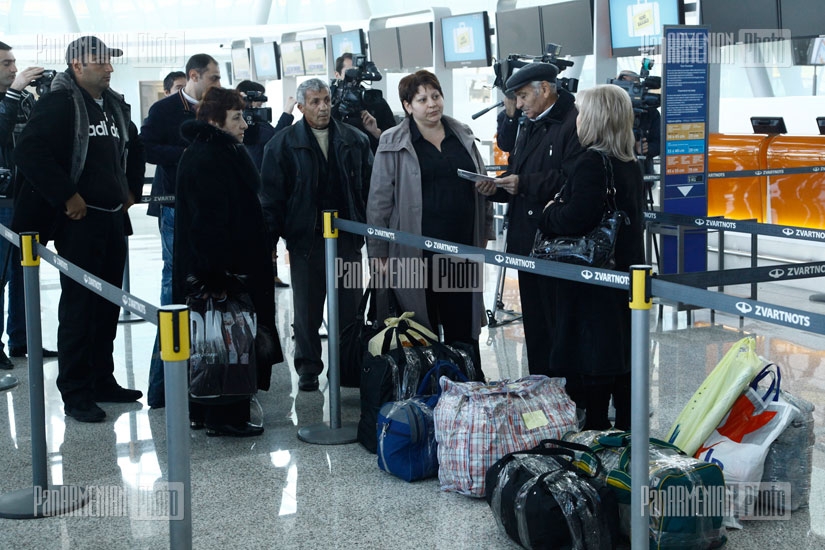


Source: http://www.gallup.com/poll/161591/desire-leave-fsu-ranges-widely-across-countries.aspx
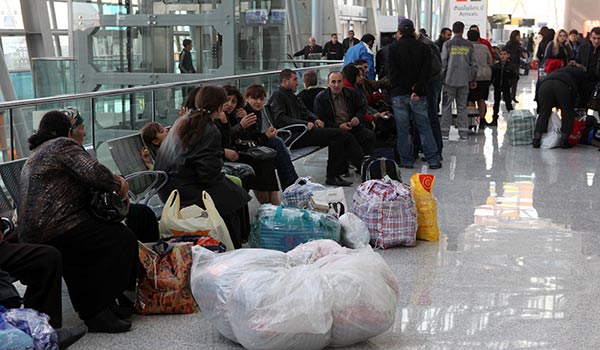
Emigration
tendencies have grown in Armenia over the recent years. By official
statistics, 125,000 people left Armenia between 2010 and 2012 and never
returned.
The Armenian president made a reference to the emigration issue a few weeks ago, citing the “lukewarm atmosphere” created by the media as its main reason.
“The core reason for emigration is this lukewarm atmosphere, people don’t see a light in the end of the tunnel, they have no hopes. Why, because for many years at least two TV channels, dozens of printed and electronic media have been talking about the very worst, have been only blackening the picture,” said Sargsyan.
Ethnographer Hranush Kharatyan says both the authorities and the opposition – by constantly giving hope and failing to “mobilize so that they can solve something” – are responsible for the population’s incessant outflow from the country.
Editor-in-chief the local daily newspaper Aravot Aram Abrahamyan points out another reason, apart from blaming the “unyielding” authorities “which have no adequate idea of the real state of things in the country and are deaf to people’s needs”.
“Let us admit that Armenia is not the poorest, the most authoritarian, the most corrupt and the most unjust country among the 12. Even the atmosphere here is not the most lukewarm. Then, what is the one of the possible reasons? Of course, it requires a serious research, but I’ll attempt a guess: one of our issues is that we, Armenians, easily get inspired and as easily fall into despair,” Abrahamyan wrote today in his editorial. “Now that Raffi Hovannisian and his supporters are saying this and that will happen on April 9, they seem to be ignoring the fact that if nothing happens (which is quite likely), then on April 10 or 11 nobody will rally with the same enthusiasm and it won’t be possible to “entertain” with drives like hunger strike.”
Ruling Republican party representative Hovhannes Sahakyan told ArmeniaNow that over the coming five years all the steps to be taken by the authorities “be it legislative initiatives, creation ofjobs , solving this or that issue” will be aimed at overcoming all the negative processes in the country, including emigration.
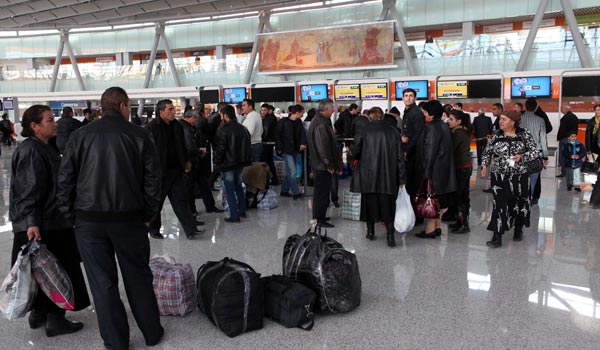
Accordingly, they came to the conclusion that... they do not need any homeland.
Haytoug Chamlin
To Greener Shores: A Detailed Report on Emigration from Armenia
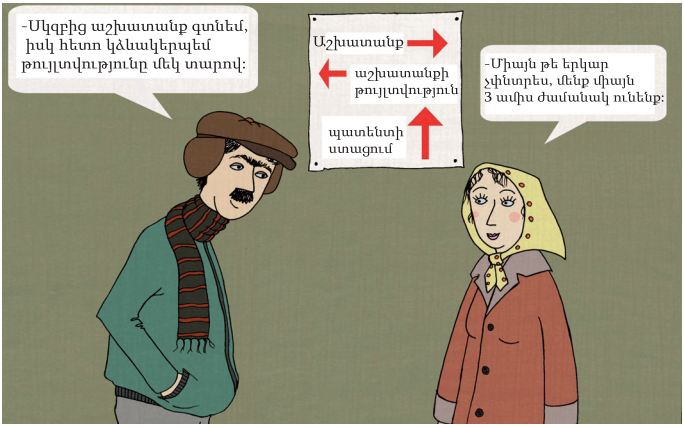
Lilit and her family considered emigration as a last resort, but when an Armenian-American showed interest in Lilit’s daughter, then in her 20s, the family believed it was a path to salvation. It did not matter that the man was twice the daughter’s age, as long as he could take her abroad. The couple married, despite Lilit’s objections. She had envisioned a different future for her daughter. “We were a poor family. In Armenia, if you’re poor, it’s hard to marry off your daughter. My husband wanted for my daughter to move to the States as that would also be a way out for us.”
Lilit’s daughter was married within 15 days of meeting her husband. “She was a sacrifice for our salvation,” said Lilit, adding, “This is common in Armenia. Many people marry off their daughters to men from abroad so that they can get out and help in some way, whether financially, or if the parents are old, perhaps get them out as well.” Lilit’s daughter moved to the U.S. 12 years ago. She has since separated from her husband, and lives with her three young children.
Meanwhile, as a first and crucial step, the government is at the early stages of initiating a project to compile a registry of emigrants. “The source for data on emigration is studies and surveys, including from sociological organizations and international organizations such as the OSCE and UNDP, and not registrations. Undertaking such a project costs money—it requires field work and interviews, and thousands of people need to be surveyed. For the first time, the government has approved, in its 2013 budget, that such a study be funded, not by the SMS, but by professionals.
Desire to Leave FSU Ranges Widely Across Countries
Fifteen percent of adults across 12 former Soviet Union (FSU)
countries desire to migrate to another country permanently, according to
Gallup data collected between 2010 and 2012. Desire varies within the
region, from 40% in Armenia to 5% in Uzbekistan. Adults in Central Asian
countries are generally less likely to want to migrate than those
living in other areas within the larger region.
When Gallup asked potential migrants in 2011 and 2012 to identify the
main reason they would like to move, the majority cited
economic-related factors. Fifty-two percent of potential migrants in FSU
countries say they want to improve their standard of living or live in a
country with a better standard of living. Another 10% say they want to
get a good job or cannot find a job in their own country. More than one
in eight (13%) are thinking not of their own futures, but those of their
children.
But 12% said they did not have an opinion on the reason they desire
to move. Four percent or fewer potential migrants mentioned other
reasons such as social benefits (namely retirement and medical
benefits).
In contrast to the commonly held belief that reuniting families is
one of the most important reasons for migration in the region, Gallup
data show that it is not near the top of the list for residents in these
12 countries. Those in Central Asian countries are the most likely to
cite wanting "to be close to family" as the main reason they would like
to migrate, with the highest percentage in Kazakhstan, at 11%.
Potential migrants aged 50 and older are more likely than younger
respondents across all 12 countries to want to move to be closer to
family. In Central Asian countries, nearly one in four adults in this
older age group say family is the main reason they desire to migrate.
Those aged 50 and older (9%) are more likely than younger adults (3%)
to say social benefits are the main reason they want to move to another
country. Young adults, on the other hand, are most likely to say
improving their standard of living is the main reason they want to
migrate, at 56%.
Children's Future Top Motivator in Some Countries
Adults in Turkmenistan (29%) and Kazakhstan (21%) are the most likely
to cite their children's future as the main reason they want to migrate
to another country. Far fewer in other countries offered this as a
reason.
Women across all countries were more likely than men -- 17% vs. 10%,
respectively -- to say they want to move for their children's future.
And those who have children younger than age 15 in their household are
more likely to cite this reason for wanting to migrate.
Implications
Leaders need to be cognizant of the factors that play an important
role in people's decisions to leave their countries. In FSU countries,
the main reasons behind people's desire to migrate are largely economic,
but they are also motivated to move to provide better futures for their
children. If countries fail to provide good jobs, many residents in the
region may act on their desire to leave their country to find better
employment and a better standard of living for themselves and their
families.
For complete data sets or custom research from the more than 150 countries Gallup continually surveys, please contact us.
Survey Methods
Results are based on aggregated face-to-face interviews with 41,072
adults, aged 15 and older, in 12 countries from 2010 to 2012: Armenia,
Azerbaijan, Belarus, Georgia, Kazakhstan, Kyrgyzstan, Moldova, Russia,
Tajikistan, Turkmenistan, Ukraine, and Uzbekistan.
In 2011 and 2012, 4,519 survey respondents said they would like to
move to another country permanently. These respondents were asked to
indicate all reasons why they would like to move abroad, and then to
choose the main reason among those mentioned. One can say with 95%
confidence that the margin of sampling error for the total sample of
4,519 respondents is less than ±2 percentage points. Margin of error for
subgroups is larger.
For more complete methodology and specific survey dates, please review Gallup's Country Data Set details.
Source: http://www.gallup.com/poll/161591/desire-leave-fsu-ranges-widely-across-countries.aspx
Gallup poll shows 40 percent of Armenians want to leave their country, authorities blame ‘lukewarm’ atmosphere
The Gallup International polling organization has presented the results of its survey
covering 2010-2012, by which among the 12 post-Soviet countries
citizens of Armenia showed the highest tendency for leaving their
country.
To the question whether they would like to leave for permanent residence in a different country if they had a chance, or would prefer to live in their homeland, 40 percent of the interviewees in Armenia said they would like to leave. The lowest index was registered in Tajikistan, Turkmenistan, and Uzbekistan, with 11, 6 and 5 percent, respectively. Only 14 percent of the survey participants in Armenia’s neighbor Azerbaijan and Georgia said they would like to leave permanently.
To the question whether they would like to leave for permanent residence in a different country if they had a chance, or would prefer to live in their homeland, 40 percent of the interviewees in Armenia said they would like to leave. The lowest index was registered in Tajikistan, Turkmenistan, and Uzbekistan, with 11, 6 and 5 percent, respectively. Only 14 percent of the survey participants in Armenia’s neighbor Azerbaijan and Georgia said they would like to leave permanently.
The Armenian president made a reference to the emigration issue a few weeks ago, citing the “lukewarm atmosphere” created by the media as its main reason.
“The core reason for emigration is this lukewarm atmosphere, people don’t see a light in the end of the tunnel, they have no hopes. Why, because for many years at least two TV channels, dozens of printed and electronic media have been talking about the very worst, have been only blackening the picture,” said Sargsyan.
Ethnographer Hranush Kharatyan says both the authorities and the opposition – by constantly giving hope and failing to “mobilize so that they can solve something” – are responsible for the population’s incessant outflow from the country.
Editor-in-chief the local daily newspaper Aravot Aram Abrahamyan points out another reason, apart from blaming the “unyielding” authorities “which have no adequate idea of the real state of things in the country and are deaf to people’s needs”.
“Let us admit that Armenia is not the poorest, the most authoritarian, the most corrupt and the most unjust country among the 12. Even the atmosphere here is not the most lukewarm. Then, what is the one of the possible reasons? Of course, it requires a serious research, but I’ll attempt a guess: one of our issues is that we, Armenians, easily get inspired and as easily fall into despair,” Abrahamyan wrote today in his editorial. “Now that Raffi Hovannisian and his supporters are saying this and that will happen on April 9, they seem to be ignoring the fact that if nothing happens (which is quite likely), then on April 10 or 11 nobody will rally with the same enthusiasm and it won’t be possible to “entertain” with drives like hunger strike.”
Ruling Republican party representative Hovhannes Sahakyan told ArmeniaNow that over the coming five years all the steps to be taken by the authorities “be it legislative initiatives, creation of
About Gallup Polls,
Kazakhstan and William Saroyan
According to polls
conducted between 2010 and 2012 by the Gallup World Institute in twelve
countries of the former USSR, 40% of the population of Armenia want to leave
permanently their country, while in the case of Kirghizstan, Kazakhstan,
Tadjikistan and Ouzbekistam, that percentage would be reduced respectively to 16%,
13%, 11% et 5%.
Not only objectively,
but even with a maximum of pessimism, bad faith – or even downright
armeniaphobia - possible and
imaginable, comparing the current conditions of life and the perspectives of
the future between Armenia and those other countries, the excessive disproportion between the above-stated results cannot be
explained, rationally. It is therefore necessary to study this phenomenon from
another angle.
Armenians, in a large
majority, do not have the sense of Homeland.
Why is it so ? The
answer is simple. In the whole History, on a territorial and statehood level,
Armenians had a homeland during approximately 24 years only. Including 1918-20.
In the whole History of the world and humanity, that is, since the beginning of
times...
A total of hardly 24
years, over a period of at least 3000 years.
During the period
when Armenia existed under its name, there never was any central Armenian
State, nor any pan-armenian national consciousness, identifying itself with
regard to any such supreme and unique authority. Until the Kingdom of Cilicia,
Armenia was an arrangement of various sub-countries, based on a radical feudalistic
system. Not only the multiple princedoms did not entertain any relation of
belonging – let alone subordination – towards the country of the King, but most
of the time, they were literally at war against the latter. Each princedom was
also internally fractioned by its own feuds, mainly for family issues.
The Kingdom of
Cilicia constitutes a fundamental dissociation, in the territorial and
geographic sense of the word, with what could have been the homeland of
Armenians. But even that did not work…
During the subsequent
five and a half centuries, Armenia disappeared totally, as a distinct country.
In this interval, even on an abstract or conceptual level, the divisions
continued though. Between Persian Armenia, Western Armenia and Caucasian
Armenia - none of which being, nor even being actually called, Armenia -,
Armenians did not have neither a real country, nor a unique homeland, nor any
common national identity.
At the beginning or
the middle of the 19th century, the Movement of National Liberation started, aspiring
to change the situation. The idea of "one Nation, one People, one
Homeland, one State" was establish, and resulted in 1918, for better or
for worse, to the genesis of a residual country. But before things could really
take shape, the soviet episode occurred. The latter ended with the re-emerging
of this country of Armenia at a foetal state, this embryonic State. In the
interim, though, the Diaspora became a distinct entity by itself.
Thus, during the
whole history of the world, Armenians existed, lasted, and even sometimes
evolved, without any country, any homeland, any Statehood.
Accordingly, they came to the conclusion that... they do not need any homeland.
They even massively
convinced themselves that a country, a homeland or a State is rather a
deplorable obstacle to their preservation, their development and their future.
This is why, today,
Armenians living in other countries do not consider Armenia as their homeland,
and Armenians who live in Armenia are not interested in remaining there.
William Saroyan has a
famous text, which we often find nicely framed and hung in the living room of
Armenians. He says that, whenever two Armenians meet, anywhere and even by
chance, they instantly build their own Armenia there, even by the mere fact of
having met.
Today, Saroyan could
have gone further. Because nowadays, even one Armenian is sufficient to create
his/her Armenia, the way he/she wants it. Sometimes, one Armenian can even
invent several Armenias, and not only at different stages of his/her life, but
often all of them at the same time.
But here's the
problem. By continually creating and re-creating, to infinity, all those multiple
and innumerable Armenias, the only Armenia that Armenians do not recognize
anymore, the only one to which they do not relate, the one that they consider unreal,
useless and without any future, is – yes, you guessed it ! - : Armenia.
Under these
circumstances, the 40% mentioned at the beginning of this status report is
probably less then what the reality is, certain respondents having chosen to
contain themselves, by some kind of shyness.
Also, the Poll in
question should be completed with another one, in order to confirm formally that
99% of Armenians outside of Armenia not only do not want to move there, but
that a staggering percentage of them have not even visited it, not once. What
for, since they already have their own multiple Armenias ? Each of them his/hers, even several ones.
But let us conclude
by reminding that, also at all times, it is always a minority of Armenians who
have insured the survival, the preservation - and from time to time, the
progression - of this strange nation.
Consequently, 60% of Armenians not wanting to permanently leave Armenia, that
is already too enormous. Come to think of it, it is even suspicious, as a poll
result...
Haytoug Chamlin
“It’s been 10 years that I’ve been out of the country. Life is very hard in Armenia; there are no jobs over there,” Lilit1,
53, told the Armenian Weekly. “Women worked very long hours—we worked
more than men—but were paid very little. One person would do three
people’s jobs, but would get paid one person’s salary. It was very hard to keep a family.”
Lilit is one of around one million people who have left Armenia since
the country gained its independence in 1991. Blockades by two
neighbors—Turkey and Azerbaijan—coupled with the Nagorno Karabagh War
paralyzed the country economically. Armenia hemorrhaged about one fourth
of its population within the first decade. The emigration rate,
although reduced, still continues to alarm observers. According to the
World Bank, based on 2010 figures, 28.2 percent of Armenia’s
population—or 870,200 persons—have emigrated.2 Some have referred to it as a crisis, a disaster, and a serious threat to national security. For Lilit, it means a family torn apart, and a homeland unable to sustain her.
Lilit worked at a privately owned bakery in Yerevan for 10 years,
baking bread. Despite her hard work, she could not seem to save any dram.
“I used to work about 24 hours a day, sleeping while the bread baked.
There were days I wouldn’t go home or sleep. If the owners wanted us to
work long hours, we had to, in order to keep our jobs,” she said. The
long hours yielded a pitiable salary for Lilit—somewhere between $50 and
$60 a month—as she struggled to cover the family expenses that also
included the needs of her three teenage children. “We would buy food and bread with loans . The girls were young and wanted to dress nice. We had to borrow money
until the paycheck arrived; we’d pay back our debt, and then the cycle
would resume. There were many others in my situation. Whoever could
leave the country did so to find work and support their family. It seems to me things are still the same,” she said in resignation.
For love or security
Lilit and her family considered emigration as a last resort, but when an Armenian-American showed interest in Lilit’s daughter, then in her 20s, the family believed it was a path to salvation. It did not matter that the man was twice the daughter’s age, as long as he could take her abroad. The couple married, despite Lilit’s objections. She had envisioned a different future for her daughter. “We were a poor family. In Armenia, if you’re poor, it’s hard to marry off your daughter. My husband wanted for my daughter to move to the States as that would also be a way out for us.”
Lilit’s daughter was married within 15 days of meeting her husband. “She was a sacrifice for our salvation,” said Lilit, adding, “This is common in Armenia. Many people marry off their daughters to men from abroad so that they can get out and help in some way, whether financially, or if the parents are old, perhaps get them out as well.” Lilit’s daughter moved to the U.S. 12 years ago. She has since separated from her husband, and lives with her three young children.
Poverty
In 2011, over 35 percent of Armenia’s population was poor (that
number was 35.8 percent in 2010), of which 19.9 was very poor, and 3.7
percent was extremely poor, according to the 2012 Integrated Living
Conditions Survey .
The “poor” are defined as those whose consumption is below the upper
general poverty line; the “very poor” below the lower general poverty
line; and the “extremely poor” or undernourished below the food poverty
line. In 2011, the general poverty lines for the poor, the very poor,
and the extremely poor were estimated to be AMD 36,158 (USD 97.1) a
month, AMD 29,856 (USD 80.2) and AMD 21,306 (or, USD 57.2),
respectively.
According to the report, “Just in two years (2009-11) some 250,000
people became poor as compared to 2008, thus raising the number of the
poor in 2011 to around 1.1 million (per resident population); over the
same period, some 240,000 became very poor, thus raising the number of
the very poor to 650,000. In those 3 years, around 70,000 became
extremely poor, thus raising the number of the extremely poor in 2011 to
around 120,000”.
Migration rate, a contentious topic
Currently, analysts rely on estimates, extrapolations, and incomplete
and often contentious data when discussing the rate of emigration from
Armenia. “Unfortunately Armenia does not have a very reliable tool for
measuring migration, which in itself is a serious problem for a country
like Armenia, with its high level of emigration,” Garik Hayrapetyan, the
United Nations Population Fund (UNFPA) assistant representative in
Yerevan, told the Armenian Weekly.
Ilona Ter-Minasyan, the head of the International Migration
Organization’s (IOM) Yerevan office, agrees. “In most cases, Armenian
migrants leave for the Russian Federation or CIS [Commonwealth of
Independent States] countries. However, since a visa-free regime is
applied to the CIS, emigration of Armenians is difficult to track, and
therefore it is difficult to talk about [emigration] rates, which would
be based on reliable migration statistics,” she told the Weekly.
One method currently used to determine the migration rate in Armenia
is a rudimentary head count of arriving and departing passengers, via
airplane, railway, and highway. The balance—whether negative or
positive—is used by many as an approximation of the migration rate.
“[This] gives only quantitative data [that] is very hard to analyze for
revealing the real causes for and the situation with migration.
According to this tool, the country is losing approximately 1.5 percent
of its population annually. The situation is aggravated when we add to
this the fact that those who are leaving are at the most active
reproductive and economic age. This is a very serious number for a
country with a population of 3 million as it also influences the
population structure,” said Hayrapetyan.
Gagik Yeganyan, the head of State Migration Service (SMS) at the
Armenian Ministry of Territorial Administration, believes that relying
on transportation data to determine the net migration figures can be
misleading. “The international passenger flow is not the same as
migration. They are completely different. Perhaps there is a similarity
between them, but they are not the same… Many misinterpret the passenger
data, and construct stories around it,” he told the Armenian Weekly
during a phone interview. When asked why the SMS had labeled the
difference between the number of departing and arriving as “net
migration” (see Figure 4 below), Yeganyan said the column was
mislabeled, and the appropriate term is “balance” (or hashvegshir in Armenian).
Based on the transportation data (airlines, railway, state highway),
the net migration rate was estimated to be -57,500 in 2000; -60,400 in
2001; -23,100 in 2008; -25,000 in 2009; and nearly -30,000 in 2010. Alternately, the National Statistics Service of Armenia provides a
starkly different set of data, with much lower emigration rate
estimates. In the 2012 Demographic Handbook of Armenia (Part 2:
Population), the NSS lists the following net migration figures: -21,900
for 2000; -10,500 for 2001; -5,900 for 2008; -5,300 for 2009, and -3,800
for 2010.
The Armenian Weekly reached out to the NSS for clarification on how
the agency determined the net migration rate. “The data on migration of
population, which are subject to administrative recording, were obtained
from the processing of statistical registration coupons of
administrative registrations from arriving and departing people—they are
compiled according to the place of residence and during the
registration write-off—from the regional passport services of Police
under the Armenian government,” the head of the Population Census and
Demography Division of the NSS, Karine Kujumjyan, told the Weekly (see
Figure 5). “These indicators don’t fully reflect the real movement of
population within the country. The population censuses, use [the
data]—as a unique source of administrative official registration—for the
periodical updating of the number of resident population,” she added.
Kujumjyan said the NSS also makes use of data on the transportation
flow, although the data are unreliable. “In order to register the volume
of population movement, we also provided users with information on
summary volume of passengers’ turnover from air, road, and railway
transport. However, as this data represent the fact of the border
crossing (the same person could cross the border several times), rather
than specific migrants, and because the basic data are not identified
and don’t reflect the purpose and duration of departure or arrival,
consequently they can’t be considered as migration data with
international methodology. They reflect a registered passenger turnover
balance with the quantitative difference of arrivals and departures for
certain periods of time,” she explained.
Yeganyan, from the SMS, insists that the figures compiled by the
National Statistics Service are the most “reliable yet general” data
available on emigration. “The NSS data reflect the number of registered
migrants, but they are only a small part of the larger picture. There
are hundreds of thousands of people who have lived in Russia for
years—5-10 years—but they are still counted as residents of Armenia. The
NSS counts the de jure migrants, the registered ones,” he said,
adding that this approach was also apparent in the registered voter
list, which includes the names of long-term and temporary emigrants.
Between January and August 2012, the balance of people who arrived in
the country (1,455,246) and left the country (1,477,246) was -90,799,
according to the National Statistical Service of Armenia.3 That number was an increase of 20.7 percent from 2011, when the balance was at -75,200.4
Similarly, the Civil Aviation Department released their numbers for the
first 8 months of 2012; their data showed that nearly 59,000 people
flew out of the country and did not return, compared with around 62,000
the previous year. Reports speculated that the decrease could be
explained by the 5,000 or so Syrian Armenians who arrived in Armenia
during that period.5
Though reluctant, Yeganyan acknowledged that the passenger flow
figures at the very least pointed to a problem (see Figure 4). “When you
see the minus sign consistently in the balance—for four years in a
row—then yes, it shows that people are thinking of emigrating,” he said,
adding, “but you need a study to prove it… You have to always ask: What
are the sources for figures on emigration? Sometimes, some people and
political parties take advantage of numbers… People go to villages, see
there are no lights in houses, and they become upset. Of course it is
upsetting, but you cannot use that as a source.”
“Emigration goes on all over the world,” continued Yeganyan. “Here,
people are too sensitive about this issue, but it also exists elsewhere.
For instance, one study found that 48 percent of Brits want to leave
England, the first reason being the economy, this according to the Sun.
From the U.S., people immigrate to Canada and elsewhere. I’m not saying
Armenia is better than the U.K.—not at all—but circumstances have
changed. Migration has always been a part of human history… But we do
have plenty of problems in Armenia; after all, poverty is at 30
percent.”
ILCS report on poverty and labor market
There have been other sets of studies that have aimed to clarify the
rate and causes of emigration. The Integrated Living Conditions Survey
(ILCS), funded by the state budget and the Millenium Challenge
Corporation, is one such alternative source of data. “[The survey
provides] information on the place of residence and reasons for leaving
of household members aged 15 and over involved in the migration
processes,” explained Kujujyan of the NSS.
According to the ILCS study and based on their survey of 7,872
households, 61.3 percent of household members in external and internal
migration since 2008 lived in Russia as of 2011; 12.4 percent in other
countries; and only 26.3 percent in Yerevan or other regions in Armenia
(see Figure 6). About 58.4 percent of all household members aged 15 or
older were involved in international migration, and 41.6 percent were
long-term migrants.
Survey on migration
The 2007 “Report on Sample Survey on External and Internal Migration
in RA” (henceforth, the “2007 Report on Migration”) is another important
source on migration. The survey—implemented by the Ministry of Labor
and Social Issues of Armenia and the NSS, and funded by UNFPA—evaluated
changes in migration trends in 2002-07 that resulted from socio-economic
reforms, and assessed “the quantitative and qualitative
characteristics, socio-demographic and economic characteristics, and
future migration plans of different groups involved in migration
processes.” A total of 2,500 households were surveyed, of which 83.1
percent had “no intention” or “little intention” to permanently or for a
long-term period leave their residence, while 5.3 percent were
“definitely determined” or “probably would” leave permanently or for a
long period (36.5 percent to Russia, 21.2 percent to the U.S., 11.5
percent to Ukraine, 5.8 percent to Georgia, and 13.5 percent to other
states). About 8.5 percent of the surveyed household members were
formerly involved in foreign migration procedures (30.1 percent of whom
had returned from foreign migration, of which 62.3 percent were male,
37.7 percent were female, and 65.7 percent were between the ages of 20
and 49 with the average age being 35). Many—54 percent—of the foreign
migrants surveyed considered their trip as “completely successful,” 27
percent as “unsuccessful,” and 19 percent could not tell.
Most migrants—56.7 percent—had worked in construction abroad, and
15.3 percent in commerce and trade. About 54.5 percent of them had
worked abroad for up to one year, while their employment was legally
formalized for 18.5 percent of the months they worked. Forty-nine
percent of foreign migrants were temporarily registered in the foreign
country they resided in; 22.5 percent had obtained an employment right;
6.6 percent had acquired citizenship; and 3 percent had applied as
refugees or asylum seekers. Sixty percent of the foreign migrants had
intended to return before the end of the year, and 18 percent had no
intention of returning. From the migrants that were in foreign countries
during the survey, 76.4 percent were in Russia, 9.8 percent were in
European countries, and 4.8 percent were in the U.S.
The authors of the report extrapolated the survey results to the
total population, according to which 86,397 persons out of an estimated
2,927,0006 residents in the country would have returned from
foreign migration, and 205,620 would be residing in foreign countries. The survey also revealed the main motivating factors for citizens
seeking life abroad. Quite predictably, the most cited reason was lack
of jobs, followed by inadequate pay.
The lack of comprehensive data also hampers the possibility of
effective solutions targeting the emigration crisis. UNFPA’s Hayrapetyan
agrees that one of the main compounding factors is the socio-economic
situation in Armenia. However, “[without] a qualitative tool for
measuring migration…we were not able to reveal the causes,” said
Hayrapetyan, adding, “Some of the causes might not be socio-economic,
but rather related to the value [system and] psychological environment,
such as feelings of non-security or social stigma. Unfortunately, those
who are leaving because of the above-mentioned reasons are not the
less-skilled workers but high-skilled professionals for whom economic
hardship is not the real issue.”
Brain drain
There is the fear that the country’s brightest are leaving for
greener shores. According to the 2007 Report on Migration, 41.9 percent
of external migrants had secondary education, 24.8 percent had secondary
vocational education, and 21.1 percent had higher education (see figure
10 below). In fact, according to the World Bank Migration and
Remittances Factbook 2011, Armenia was ranked 5th out of the
top 10 countries with the highest rate of emigration among people with
tertiary-education; Armenia’s emigration rate among this group was 8.8
percent (after the former Yugoslav Republic of Macedonia (29.1 percent),
Bosnia and Herzegovina (23.9 percent), Romania (11.8 percent), and
Albania (9.0 percent)).
A 2008 survey funded by the OSCE Yerevan office and titled “Return
Migration to Armenia in 2001-2008” broke down migrants by professional
profile. The study surveyed 2,500 households, and found that 10 percent
of Armenia’s skilled labor, or 90,000 people, had left Armenia in the
period of 2002-07.7
The survey found that migration trends aren’t solely affected by
competitiveness in a specific professional group in the domestic labor
market, but also by demand in the destination countries—mainly Russia—as
well as better wages. IT professionals, for instance, have a low
migration rate as the demand for them is high in the country;
additionally, IT jobs can be outsourced. The migration activities of
economists, doctors, teachers, and specialists in the humanities and
social sciences (mostly lawyers)—together making up 52 percent of the
skilled labor force—are affected by different variables: These
professions have a high unemployment rate, because there simply are not
enough jobs for them, but foreign labor markets cannot absorb them
either. Some migrants working in these professions instead choose to
take on less skilled jobs. On the other hand, most—“the overwhelming
majority”— working in the food technologies, and the textile and light
industries are women (40 percent unemployed) and they are less likely to
find work abroad.
In 2012, Armenian Minister of Education and Sciences Armen Ashotyan
reportedly told up-and-coming scientists to build their careers abroad.
“It would be preferable that you, a physicist with a bright future, go
to Chicago or Boston and make a name for yourself. Afterwards, you will
be in a better position to help Armenia through your contacts and
grants, rather than staying and working as a laboratory assistant
somewhere. Right now the government cannot guarantee the condition
necessary for your career path,” he was quoted as saying by Hetq. The
author of the article, Heritage Party member Daniel Ioannisyan
responded, “It seems that our government is not interested in
maintaining an intellectual segment of society. The regime appears more
intent on creating a nation of waiters, cab drivers, laborers, miners,
car washers, and cops, since–with all due respect to the former–it’s
easier for the regime to control them. We cannot let the powers that be
continue their policy of driving out what remains of Armenia’s
intellectual class.”
Government response
The migration rate has also given way to a blame game within the
government and the opposition. Secretary of the Armenian National
Congress (ANC) and MP Aram Manukyan accused the current ruling coalition
of facilitating migration, as 69,000 people had left the country from
January to June 2012, and that number could reach 150,000 by the end of
the year, they said. In response, Prime Minister Tigran Sargsyan said
the government did not have a “conspiracy plot.” Sargsyan retorted that
the greatest wave of migration occurred in the early 1990’s when the ANC
held power, and added, “As a matter of fact, migration volumes started
to decrease parallel to the increase of economic growth. However, the
2009 crisis had a negative impact on stimulating the migration.”
Sargsyan assured that the government was working on creating new jobs
and increasing living standards in the country.8
Manukyan raised the issue of emigration once again in November 2012,
saying it should be a main discussion topic in the upcoming presidential
elections. He also promised that the ANC presidential
candidate—believed at the time to be former President Levon Der
Petrosyan (who will in fact not run)—would be able to tackle the issue.
He also claimed that the current emigration figures are but 40 percent
of the real numbers. “If years ago people were leaving Armenia because
of social issues only, today they are leaving because of not seeing any
prospect, [or] stability,” he said. “Everyone should put aside his
ambitions. Armenia is being emptied. Unless the ruling authorities
choose the consolidation path, the result will be irrevocable. These
authorities have already failed in this issue. The only way to stop
emigration is to overthrow the authorities,” he added.9
In July 2011, President Serge Sarkisian said that during the
preceding 10 years, emigration had become constant, especially in the
case of seasonal migrants. “The main factor that concerns us is the
negative difference between departures and arrivals of the citizens, as
more people leave than return. About 57,000 people did not return to
Armenia in 2000; the number was 60,000 in 2001. However, positive trend
was registered in 2004-06. As a result, 23,000-29,000 people did not
return to Armenia during the last years,” he was quoted by news.am as
saying. He added that the best way to combat the problem is by fighting
against factors that drive people out of the country.
To encourage population growth and also tackle the issue of low birth
rates in the country (currently below the 2.15 children per female
required to maintain the current population number), the government has
formulated an action plan that entails offering preferential mortgages
to newlyweds, and increasing the birth allowance to $2,400 for every
third and fourth child, and $3,600 to every fifth child. Currently that
allowance is at $120 for the first two children, and $1,000 for
additional children, reported news.am.10
However, for a solution to work, it has to be a long-term one. “In
order to deal with the issue, the government must get rid of the causes
for emigration. Economy is the main reason: poverty, lack of jobs, and
difficulties in starting businesses. About 70 percent of the people
leave because of this. Others leave for other reasons, such as a lack of
hope in the future,” said Yeganyan of the SMS. “We get asked, ‘Why
won’t the government draft laws to halt emigration?’ That is ridiculous.
Imagine if someone were to tell you, you cannot leave the country…” he
added.
Hayrapetyan of UNFPA, like Yeganyan, agrees that the government
should not restrict movement, but rather, manage it. “The government
tries not to control but manage the migration flow, which to me is the
right action. The effectiveness of the government’s actions is a
different issue, but the direction is right. The point is that
prevention of migration is a very complex problem and it cannot be
solved overnight. So as Armenian migration is mainly labor migration, it
is important to make sure that links are preserved between the migrants
and the state by making sure that the state plays an important role in
defending the rights of its citizens in other countries, and helps to
ensure legal contractual relations and makes migration cyclical,” he
said.
In fact, the 2007 Report on Migration revealed that 7.3 percent of
the surveyed migrants had their passports confiscated during their stay
in a foreign country, 60 percent of them had not been familiar with
legislation pertaining to their rights as migrants, and 84.6 percent had
not applied to any entity—including the Armenian authorities—for
support when they were found in difficult situations.
To help the government better cope with the migration issue, the IOM
prepared the Migration Management Assessment Report in 2008, which
provided the government with a broad range of recommendations to tackle
the issue more efficiently, said their Yerevan office head Ter-Minasyan.
Meanwhile, as a first and crucial step, the government is at the early stages of initiating a project to compile a registry of emigrants. “The source for data on emigration is studies and surveys, including from sociological organizations and international organizations such as the OSCE and UNDP, and not registrations. Undertaking such a project costs money—it requires field work and interviews, and thousands of people need to be surveyed. For the first time, the government has approved, in its 2013 budget, that such a study be funded, not by the SMS, but by professionals.
The budget will be on the table soon, I trust they
will keep that on there,” said Yeganyan, whose department in August had
proposed to the government to carry out a study on the matter to get a
clearer picture of the migration rate in Armenia. Yeganyan takes the matter to heart. “For me, even one person
emigrating is a problem; for others, tens of thousands of people isn’t a
problem. Emigration brings with it social, economic, and national
security issues,” he said. “However, there is no sound data out there
about the rate of it in Armenia,” he repeated.
Remittances for survival
Remittances sent home by migrants from Armenia were estimated to be
over US$1 billion in 2008. Remittances constituted about 9 percent of
Armenia’s GDP in 2009 (US$769 million), according to the World Bank
Migration and Remittances Factbook 2011.
Today, Lilit resides in New England, as do her daughter and three
grandchildren. Lilit’s two other children live in Russia with their
families. Lilit’s husband and her mother are the only remaining family
members in Armenia. “My husband drives a marshutka [minivan] and
is barely able to take care of his own needs,” she said. Now, Lilit
works every day. For the first eight years she cleaned people’s homes.
Last year she found a full-time job in the textile industry, and another
part-time job in the same field. She works around 12 hours a day,
earning $17 an hour from one job, and $150 a week from the other. “It’s a
much better job than bread baking,” she smiled. “I send a portion of my
earnings back home, because they need it. Without our help they can’t
survive,” she said.
As a pensioner, Lilit’s elderly mother receives less than $100 a
month, which her daughter says is insufficient to cover the
bills—utilities, and the rising prices of food—let alone medical
expenses. “My mother is a pensioner, but she pays for electricity and
gas, and the money runs out fast, leaving her waiting for her next
monthly payment. The other day, they said on TV that the pension was
being increased by around 30,000 dram, but the price of food has also
gone up,” she said. “My mother was just in the hospital. She had her hip
replaced. If I hadn’t sent her the $2,000, no one would have cared for
her… If I had never left Armenia, if I was still living there, how would
I have been able to pay for it?” she asked.
“While the remittances sent to Armenia help the migrants’ families to
solve some of their financial problems, a large amount of these
resources is used to cover their immediate needs. Investment in longer
term sustainable economic activities is apparently limited,” summarized a
2008 report by the International Labor Organization titled, “Migrant
Remittances to Armenia: The Potential for Savings and Economic
Investment and Financial Products to Attract Remittances.”
The study surveyed 1,000 households that have a family member in
migration. Seventy-five percent of them had one migrant family member;
four percent had three or more. About 70 percent of households with
migrant family members abroad received remittances; around one fifth of
them received it every month. For the overwhelming majority of these
households (80 percent), more than 90 percent of remittances were used
to cover everyday expenses. Eighty-five percent of households were
unable to save any portion of their income, while 9 percent saved up to
20 percent. These savings are rarely kept in banks. However, there are a
number of banks that focus on money transfers, targeting migrants. For
instance, the Armenian Anelik Bank, with 13 branches in Armenia and 1 in
Moscow, caters to Armenian migrants in Russia, allowing them to send
remittances without opening a bank account, and for a low fee. The bank
guarantees that the money will arrive to its destination within 1-24
hours.11
The Russian way
Recently, Lilit’s brother, along with his wife, their two children,
and grandchildren, were also “forced” to move abroad. Unemployment had
eroded her brother’s will to stay, and he decided to try his luck in
Russia. “He used to say, ‘I won’t leave my Armenia. Armenia is a good
place.’ But he was out of options. He now works in construction in
Russia,” said Lilit.
Most migrants from Armenia—some experts argue as much as 90 percent12—choose Russia as their destination.13 Like Lilit’s brother, many of them—around 40 percent—work in construction.14 Russian authorities see a solution to their own demographic problems
in immigration. Russian President Vladimir Putin on Sept. 15, 2012
signed a decree15 giving new incentives for “compatriots”
from former CIS countries, including Armenia, to relocate to Russia as
part of his government’s “Fellow Countrymen” Program (also referred to
as the Compatriots Program), which—as stated on the Kremlin’s official
website—“aims to harness the potential and capabilities of compatriots
abroad to the development needs of Russia’s regions. The program adds to
the series of measures being taken to stabilize Russia’s population,
especially in regions of strategic importance for the country.” During
the Fourth World Congress of Compatriots, Putin reiterated his
government’s commitment to providing aid to those wishing to make the
move. “Assistance in moving to Russia will be provided for those who
want to work or study in Russia, plan to open their own business, as
well as individuals with outstanding achievements in science,
technology, and culture, and with unique management experience,” he
said.16
The Armenian Migration Service puts the number of applicants to the
Compatriots Program at over 26,000, about 1,500 of whom have given up
their Armenian citizenship to move to Russia. According to data from the Armenian Migration Service, during the
past four years the Compatriots Program in Armenia had a total of 26,000
applicants, of whom 1,500 have given up their Armenian citizenship and
moved to live in Russia. Prime Minister Sargsyan voiced his concern, noting the topic had been
raised with Russian counterparts. “We have expressed our clear position.
It is known to the political leadership of Russia. The ‘Compatriots’
program will no longer operate in Armenia in this format. The activities
of such an organization in Armenia are not permissible,” he said.17
At a news conference, Russian Ambassador to Armenia Vyacheslav
Kovalenko was asked why Russia refuses to suspend the “Fellow
Countrymen” Program. “Does anyone drag the Armenians to Russia? Does
anyone force them to go there? Do you think people will stop going if we
end the program?” responded Kovalenko, who characterized the reactions
to the program as “fuss” and “rumor.” “Why doesn’t anyone ask how the
U.S. Embassy works? I can say that the Green Card has helped more people
leave Armenia… Since 2007, more than 5,000 people have left Armenia
with their families due to the Green Card,” he said, claiming that in
comparison less than 5,000 had left for Russia. The program, he added,
was to manage migration, and to ensure “normal” living conditions and
salaries for the migrants.18
Irregular migration
In 2005, studies put the overall number of irregular migrants to
Russia between 3 and 5.5 million, while migrants with proper
documentation numbered only 300,000. “Many of these migrants are filling
a niche in the Russian labor market by doing jobs that Russians do not
want. At the same time, labor migration and remittances sent to families
have become a survival strategy and a financial safety net,” according
to the “Handbook on Establishing Effective Labour Migration Policies in
Countries of Origin and Destination,” a joint project of the OSCE, IOM,
and ILO.19
Armenian citizens are also engaged in irregular migration. “Armenian
migrants often find themselves in irregular situations,” said
Ter-Minasyan of the IOM. “In the IOM, we refer to someone who, owing to
illegal entry or the expiry of his or her visa, lacks legal status in a
transit or host country as an irregular migrant. The term applies to
migrants who infringe on a country’s admission rules and any other
person not authorized to remain in the host country… Indeed, this is an
issue [for Armenia],” she explained.
When Lilit’s son moved to Russia, he, too, became an undocumented
worker. “The government passed a law that all young Armenians in Russia
should return to Armenia. The police would catch them and after paying
fines they would be deported. But the money that he made was sufficient
for him. He lived in a Russian village where he worked under the table
in construction along with other Armenians,” said Lilit.
Her son eventually married a Russian woman, with whom he had a child.
Four years later, he moved his family back to “his Armenia.” He wanted
to give it another try. He found a job in construction, but work was
sporadic: One day of work would be followed by a week of idle sitting
and no pay. Frustrated, he tried his luck in carpentry, building tables
and chairs. Again, work was scarce. Unable to support his family, he
took his family back to Russia, where he now works in construction.
The housing construction sector was the first to be hit in Armenia
following the global economic crisis, when the teal GDP dropped by 14.1
percent (GDP grew 2.2 percent in 2010, and 4.7 percent in 2011),
according to the 2012 ILCS survey. “The sizable downturn of construction
in 2009 (41.6 percent) accounted for 74.5 percent of GDP reduction,
decreasing its share in GDP to 18.6 percent. In 2010, positive changes
observed in this sector resulted in 3.3 percent growth rate over 2009;
however, share of construction within GDP still remained low (17.3
percent), as compared to 25.3 percent in 2008.”
Emigration and the media
Despite the lack of reliable figures, there is serious concern that
the population is diminishing at a worrisome rate. Over the past decade,
nearly every perceived or expected change in population growth
figures—pertaining to death, birth, abortion, marriage, divorce, and
migration—brought with it articles, commentaries, and projections in the
media. The nation, in turn, like shareholders in the stock market,
watched these numbers in constant fluctuation. Headlines appearing in
the Armenian news were disorienting, while the ones in the international
media were no less alarming (see tables below).
For love of country
Lilit believes that if the situation in Armenia improves, others like
her would return, and families would reunite. “If they only give us a
way to stay—create jobs, improve the conditions a little—people will
return. I, for one, would go back. My kids would go back as well,” she
said, despite having a Green Card.
Lilit says she wants an Armenia where there are jobs and fair wages.
She also wants a little bit of justice. “Without justice, it will be
hard. If there is justice from the top, and things go into order,
Armenia will be better. These things have to come from the government,”
she said firmly. “If they were a little just and didn’t favor a few
people… One person owns the gas industry and hosts a wedding that costs
millions, and on the other hand you have someone whose child goes to bed
hungry. If they give the people a chance to live—my people are a
hardworking people—they will work again, and they will get back on their
feet,” she added.
Despite the contentious figures on emigration, most experts agree
that there is substantial reason to worry, and that steps must be taken
to reduce the rate of emigration from Armenia. Migration management is
one approach, a necessary one, but one that only deals with symptoms.
The response must be multifold: Widespread reforms to uproot corruption
from state institutions will both attract investment to the country, in
turn creating jobs, as well as give people the hope they need to stay.
As Yeganyan said, “Small steps—like drops of water—will eventually make a
difference. Steps like reforming the police force, helping businesses
grow, opening factories, and building roads…”
Who and why wrote "Barevolution"?

Translated into English from the Russian original by Google translate:
As analyzed earlier, the movement of the former presidential candidate Raffi Hovannisian moved into a phase of civil disobedience. This is not surprising, the script is written by American spin doctors, and the consequences that may result from this "revolutionary" show for Armenia will be very sad. Let me remind you that these same "writers" outline orange revolutions in other countries, the post-Soviet space. But for the Armenian American "producer" revolutions have developed a special script. On the one hand Washington has recognized the Armenian elections, but then he has continued to support the opposition. Tactics in the spirit of the Americans, if you remember Cuba, Guatemala, Korea, Vietnam, Georgia, Ukraine, etc.
Opposition leader of "Heritage" told a rally of supporters in Yerevan that will hold on April 9 alternative inauguration at Yerevan Liberty Square, then "with the people will return the power." Oddly enough, given that Mr. Hovhannisyan previously vowed that he would not shed a single drop of Armenian blood, and now he deliberately make provocative statements. No need to be a high-end analyst to understand the meaning of the phrase "with the people will return the power": the de facto scenario will be repeated in 2008, but this time the victims will be much greater, because the political degree ran high.
Now about the "alternative inauguration." Pretty clever, but preferred method unconstitutional movement. Such an initiative will automatically means creating a second vertical of power in the country. Again, do not need to be Nostradamus to see what will happen next. And then it all just - Civil War with the circumstances arising therefrom, for the Republic of Armenia and the Nagorno-Karabakh Republic, and for the Diaspora. The main purpose of the U.S. "rounds" of the Armenian opposition is clear - to provoke internal conflict, thereby providing an opportunity to official Baku to wage war against the NKR. And that "Captain America" first come to the rescue, having previously hosted a UN mandate for peacekeepers in Artsakh. Only this development will allow the White House to focus on certain military kontigent border with Iran.
In the case of this scenario, Armenia will be catastrophic geopolitical position. Having achieved his goals, Washington goes, as it did in Afghanistan, Iraq, as it did in Georgia. U.S. overseas, and the Armenian people have nowhere to go, Iran will remain a neighbor, as well as Russia. There are certain objective factors to be taken into account. Can anyone seriously expects that the White House would give security guarantees to Yerevan? Namely, these guarantees are now vital to the Republic of Armenia, which is located in the economic and geopolitical blockade. No need to have any illusions about what the American political establishment does not sleep at night, thinking about how to return power to the people. There are those people who believe in the great mission of the carrier Democracy?
The other interesting news was the possible presence of "alternative inauguration" of the well-known businessman and philanthropist, National Hero of Armenia Kirk Kerkorian. I do not know what guided the author of the article, but apparently he did not know that Mr. Kerkorian 96 years and he is unlikely to want to risk their health to look for a political show in the American style. Needless to say that Kerkorian knows all vestiges of the political game, and the last 10 years, he never went anywhere for health reasons. The main works of the great son of the Armenian people engaged his friend Alex Emenidzhyan. Another serious mistake is that some Armenian media claim that Kerkorian knows and supports family Hovannisian. However, these authors refer to the interview but, unfortunately, does not indicate what kind and where it is available. But I venture to suggest that supporters of Hovannisian's just so saturated with the desire to destroy the country, which confused the name of its leader and the other known philanthropist Hrayr Hovnanian. Indeed, Kirk Kerkorian is well acquainted with the family Hovnanian, for a very long time, it Kerkorian and brothers Hovnanians provided tangible financial support to Armenia. Moreover, hardly anyone really believes that Kirk Kerkorian so shortsighted that will fund "alternative" government. This will only mean that the National Hero of Armenia and other famous philanthropists themselves sponsored chaos and future geopolitical catastrophe.
Of course, the purpose of which was put Raffi Hovannisian noble and very important - to return power to the people. But the methods used by the leader of the opposition, to the contrary. People and their plight - just a tool, as is often the case in the struggle for power. But people can not really ask yourself some simple questions: Where was Raffi Hovannisian all this time? Why did not he wants to return power to the people by peaceful political tools? Why is he making some political statements, after a while rejects them? And most importantly, why have selected the period of time when acute Iranian issue, and why Hovannisian so hurry and does not want to strengthen the party, to participate in the political process, to unite all opposition forces and legal way to return power to the people?
Certainly, Armenia is in a difficult situation, corruption eaten all spheres of life in the country, the high level of immigration, which is driving the country into a demographic hole, excessive influence of oligarchic clans, etc. However, you must understand that the revolution - is not the solution of all the problems, this is chaos, which in the current regional scenario can lead to irreversible consequences. Armenia needs forces that can create the beginnings of the civil and political culture can not allow external forces once again to divide the Armenian people for their own benefit. History has taught Armenian people many useful lessons, but as you can see, we have not yet learned how to correct errors and to believe in themselves.
An Armenian spring?

A
landscape exuding hopelessness and catastrophe surrounds the city of
Vanadzor in Armenia. As we neared the end of the three-hour drive from
Tbilisi last week, my companions and I passed orchards reduced to
stubble, farms that could barely be called subsistence, inhabited homes
whose roofs
had long since caved in, and—bleakest of all—a sprawling wasteland of
concrete rubble from the earthquake that devastated this region in
1988. Vanadzor itself, Armenia’s third-largest city, reminded me of
Russian provincial cities in the 1990s: depressing, impoverished, grey.
Yerevan, the capital and home to a third of the country’s three
million people, shows a façade of modern prosperity. The buildings are
grand, gaudy, and intact, though many of the high-end apartments stand empty. But I was told that until a few weeks ago, a common hopelessness seemed to hang over both Yerevan and Vanadzor.
The reasons for the hopelessness were clear. President Serzh Sargsyan
presides over a corrupt and sometimes thuggish government. A small
number of oligarchs rule the economy
and control its markets. Violent repression of protests following
Sargsyan’s election in 2008, combined with the devastating impact of the
global financial crisis on Armenia, the sporadic war with Azerbaijan,
and the failed border talks with Turkey, have steadily deepened
cynicism, poverty, and despair, while propelling emigration.
As last month’s presidential elections approached, virtually all
observers expected the incumbent Sargsyan to return to power with an
overwhelming majority, especially since the main opposition party
announced it would not even field a candidate. “We saw the same pattern
as in previous elections: the same bribes, the same misuse of the
government apparatus,” an election monitor said about the weeks before
the election. One relatively obscure former minister ,
Raffi Hovannisian, chose to challenge the president. The result seemed
easily predictable. Estimates of the president’s likely majority at the
polls reached as high as 90 percent. “I expected this to be the most
boring election of the four I have observed,” the monitor recalls.
Instead, everything changed. The February 18 elections sent
shockwaves through the country as unexpected as those of the earthquake a
generation earlier…but these were waves of hope. Thousands of the
ballots cast were spoiled or blank. With the spoiled ballots put aside
in the official tally, Hovannisian won 37 percent of the vote. Even
more remarkably, the official tally acknowledged that the president lost
in Vanadzor as well as in Gyrmri, the second largest city. People had
happily accepted the bribes, but voted against Sargsyan anyway. The
president was quickly declared the winner and his election acknowledged
by both Putin and Obama. But many Armenians are convinced he was
defeated.
The political energy
released since then is palpable. Large protests have taken place
across the country, and for the first time they have attracted thousands
of young people unaffiliated with any political party. Hovannisian,
having lost an appeal to the Constitutional Court alleging election
fraud, ended a hunger strike on Easter Sunday, but the protests have
become a weekly event in Yerevan. Student activism has surged. A
grassroots women’s movement seems to be supplying most of the new, young
leadership in the protests. Longtime human rights activists are
comparing the mood to the days in which the Soviet state lost its
legitimacy.
Inauguration Day for the president is April 9. Sargsyan is planning a
modest, private ceremony. On the same day, a shadow inauguration is
planned in a public square for Hovannisian, whom some call the “truly
elected president.” How many people will attend the shadow inaugural? I
asked one human rights veteran. “I signed a letter pledging to be in
the square that day, and maybe others will come too,” he replied.
“Maybe we will have the largest inauguration in history.”
The Open Society Institute Assistance Foundation of Armenia is
equally energized. Larisa Minasyan, the veteran executive director,
told me that she has never seen the staff so excited. The head of the
women’s program exudes enthusiasm in every conversation; others
creatively debate how to connect their policy agendas for more a open
society to the new energy of the social movements filling the streets.
At lunch with six of the most respected human rights leaders in the
country last week, I asked those at the table to consider three possible
scenarios. In the first, the enthusiasm of the past few weeks runs its
course, the president remains in power, and, in a few months, the
status quo reestablishes itself. In the second, the energy of these
weeks grows stronger and profound change comes to the Armenian state and
society. In the third, the protests grow but are met with a state of
emergency and violently repressed. Which is most likely? The table was
unanimous in its choice of the second scenario: real transformation.
No one thought the first was even a possibility, but they disagreed
about the probability of a crackdown.
Far from Armenia, all of this may seem the mild delusions of
optimistic activists. Surely the first scenario, a return to the status
quo, is the most likely, at least judging by the world’s press. The
parliamentary representative from Vanadzor tells me the same thing: the
election was a big surprise, but the post-election situation has already
returned to the status quo. When I put this question to a lawyer
working in Vanadzor, she shook her head, and tried to help me
understand. “It wasn’t just election day,” she explained. “In our
office in Vanadzor there is a box, and every day people come to the
office to deposit letters in it. The letters are to President Sargsyan,
and they all say the same thing: ‘I don’t believe you won the election.
Please have the political courage to resign.’ We will deliver the
letters one day soon, and who knows? Everything has changed. There is
hope.”
Source: http://www.opensocietyfoundations.org/voices/armenian-spring
Tentative ‘Shadow Cabinet’ proposed to opposition leader
The first so-called civil forum held in Yerevan’s Liberty Square has
produced a list a candidates for the ‘shadow cabinet’ of an
ex-opposition candidate who claims to be the rightful winner of last
month’s presidential election.
Supporters of Heritage Party leader Raffi Hovannisian, who has been on a hunger strike in the venue since March 10, urging the official winner of the vote, incumbent President Serzh Sargsyan, to resign until his planned inauguration for the second presidential term on April 9, are expected to be gathering in the square during then next two weeks or so to discuss various matters of interest and concern to the public.
One of the key speakers at the first in the series of such events held on Sunday was opposition lawmaker Nikol Pashinyan. He said a list of 70 people whose services would be appreciated and used by the new “government” to be formed by Hovannisian had been drafted.
Among those mentioned during the event were former presidential candidates Hrant Bagratyan and Andrias Ghukasyan, leader of the People’s Party of Armenia Stepan Demirchyan, human rights champions and civil society activists, such as chairman of the Gyumri-based Asparez Club Levon Barseghyan, head of the Shirak center Vahan Tumasyan, owner of the GALA television Vahan Khachatryan, chairman of the Yerevan Press Club Boris Navasardyan, head of the Vanadzor office of the Helsinki Citizens’ Assembly Artur Sakunts and others.
Pashinyan made it clear that the list had been drafted without the knowledge of the people mentioned in it. He said it would be up to Hovannisian to choose from the nominated persons in forming his “government”.
Hovannisian, who officially polled close to 37 percent of the vote in the February 18 presidential election, claims its outcome was rigged in favor of Sargsyan, whose official election tally was put by the Central Election Commission (CEC) at nearly 59 percent. International observers gave a mainly positive assessment of the election in their preliminary reports on the basis of which the leaders of major world powers have congratulated the incumbent Armenian leader on his reelection amid protests from Hovannisian.
The Constitutional Court last week upheld the CEC decision certifying Sargsyan as president-elect, after which the opposition movement announced its intention to form an “alternative” government in Armenia that it said would be the only legitimate government as opposed to the “de facto” administration of Sargsyan.
Supporters of Heritage Party leader Raffi Hovannisian, who has been on a hunger strike in the venue since March 10, urging the official winner of the vote, incumbent President Serzh Sargsyan, to resign until his planned inauguration for the second presidential term on April 9, are expected to be gathering in the square during then next two weeks or so to discuss various matters of interest and concern to the public.
One of the key speakers at the first in the series of such events held on Sunday was opposition lawmaker Nikol Pashinyan. He said a list of 70 people whose services would be appreciated and used by the new “government” to be formed by Hovannisian had been drafted.
Among those mentioned during the event were former presidential candidates Hrant Bagratyan and Andrias Ghukasyan, leader of the People’s Party of Armenia Stepan Demirchyan, human rights champions and civil society activists, such as chairman of the Gyumri-based Asparez Club Levon Barseghyan, head of the Shirak center Vahan Tumasyan, owner of the GALA television Vahan Khachatryan, chairman of the Yerevan Press Club Boris Navasardyan, head of the Vanadzor office of the Helsinki Citizens’ Assembly Artur Sakunts and others.
Pashinyan made it clear that the list had been drafted without the knowledge of the people mentioned in it. He said it would be up to Hovannisian to choose from the nominated persons in forming his “government”.
Hovannisian, who officially polled close to 37 percent of the vote in the February 18 presidential election, claims its outcome was rigged in favor of Sargsyan, whose official election tally was put by the Central Election Commission (CEC) at nearly 59 percent. International observers gave a mainly positive assessment of the election in their preliminary reports on the basis of which the leaders of major world powers have congratulated the incumbent Armenian leader on his reelection amid protests from Hovannisian.
The Constitutional Court last week upheld the CEC decision certifying Sargsyan as president-elect, after which the opposition movement announced its intention to form an “alternative” government in Armenia that it said would be the only legitimate government as opposed to the “de facto” administration of Sargsyan.
Source: http://armenianow.com/vote_2013/44511/armvote13_raffi_hovannisian_shadow_cabinet_nikol_pashinyan
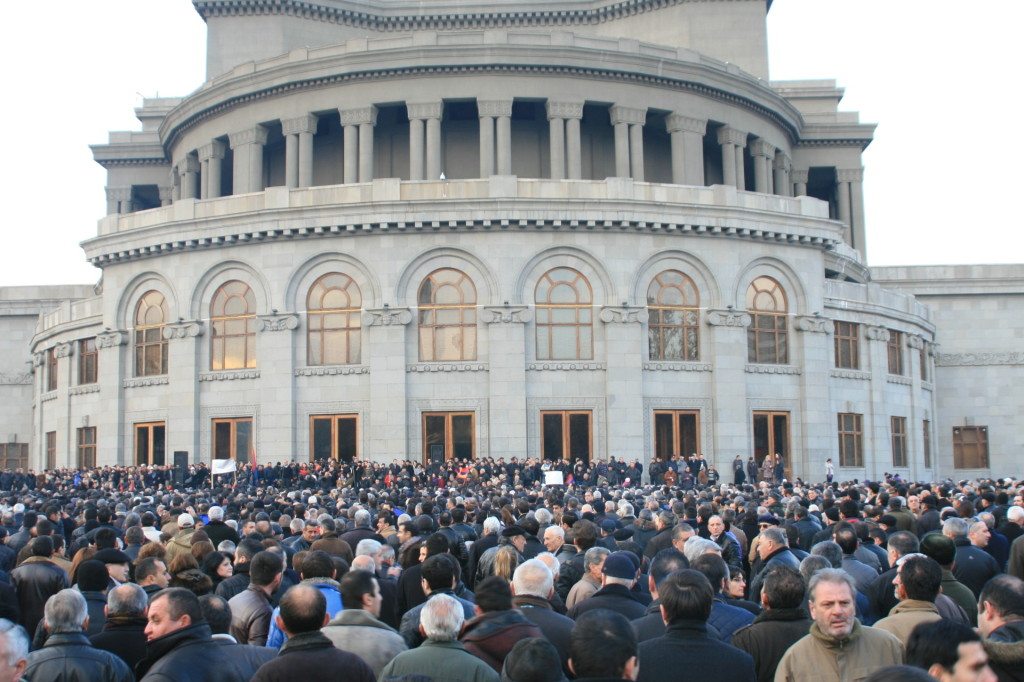
Hovannisian has a record in both. In the latest parliamentary elections, he partnered with another former Foreign Minister—Alexander Arzumanyan. The two parted ways after securing a small number of seats and disagreeing over their pledges and plans. This may explain, in part, why Hovannisian launched a presidential campaign of direct outreach, which often included random appearances in different neighborhoods to shake hands. His outreach to young people also included an appearance on ArmComedy, Armenia’s popular version of Jon Stewart’s The Daily Show with occasional Stephen Colbert-like nationalist sarcasm. Hovanissian told the hosts that he cancelled everything as soon as he got their invitation.
Hovanissian also cancelled his comfortable life in his native California, relocating to Armenia in the aftermath of the 1988 earthquake. A lawyer and diplomat, he soon accepted to become the newly-independent country’s first Foreign Minister in 1991 and fax “Armenia is free. Please recognize” to the world. Yet his diplomacy, charisma, and fair-mindedness seem to contradict some of his arguably hard-line positions. Hovanissian wants Armenia to recognize Nagorno-Karabakh as a free country, which many believe would hinder the hitherto unfruitful peace negotiations and even be used as an excuse by conflict party Azerbaijan for a military attack against Armenia and Nagorno-Karabakh. It is particularly offensive for incumbent President Serge Sarkisian to hear hints that he isn’t doing his best for the region he hails from and fought for. Yet Hovanissian is the only major political figure to have recently visited Azerbaijan’s capital Baku.
Hovanissian’s perceived hardline position on Nagorno-Karabakh, as well as the recognition of the Armenian Genocide, may explain western powers’ reluctance to support his case. Serge Sarkisian, his critics argue, has been more than accommodating in demands to reconcile with Turkey, in part because of the West’s implicit recognition of his first, 2008 election. The New York Times bluntly articulates Washington’s stake in the Feb. 18, 2013 Armenian election: To “maintain stability in a country that has become an increasingly important, if uneasy, United States ally in monitoring Iran’s nuclear ambitions.”
In the eyes of some, international observers’ monitoring results seemed to reflect Washington’s interests (while a non-governmental observer reported massive ballot stuffing). A group of activists interrupted the press conference by official observers and read a statement about the fraud. They didn’t mention Hovanissian’s name and only identified themselves as “Citizens of the Republic of Armenia.” One of them screamed in Armenian, “Do you have such elections back home?”
Presidential elections, save the first one, have always been divisive and sometimes bloody in Armenia. All candidates who won second place and their supporters felt that the election was rigged. Unlike Hovanissian, however, these candidates were or had been a key part of the establishment and had influential supporters with eyes on power and resources. Most of those forces have been quiet, waiting for the next comeback opportunity. Hovannisian’s failure or choice not to unite opposition forces is an apparent shortcoming. But it may have been a blessing, as a stronger challenge might have actuated more intense election fraud. An Armenian saying advocating for unity states, “Spring won’t come with one flower.” But it can start with one.
Source: http://www.armenianweekly.com/2013/02/21/can-an-armenian-spring-come-with-one-flower/
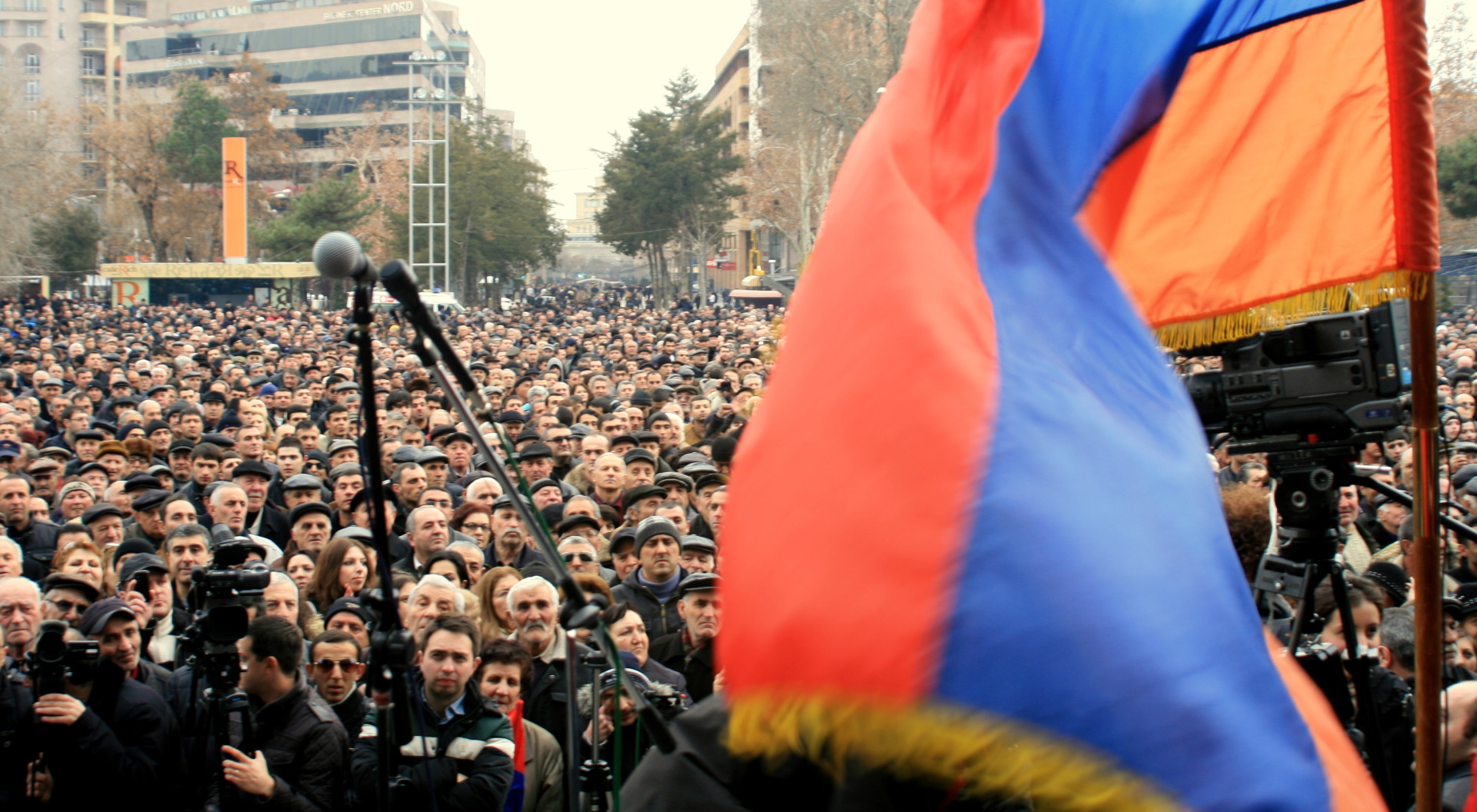
During previous elections, the diaspora has, for the most part, remained silent. Today, with the Internet, social media, and live coverage of the election and its aftermath, information has become more widely available, allowing the diaspora to not only be more informed and connected, but more involved. However, in the current state and projected future of the country, the diaspora must utilize this critical opportunity to get involved in a deeper way if it cares about the survival and prosperity of the country.
What role can the diaspora play? Do they have any power? Does it matter to the locals if the diaspora gets involved? The diaspora already does its part in other spheres; do they have any business getting involved in daily politics if they don’t live in Armenia? To answer some of these questions, I turned to local activists who were at the time writing letters to Serj Tankian asking him to come to Armenia. When asked why they wanted him to come, they responded with confidence that if Tankian were to come to Liberty Square, he would have a vital role to play in Barevolution. After all, in his written exchange with Tankian, Sarkisian replied to more questions posed by a diasporan expressing concerns about the election than he has to the thousands of citizens protesting outside the presidential palace. One might argue that Serj Tankian may have no business in Armenia’s local politics, but he is still able to make an impact.
Why is it vital that the diaspora join the movement? Since the last presidential election, roughly 180,000-250,000 people have left Armenia, mostly right after the election. Political instability, loss of hope in the system, monopolization of the country’s resources, poverty and unemployment are all to blame. Studies on population and emigration trends show that at the current high rate of emigration and low birth rate, there will only be one person left in Armenia by 2048. The diaspora has been fighting for years for the survival of the Armenian state, carrying out the mission of Hye Tahd (Armenian Cause). Surely, Armenia’s depopulation and domestic plight should become part of this mission.
Since regaining independence two decades ago, Armenia has faced no shortage of regional and internal challenges. It has endured a devastating earthquake, a war with neighboring Azerbaijan for Nagorno-Karabakh, and a blockade from two of its four neighboring countries. This prompted the diaspora to focus on aid to Armenia—and rightly so. Armenia needed first-responders such as charities. Diasporans sent food and clothing, or wrote a check to a trusted charity and felt good about doing their part. Now, more than twenty years later, the diaspora’s approach towards Armenia must shift, as Armenia has reached another phase in the effort to build a stable republic.
Today’s ailments and key threats to the nation’s survival include widespread emigration, human rights injustices, environmental degradation, regional hostility, and the suppression of pluralism and diversity of opinion in the private and public sectors. Oligarchs and mafia, all of whom are widely believed to have ties to the sitting president, currently monopolize the country’s thin resources, neglecting investment in economic development and in a viable middle class. Therefore, today’s Armenia needs partners, activists, and human-rights defenders. The Gyumretsi of yesterday needed emergency earthquake relief, but today she needs a partner in justice, making sure her voice is heard and her rights and resources are protected.
One does not need to be a rock star in order to play a role in changing Armenia’s future. Diasporan efforts can play a major role in providing moral support, resources, or pressuring both the Armenian and foreign governments to not legitimize fraudulent elections. To sustain claims of legitimacy, the Sarkisian camp has relied on congratulations from not only foreign heads of state but diaspora Armenian organizations. The initial OSCE assessment of the Presidential election was favorable, which most foreign leaders then echoed. After local activists intensely protested OSCE’s findings, OSCE altered their final report to state, “The analysis of official results shows a correlation between very high turnout and the number of votes for the incumbent. This raises concerns regarding the confidence over the integrity of the electoral process.” Unfortunately, the damage was done, as the preliminary report had already informed the decisions of several foreign governments to congratulate Sarkisian. The local effort by activists could have been bolstered by diasporan efforts abroad to pressure foreign governments to follow suit and reassess their conclusions about the election. American Armenians certainly have the power to write to their congressional leaders in such issues, as do their European counterparts.
There are many examples of diasporans who have physically joined the effort. Inspiring stories are being told around town of people quitting their prestigious jobs to fly to Yerevan to support the wave of change. Although this kind of commitment is not possible for everyone, drastic measures are not necessary; moral support can also go a long way. When local activists were asked what value diasporan support would offer them, and what kind of support they would like to see, they stated that, “The homeland is not only for the locals. It is the homeland of all Armenians. In the last 20 years we have reached out to the diaspora asking for aid through charities, we cannot tell them now to not get involved. We shouldn’t have two agendas and split our resources. The diaspora should be involved in this process bringing its resources and connections towards concrete actions for Armenia.” Recently, the board of the Armenian Law Student’s Association at Southwestern Law School wrote a letter to Amnesty International, urging the launch of a supporter mobilization campaign to assist in collective efforts towards a more democratic Armenia.
Barevoltion is a nationwide movement joined by different groups working towards the goal of a more democratic, citizen driven republic. Like every movement in history, change will not come overnight. It will require a committed group united in the struggle willing to defy the status quo fighting for the mission of a better tomorrow. The involvement of the diaspora in Armenia has always been a controversial topic, but I decided to address it in this article because the alarm is ringing loud. Armenians in foreign lands needs to hear it before it is too late, because today the diaspora needs Armenia as much as Armenia needs the diaspora. The injustices in Armenia are making our nation ill, and they call for an emergency departure from the status quo. The diaspora has the resources, the far reaching network, and the ability to organize and lobby a cause. Armenia is looking for partners, investors, and activists to make the average citizen’s voice heard. Our parents’ generation fought to see an independent Armenia. This generation will be tested to see if they are able to create a stable, democratic republic for all—including the diaspora.
Source: http://www.armenianweekly.com/2013/03/23/why-the-diaspora-should-join-armenias-barevolution/
Can an Armenian Spring Come with One Flower?
Hovannisian’s strong performance has brought hope to many,
particularly in light of speculation that Sarkisian would handily win
reelection. Hovanissian’s performance, which some minimize as a mere
vote of protest against the regime, is also surprising in light of a
lack of endorsements from other opposition forces such as Prosperous
Armenia, Armenian National Congress, and the Armenian Revolutionary
Federation. It is unclear whether this was an inability to build
coalitions or a strategy of direct outreach.
Hovannisian has a record in both. In the latest parliamentary elections, he partnered with another former Foreign Minister—Alexander Arzumanyan. The two parted ways after securing a small number of seats and disagreeing over their pledges and plans. This may explain, in part, why Hovannisian launched a presidential campaign of direct outreach, which often included random appearances in different neighborhoods to shake hands. His outreach to young people also included an appearance on ArmComedy, Armenia’s popular version of Jon Stewart’s The Daily Show with occasional Stephen Colbert-like nationalist sarcasm. Hovanissian told the hosts that he cancelled everything as soon as he got their invitation.
Hovanissian also cancelled his comfortable life in his native California, relocating to Armenia in the aftermath of the 1988 earthquake. A lawyer and diplomat, he soon accepted to become the newly-independent country’s first Foreign Minister in 1991 and fax “Armenia is free. Please recognize” to the world. Yet his diplomacy, charisma, and fair-mindedness seem to contradict some of his arguably hard-line positions. Hovanissian wants Armenia to recognize Nagorno-Karabakh as a free country, which many believe would hinder the hitherto unfruitful peace negotiations and even be used as an excuse by conflict party Azerbaijan for a military attack against Armenia and Nagorno-Karabakh. It is particularly offensive for incumbent President Serge Sarkisian to hear hints that he isn’t doing his best for the region he hails from and fought for. Yet Hovanissian is the only major political figure to have recently visited Azerbaijan’s capital Baku.
Hovanissian’s perceived hardline position on Nagorno-Karabakh, as well as the recognition of the Armenian Genocide, may explain western powers’ reluctance to support his case. Serge Sarkisian, his critics argue, has been more than accommodating in demands to reconcile with Turkey, in part because of the West’s implicit recognition of his first, 2008 election. The New York Times bluntly articulates Washington’s stake in the Feb. 18, 2013 Armenian election: To “maintain stability in a country that has become an increasingly important, if uneasy, United States ally in monitoring Iran’s nuclear ambitions.”
In the eyes of some, international observers’ monitoring results seemed to reflect Washington’s interests (while a non-governmental observer reported massive ballot stuffing). A group of activists interrupted the press conference by official observers and read a statement about the fraud. They didn’t mention Hovanissian’s name and only identified themselves as “Citizens of the Republic of Armenia.” One of them screamed in Armenian, “Do you have such elections back home?”
Presidential elections, save the first one, have always been divisive and sometimes bloody in Armenia. All candidates who won second place and their supporters felt that the election was rigged. Unlike Hovanissian, however, these candidates were or had been a key part of the establishment and had influential supporters with eyes on power and resources. Most of those forces have been quiet, waiting for the next comeback opportunity. Hovannisian’s failure or choice not to unite opposition forces is an apparent shortcoming. But it may have been a blessing, as a stronger challenge might have actuated more intense election fraud. An Armenian saying advocating for unity states, “Spring won’t come with one flower.” But it can start with one.
Source: http://www.armenianweekly.com/2013/02/21/can-an-armenian-spring-come-with-one-flower/
Why the Diaspora Should Join Armenia’s Barevolution
Raffi Hovannisian was asked by a reporter recently, “What would you
like to say to the diaspora?” His response, “You’re asking me the wrong
question. You should ask the diaspora what they want to say, and I will
listen. Do they want to be part of building a more Democratic Armenia?
If so, I will listen.
During previous elections, the diaspora has, for the most part, remained silent. Today, with the Internet, social media, and live coverage of the election and its aftermath, information has become more widely available, allowing the diaspora to not only be more informed and connected, but more involved. However, in the current state and projected future of the country, the diaspora must utilize this critical opportunity to get involved in a deeper way if it cares about the survival and prosperity of the country.
What role can the diaspora play? Do they have any power? Does it matter to the locals if the diaspora gets involved? The diaspora already does its part in other spheres; do they have any business getting involved in daily politics if they don’t live in Armenia? To answer some of these questions, I turned to local activists who were at the time writing letters to Serj Tankian asking him to come to Armenia. When asked why they wanted him to come, they responded with confidence that if Tankian were to come to Liberty Square, he would have a vital role to play in Barevolution. After all, in his written exchange with Tankian, Sarkisian replied to more questions posed by a diasporan expressing concerns about the election than he has to the thousands of citizens protesting outside the presidential palace. One might argue that Serj Tankian may have no business in Armenia’s local politics, but he is still able to make an impact.
Why is it vital that the diaspora join the movement? Since the last presidential election, roughly 180,000-250,000 people have left Armenia, mostly right after the election. Political instability, loss of hope in the system, monopolization of the country’s resources, poverty and unemployment are all to blame. Studies on population and emigration trends show that at the current high rate of emigration and low birth rate, there will only be one person left in Armenia by 2048. The diaspora has been fighting for years for the survival of the Armenian state, carrying out the mission of Hye Tahd (Armenian Cause). Surely, Armenia’s depopulation and domestic plight should become part of this mission.
Since regaining independence two decades ago, Armenia has faced no shortage of regional and internal challenges. It has endured a devastating earthquake, a war with neighboring Azerbaijan for Nagorno-Karabakh, and a blockade from two of its four neighboring countries. This prompted the diaspora to focus on aid to Armenia—and rightly so. Armenia needed first-responders such as charities. Diasporans sent food and clothing, or wrote a check to a trusted charity and felt good about doing their part. Now, more than twenty years later, the diaspora’s approach towards Armenia must shift, as Armenia has reached another phase in the effort to build a stable republic.
Today’s ailments and key threats to the nation’s survival include widespread emigration, human rights injustices, environmental degradation, regional hostility, and the suppression of pluralism and diversity of opinion in the private and public sectors. Oligarchs and mafia, all of whom are widely believed to have ties to the sitting president, currently monopolize the country’s thin resources, neglecting investment in economic development and in a viable middle class. Therefore, today’s Armenia needs partners, activists, and human-rights defenders. The Gyumretsi of yesterday needed emergency earthquake relief, but today she needs a partner in justice, making sure her voice is heard and her rights and resources are protected.
One does not need to be a rock star in order to play a role in changing Armenia’s future. Diasporan efforts can play a major role in providing moral support, resources, or pressuring both the Armenian and foreign governments to not legitimize fraudulent elections. To sustain claims of legitimacy, the Sarkisian camp has relied on congratulations from not only foreign heads of state but diaspora Armenian organizations. The initial OSCE assessment of the Presidential election was favorable, which most foreign leaders then echoed. After local activists intensely protested OSCE’s findings, OSCE altered their final report to state, “The analysis of official results shows a correlation between very high turnout and the number of votes for the incumbent. This raises concerns regarding the confidence over the integrity of the electoral process.” Unfortunately, the damage was done, as the preliminary report had already informed the decisions of several foreign governments to congratulate Sarkisian. The local effort by activists could have been bolstered by diasporan efforts abroad to pressure foreign governments to follow suit and reassess their conclusions about the election. American Armenians certainly have the power to write to their congressional leaders in such issues, as do their European counterparts.
There are many examples of diasporans who have physically joined the effort. Inspiring stories are being told around town of people quitting their prestigious jobs to fly to Yerevan to support the wave of change. Although this kind of commitment is not possible for everyone, drastic measures are not necessary; moral support can also go a long way. When local activists were asked what value diasporan support would offer them, and what kind of support they would like to see, they stated that, “The homeland is not only for the locals. It is the homeland of all Armenians. In the last 20 years we have reached out to the diaspora asking for aid through charities, we cannot tell them now to not get involved. We shouldn’t have two agendas and split our resources. The diaspora should be involved in this process bringing its resources and connections towards concrete actions for Armenia.” Recently, the board of the Armenian Law Student’s Association at Southwestern Law School wrote a letter to Amnesty International, urging the launch of a supporter mobilization campaign to assist in collective efforts towards a more democratic Armenia.
Barevoltion is a nationwide movement joined by different groups working towards the goal of a more democratic, citizen driven republic. Like every movement in history, change will not come overnight. It will require a committed group united in the struggle willing to defy the status quo fighting for the mission of a better tomorrow. The involvement of the diaspora in Armenia has always been a controversial topic, but I decided to address it in this article because the alarm is ringing loud. Armenians in foreign lands needs to hear it before it is too late, because today the diaspora needs Armenia as much as Armenia needs the diaspora. The injustices in Armenia are making our nation ill, and they call for an emergency departure from the status quo. The diaspora has the resources, the far reaching network, and the ability to organize and lobby a cause. Armenia is looking for partners, investors, and activists to make the average citizen’s voice heard. Our parents’ generation fought to see an independent Armenia. This generation will be tested to see if they are able to create a stable, democratic republic for all—including the diaspora.
Source: http://www.armenianweekly.com/2013/03/23/why-the-diaspora-should-join-armenias-barevolution/
