The
world is on edge as Russia and Western powers face off in eastern
Europe and in the Middle East. The political climate throughout the
region
has not been this volatile, this unpredictable since the Second World
War. A continuous arc starting from eastern Europe to the southern tip
of the Middle East has been turned into a boiling cauldron in recent
years. Exactly a century after the onset of the First World War,
humanity faces the possibility of yet another man-made calamity. And
similar to factors that led humanity to the unprecedented blood-lettings
of the first and second world wars, the Anglo-American-Jewish political
order once again figures prominently in the current calculus. The Anglo-American-Jewish Western alliance is in fact the primary source of problems we see throughout the world.
What humanity is facing today is a global offensive by Western powers to preserve their global hegemony. Their ultimate goal is to contain Russia, Iran and China, because the aforementioned three, Russia in particular, pose long-term threats to their power. Their effort to undermine the growing influence of Moscow, Tehran and Beijing is essentially what has brought the world today to the precipice of a new world war. Even Westerners are beginning to understand this -
Ten years ago I began proclaiming throughout Cyberia that Russia was the long awaited messiah, the miraculously resurrected superpower that would save mankind by creating the modern foundations of a multi-polar world. For ten years I have been heralding the rise of Russia as humanity's last front against American imperialism, Globalism, Westernization, Wahhabi Islamic extremism, Zionism and pan-Turkism. Seven years ago I was ecstatic about the sudden reawakening of the Russian Bear as it angrily rampaged throughout Georgia in an attempt to salvage important remnants of its severely compromised ecosystem. But even after Georgia, even after the onset of what looked to be a new Cold War between the East and the West, I could not even begin to imagine where we are today -
Who would have thought that Libya and Syria would fall apart like they have? Who would have thought that Russia would almost single-handedly save Bashar Assad's government? Who
would have thought that the West would embark on a major crusade to
curb growing Shiite influence in the Middle East. Who would have thought
that a new, barbaric extremist group supported by the West and its
allies would establish a ruthless theocratic state on Syrian and Iraqi
territory? Who would have guessed that Crimea would be part of Russia
once more? Who in their wildest imagination would have thought that NATO
and Russian forces would be facing off in Ukraine in the twenty-first
century?
What we are seeing take place in Ukraine, Syria, Iraq and Yemen currently - and the war like situation that has developed between Armenia and Azerbaijan - may one day be looked upon as the preliminary stages of a third world war. Tension is steadily building throughout the region. If deescalation does not take place and the prevailing situation persists, the boiling cauldron is bound to explode and when it does Armenia will be in the epicenter of it. We are again at this juncture in world history because we the sheeple continue to be easily manipulated and led astray by those who control global levers of manipulation. We are again at this juncture in world history essentially because of Western powers' desire to maintain supremacy in global affairs. We are at this juncture in world history essentially because Western powers want to maintain a certain standard-of-living at home.
The Western world is therefore doing what it has done best throughout history: Bringing order through chaos.
The order in question is of course a Western global order, also known as the One World Order. This is the political paradigm in which Western powers and their satellites dominate every aspect of global affairs. This is a world order in which the world's wealth is controlled primarily by Anglo-American-Jews; a world where the sheeple is racially mixed and speaks English; a world in which notions about God, family and country are looked down upon; a world where apostolic Christianity and European culture is demonized; a world in which homosexuality, birth control and women's liberation are promoted as a way of artificially curbing population growth; a world where everyone adopts and worships Anglo-American-Jewish values.
What humanity is facing today is a global offensive by Western powers to preserve their global hegemony. Their ultimate goal is to contain Russia, Iran and China, because the aforementioned three, Russia in particular, pose long-term threats to their power. Their effort to undermine the growing influence of Moscow, Tehran and Beijing is essentially what has brought the world today to the precipice of a new world war. Even Westerners are beginning to understand this -
Stratfor: Ukraine Coup Plotted by US Over Russian Stance on Syria: http://sputniknews.com/politics/20141219/1016024377.html
Stratfor: ‘US fears a resurgent Russia’: http://rt.com/news/216043-stratfor-relations-russia-usa/
World order principles should be changed to avoid 3rd world war — Italian journalist: http://itar-tass.com/en/world/768197
Thankfully, awareness of and resistance to Western imperialism is growing around the world. The Russian Federation, in particular, has become the front-line as well as the spearhead of the current global resistance effort against the West.Viewpoint: Why the shadow of WW1 and 1989 hangs over world events: http://www.bbc.com/news/magazine-30483873
Ten years ago I began proclaiming throughout Cyberia that Russia was the long awaited messiah, the miraculously resurrected superpower that would save mankind by creating the modern foundations of a multi-polar world. For ten years I have been heralding the rise of Russia as humanity's last front against American imperialism, Globalism, Westernization, Wahhabi Islamic extremism, Zionism and pan-Turkism. Seven years ago I was ecstatic about the sudden reawakening of the Russian Bear as it angrily rampaged throughout Georgia in an attempt to salvage important remnants of its severely compromised ecosystem. But even after Georgia, even after the onset of what looked to be a new Cold War between the East and the West, I could not even begin to imagine where we are today -
Call to Arms (November, 2011): http://theriseofrussia.blogspot.com/2011/11/call-to-arms-november-2011.html
Obituary: Libya 1951-2011 (November, 2011): http://theriseofrussia.blogspot.com/2011/11/destruction-of-libya-november-2011.html
Target Iran (December, 2011): http://theriseofrussia.blogspot.com/2011/12/target-iran-december-2011.html
Political unrest nearing Russia's southern border (February, 2012): http://theriseofrussia.blogspot.com/2012/02/as-political-unrests-near-russias.html
Cold War II (May, 2012): http://theriseofrussia.blogspot.com/2012/05/cold-war-ii-heralding-rise-of-bipolar.html
Russia Hints at Intervention in Armenia-Azerbaijan Conflict (July, 2012): http://theriseofrussia.blogspot.com/2012/07/russia-hints-at-intervention-in-armenia.html
Proxy war in Syria (May, 2013): http://theriseofrussia.blogspot.com/2013/05/geopolitics-and-proxy-war-in-syria-may.html
Russia Steps Into World Leadership Role (September, 2013): http://theriseofrussia.blogspot.com/2013/09/russia-steps-into-world-leadership-role.html
In a historic dispute with the West, Russia reclaims Crimea (March, 2014): http://theriseofrussia.blogspot.com/2014/03/in-historic-dispute-with-west-russia.html
Karabakhization of eastern Ukraine (May, 2014): http://theriseofrussia.blogspot.com/2014/06/karabakhization-of-eastern-ukraine-as.html
Driving a Sunni wedge in the Shiite Arc (June, 2014): http://theriseofrussia.blogspot.com/2014/07/driving-sunni-wedge-in-shiite-arc-june_18.html
Worried for its loss of hegemony the West is bent on bringing down Russia (July, 2014): http://theriseofrussia.blogspot.com/2014/08/worried-for-its-lose-of-hegemony-west.html
Trouble Brewing For the World's Policeman (December, 2014): http://theriseofrussia.blogspot.com/2014/12/trouble-brewing-for-worlds-policeman.html
What we are seeing take place in Ukraine, Syria, Iraq and Yemen currently - and the war like situation that has developed between Armenia and Azerbaijan - may one day be looked upon as the preliminary stages of a third world war. Tension is steadily building throughout the region. If deescalation does not take place and the prevailing situation persists, the boiling cauldron is bound to explode and when it does Armenia will be in the epicenter of it. We are again at this juncture in world history because we the sheeple continue to be easily manipulated and led astray by those who control global levers of manipulation. We are again at this juncture in world history essentially because of Western powers' desire to maintain supremacy in global affairs. We are at this juncture in world history essentially because Western powers want to maintain a certain standard-of-living at home.
The Western world is therefore doing what it has done best throughout history: Bringing order through chaos.
The order in question is of course a Western global order, also known as the One World Order. This is the political paradigm in which Western powers and their satellites dominate every aspect of global affairs. This is a world order in which the world's wealth is controlled primarily by Anglo-American-Jews; a world where the sheeple is racially mixed and speaks English; a world in which notions about God, family and country are looked down upon; a world where apostolic Christianity and European culture is demonized; a world in which homosexuality, birth control and women's liberation are promoted as a way of artificially curbing population growth; a world where everyone adopts and worships Anglo-American-Jewish values.
While some in the West (i.e. Neocons) believe this world order can best be achieved through economic warfare, armed intervention and fomenting revolutions in targeted countries, others, like veteran politicians such as Henry Kissinger, believe such a political global order should be achieved via diplomatic means and economic/financial baiting. Regardless of the method, however, their ultimate goal is comprehensive global hegemony. Consequently, the geostrategic desire to maintain Western supremacy over the world is thus the common thread we see within most of the bloodletting around the world today.
One of the great talents of the Anglo-American-Jewish political order is their uncanny ability to meddle in the internal affairs of nations around the world. Using their massive technological, cultural, financial, economic and political influences, they are able to go to virtually any spot on earth today and exploit societal grievances, political mismanagement, old biases and ethnic hatreds.
To better understand what they do, imagine a great power coming to North America one day and exploiting domestic problems that exists inside American society. Imagine what would happen if the central government in the United States was so weak one day that a great foreign power was able to establish itself in Mexico. Imagine what would happen if a foreign power was able to recruit, organize, finance and arm separatist such as Mexicans, Muslims, Hispanics, American Indians and/or African Americans in the US against the country's WASP/Jewish establishment. Imagine what would happen if a power came to North American shores, established thousands of NGOs and propaganda outlets and began systematically making a play on the anger and emotions of the tens-of-millions of poor and disenfranchised in the US.
In such a scenario, the US would fall apart rather spectacularly. But isn't what I just described above exactly what Western powers are doing around the world?
But let's not hold our breaths waiting for any world power to come to North America's shores. Since 1812 we have been living in an Anglo-American-Jewish period in world history. This era is not about to go through any drastic changes, at least not in the near future. The aforementioned trinity therefore currently has the high ground, the initiative, the tools and the global levers to meddle, manipulate and exploit anywhere it wants. Nations resisting the political West will therefore be on the defensive for the foreseeable future.
How did we get to this juncture? The blame ultimately goes to we the sheeple because it is our materialism, our hatreds, our biases, our political illiteracy, our shortsightedness and our ignorance of the world we live in that gives them their powers. But there is hope. While it is not nearly as powerful as the Western political order, the Russian nation today - thanks to its political acumen, natural wealth, warrior culture, deep rooted nationalism and massive nuclear arsenal - is the only political entity on earth today capable of standing in the way of the West's desire for total world domination. This is why I and many others like myself consider Russian President Vladimir Putin to be quite literally God sent. Just like when mother nature takes corrective measures to bring about order and balance in ecology, the Russian president was destined by higher, supernatural powers for his earthly task. Although they may not realize it, the Russian nation is doing God's work on earth. And this work began in earnest in 2008.
Kosovo set today's precedence
Remember Kosovo? Remember how in the spring of 1999 they used a ruthless aerial bombing campaign in Serbia to sever this historically Serbian region from Belgrade and place it essentially under Albano-Turco-Islamic rule? Now that Moscow is resorting to similar measures to correct the wrongs of history, why are Western powers shocked?
I cannot help but laugh now when I see visibly frightened Western officials talk about the dangers of "military interventionism" and the "inviolability of national borders" in reference to Russian actions in eastern Ukraine. These cowardly reptiles need to be reminded of their crimes against Vietnam, Laos, Cuba, Iraq, Lebanon, Palestine, Afghanistan, Libya and Syria. These hypocritical reptiles need to be reminded about Granada, Diego Garcia, Panama, Guantanamo Bay, Northern Ireland, Malvinas and the illegally annexed Mexican territories of south-western United States. After all, haven't these Turcophile reptiles been tolerating the Turkish occupation of northern Cyprus for the past forty years? Haven't these Anglo-American-Jewish reptiles been tolerating the Israeli occupation of the West Banks and Gaza for the past fifty years? Didn't these bloodthirsty reptiles create a Kurdistan out of Iraqi territory? Didn't these despicable reptiles sow the seeds of civil war in Ukraine by funding an armed uprising against the democratically elected government in Kiev a little over a years ago? But if a precise date is to be placed on the start of the global mess we are in today, it would be February, 2008 -
Independence for Kosovo (February, 2008): http://theriseofrussia.blogspot.com/2009/02/its-finally-happening.html
Zbigniew Brzezinski: Kosovo not Precedent for Abkhazia, South Ossetia or Karabakh (March, 2008): http://theriseofrussia.blogspot.com/2009/02/with-historic-land-disputes-with-its.html
Putin Says `War Has Started' (August, 2008): http://theriseofrussia.blogspot.com/2009/03/this-is-it.html
Russia Recognizes Georgian Regions (August, 2008): http://theriseofrussia.blogspot.com/2009/05/specter-of-western-crimes-against.html
The Western decision to grant independence to Kosovo set the precedence
for events that would later take place in Abkhazia, South Ossetia,
Crimea and Novorossia. The violent, arrogant and
flagrant manner in which Kosovo was removed from Serbia and placed under
a Western-backed Albano-Turco-Islamic rule was the geostrategic alarm
that forced the Russian Bear into action. Prior
to Kosovo's independence, international order in Eurasia was,
relatively speaking, being upheld. All sides at least pretended to
uphold international law. After Kosovo, all pretenses essentially ended. Kosovo
made it starkly apparent to Russian policymakers that the
Anglo-American-Jewish world order had to be challenged wherever and
whenever possible. Merely six months after the proclamation of
Kosovo's independence, the Russian Bear stood before a historic
opportunity to do just that. In a direct challenge to the
Anglo-American-Jewish alliance, Russia took the opportunity presented
by the Western-backed Georgian President Saakashvili's aggression
against South Ossetia by sending tank armies into Georgia to liberate
both South Ossetia and Abkhazia. February, 2008 was the historic moment
when the Russian Bear awoke. The summer of 2008 was a historic turning
point, a pivotal time that may one day be looked upon as the time in
history when Western global hegemony began its decline.
A final brief note on Kosovo: Albanians, like their European counterparts Bulgarians, Rumanians, Bosnians, Hungarians, Cypriots and Greeks have proven once more that being in the Western political/economic orbit is in no way a panacea to socioeconomic problems and may in fact be detrimental to national development -
A final brief note on Kosovo: Albanians, like their European counterparts Bulgarians, Rumanians, Bosnians, Hungarians, Cypriots and Greeks have proven once more that being in the Western political/economic orbit is in no way a panacea to socioeconomic problems and may in fact be detrimental to national development -
Kosovars Who Fought for Land Are Now Eager to Leave: http://www.nytimes.com/2015/03/08/world/europe/kosovars-who-fought-for-land-are-now-eager-to-leave-it.html
Nevertheless,
the path we are on today was paved during the years when Western powers
began taking advantage of a weak, post-Soviet Russia by redrawing
the borders of eastern Europe and the Middle East. Western powers thus
sowed the seeds of today's turmoil. Let's hope that Mother Russia is
able to correct the wrongs of history. More importantly, let's hope for
multipolarity in international affairs in the future. Until we there,
however, there will be many hurdles along the way because Western powers
will not easily give up their global hegemony.
Winter offensive in Novorossia
Unless their destructive political policies around the world begin hurting them at home, they will continue with their destructive political policies around the world. As long as the threat of war is on their enemy's border and not theirs, they will continue their aggression around the world. Unbeknownst to many, several weeks ago American officials set the stage for arms deliveries to Ukraine -
If Washington goes ahead and begins providing lethal weaponry to the junta in Kiev, it will be seen as a declaration of war against Russia. If this happens we will be in uncharted territory. Unless sober minds come forward to change the current political calculus prevailing in Washington, we will be steadily heading towards a major international configuration. In the meanwhile, however, some of the wrongs of history are currently being systematically corrected by Russian-backed militants.America on “Hot War Footing” as House Paves Way for War with Russia: http://www.veteransnewsnow.com/2014/12/06/512430-america-is-on-a-hot-war-footing-house-legislation-paves-the-way-for-war-with-russia/
Russian-backed fighters of Novorossia were recently on a brilliantly executed winter offensive. The Western-backed junta's military has suffered yet another major defeat. A strategically located airport in Donetsk and a strategic rail hub at Debaltsevo have been liberated as a result, the strategic port city if Mariupol may be next. All indicators suggest that 2015 may prove disastrous for the chocolate king. European powers are incapable of helping Kiev. Western powers are incapable of helping Kiev. The sociopolitical climate in Kiev is slowly reaching dangerous levels. We may even seen another Maidan uprising before this year is over.
Moscow's war effort in Novorossia was slow and sloppy in the beginning. But what a brilliant display of warcraft it has been since. I can't properly express how impressed I am at how well Moscow has been orchestrating its proxy war in eastern Ukraine. The way they have maneuvered between diplomacy and covert war fighting has been masterful to say the least. They have also been very effective, surprisingly effective, in the information war. Their leader, Alexander Zakharchenko, has been nothing less than amazing. The man, who was recently wounded in combat, is one of those natural born leaders that appear almost out of nowhere in times of great travail.
Russians have once again risen to the occasion. Slavs, men and women alike, Russians in particular, are indeed a warrior breed within the human ecology. Whereas other nations need either cutting edge war fighting technology (westerners), fanaticism (Muslims), racist indoctrination (Jews) or the threat of annihilation (Armenians) to get their people to fight, Slavs are naturally, organically ready for war; all they seem to require is a steady supply of cigarets and vodka. As long as Russia keeps producing such men and women, the Russian nation will never be defeated. As long as Moscow can keep "Western values" out of Russian society, Russia will continue giving birth to such warriors. If I had to go to war I can't think of a better people to go to war with. It would be wise for Armenians to form a confederation with these people. Knowing the south Caucasus, we will sooner-or-later need their assistance -
UAF POWs abused by Givi and taken to parade through the city destroyed by UAF artillery: https://www.youtube.com/watch?v=FD15bxM3mTcAssault on the New Terminal combat footage 16-18 January "Donbas under fire" documentary: http://vineyardsaker.blogspot.com/2015/01/assault-on-new-terminal-combat-footage.htmlZakharchenko hands over the bodies of UAF KIAs, POWs: https://www.youtube.com/watch?v=7FSbvbzwOb8
First footage of a mass surrender of Ukrainian troops: https://www.youtube.com/watch?v=cRiEKCaH2iA
Зачистка Дебальцево: https://www.youtube.com/watch?v=kqliEMkzVQQ
Фронтовые дневники. Дебальцевский крест: https://www.youtube.com/watch?v=8qi8ixn6-Vo
So, will the West risk such a thing by providing lethal weaponry to Kiev, especially knowing that such aid will most probably not change the course of events on the ground in eastern Ukraine? And as noted above, not providing arms to Kiev runs the risk of making Western powers look backstabbing, impotent and unreliable. This is the dilemma the West faces. Sucks to be Uncle Sam. The unenviable position Washington has gotten itself into in Ukraine was best expressed recently by the warmongering war criminal, John McCain.
Nonetheless, I have no doubt that additional territories will be systematically liberated, especially now that the infamous tie-eating dictator, Saakashvili is advising Porochenko. But, unlike what Moscow did in Crimea, this time around, I do not think it will outright annex any of the liberated territories. In other words, Karabakhization of Novorossia is what's being foreseen by Russian officials. Similar to how the political status quo in Nagorno Karabakh is used by Moscow to keep leverage over both Yerevan and Baku, Moscow will be using it's influence in Novorossia as a leverage over Kiev, NATO and eastern Ukraine. Moreover, and perhaps more importantly, the pro-Russian insurgency in Novorossia effectively takes Crimea out of any discussions. Notice that there has been very little talk in the West about Crimea's historic reunification with Mother Russia. As pro-Russian separatists grow in strength in Novorossia, Crimea will become a very distant memory for Kiev as well. It should be pointed out that Russia's successful annexation of the strategically important peninsula alone, so historic in its scope and brilliant in its execution, is ultimately why the Western-instigated crisis in the Ukraine will be a Russian victory - regardless of what happens in Kiev going forward.
With that said, it is obvious that Moscow would like to - one way or the other - turn Ukraine into a dependency and eventually bring Kiev into a pact with Russia. But I strongly feel that regardless of what happens in Kiev, Novorossia, like Nagorno Karabakh, will henceforth be defacto part of Russia. Novorossia's ties with Moscow will be very close even if the region eventually becomes a semi-autonomous, federal province within Ukraine. From a Russian perspective, it would be very foolish if Moscow surrenders Novorossia to Ukraine - even if a pro-Russian government comes into power in Kiev. I do not think Moscow will give up its hard won ties in the region for any reason. I do not think Moscow will repeat the mistake of the Soviets. Nevertheless, in the short to midterm, Novorossia will be de facto part of Russia and the rest of Ukraine will be sort of a no man's land, a buffer zone between Russia and NATO.
If the West's strategic objective was to sever Ukraine away from Moscow and place it in the EU or NATO, it has been a miserable failure. If, however, the West's objective was to sow divisions between Europeans and Russians, then it's been somewhat of a victory. But such a victory will prove to be a short-lived one because Europeans are increasingly realizing that the current crisis in the Ukraine was instigated by Anglo-American-Jews and is thus against European interests. Europeans understand that the political West is seeking more control over Europe through this crisis. As a countermeasure to Western designs, Russian officials have been doing their best to keep relations with European powers cordial and healthy. This soft approach by Moscow will pay dividend in the future as more-and-more Europeans, Germans and French in particular, turn against Western powers. The key for Moscow here therefore is to continue presenting the negative impact that the crisis in Ukraine is having on the rest of Europe as a consequence of Western aggression and duplicity. Moscow's Russia Today news agency is doing an excellent job in this regard. Moscow needs to place more emphasis on the information war currently taking place. Moscow will have the clear advantage in this regard because to has the truth behind it. After all, the artificially created crisis in Ukraine was a Western operation to curb growing Russian influence in Europe. The current mess in the region was therefore not in Russia's or Europe's interest. For historical reference, the following are materials foretelling the crisis in Ukraine many years ago -
Russian politician Zhirinovsky vs Zbigniew Brzezinski (1/2) (English subs): https://www.youtube.com/watch?v=fYe2ZamKQ78
Обама начнет третью мировую с Крыма?: http://newsland.com/news/detail/id/390375/
Armenia in the epicenter
Our tiny, landlocked and
impoverished homeland is surrounded by predatory animals in one of the most hostile ecosystems on earth. The south Caucasus is merely one
bad event away from reverting back to being a Turkic/Islamic
cesspool. Western machinations in the region has created a
climate where such a scenario is very possible today. Needless to say,
Russia (and to a lesser extent Iran) is Armenia's only deterrence factor
in the south Caucasus. The long-term health and well-being of the
Russian nation is thus crucially important for Armenians. The danger
that the region faces today is the reason why Moscow has been
signalling for the past few years that it will not hesitate to smash
through Georgia to link-up with its strategically located 102nd
military base in Armenia in the event of a major war in the region. The
following is the most recent Russian warning as covered by John Hughes' CIA-sponsored ArmeniaNow propaganda outlet -
New strategy or provocation?: Russian analyst’s article on “straight way” to Armenia via Georgia stirs controversy: http://armenianow.com/commentary/analysis/58344
Russia and Region: Moscow floats ideas on ensuring railroad link with Armenia via Georgia: http://armenianow.com/commentary/analysis/61051/armenia_russia_caucasus_troops_georgia
Armenia to become part of energy chain with Georgia and Iran: http://armenpress.am/eng/news/795997/armenia-to-become-part-of-energy-chain-with-georgia-and-iran.html
Russia supports India's full membership of SCO: http://www.timesca.com/news/15034-russia-supports-india-s-full-membership-of-sco
India to negotiate free trade zone with Russia-led Customs Union: http://rt.com/business/235731-india-russia-customs-union/
Iran to launch trade development center in Armenia: http://en.mehrnews.com/detail/News/106162
The above news
items are very significant. These types of strategic regional
projects - as well as regional superhighways - have been discussed by
Moscow, Yerevan and Tehran for quite a few years. The only obstacle to
their implementation has been Western meddling in the region. Georgia's West-leaning government, in particular, is the missing link. Tbilisi the regional party mainly responsible for
keeping the south Caucasus economically desperate and politically
volatile. Tbilisi has to be either brought to its senses or to its knees.
If that
will require Russian troops invading Georgia once more, then so be it.
Use Javakhq or Abkhazia or South Ossetia to create a pretense and send
in the beautiful tanks. The sooner Georgia is fixed, the sooner will Pax
Russica descend on to the region. The sooner Pax Russica descends
onto the region, the sooner will major economic projects for the region
become a reality. And the sooner such projects become a
reality, the sooner will Armenia finally breath.
The West's desire to undermine Russian and Iranian economic and infrastructure projects in the region reveals just how toxic the Western world has become in global affairs and just how dangerous Armenia's Western-led Russophobic activists are for the country.
The West's desire to undermine Russian and Iranian economic and infrastructure projects in the region reveals just how toxic the Western world has become in global affairs and just how dangerous Armenia's Western-led Russophobic activists are for the country.
I ask the Armenian reader to once more think of the "Caucasian table" where Turks, Georgians, Azeris, Persians, Wahhabi Islamists, Russians, Western oil interests and Armenians sit around and discuss regional matters. Think of this table without its Russian participant. In other words, think of how Armenia would have fared in the geopolitical climate of the region today had a handful of men, primarily the Karabakh clan, not been wise enough to keep Armenia firmly within the Russian orbit and allow the stationing of Russian troops on Armenian soil. Armenia has not suffered the fate of Cyprus, Serbia, Georgia, Syria or Ukraine only because of Russian boots on the ground in Armenia. Speaking of Syria, we may be nearing the end of the four year old nightmare.
The final chapter in Syria
The following is the link to an interview I saw a couple of months ago on Farid Zakaria's GPS show on CNN. The whole thing looked/felt/sounded like a rehearsed infomercial, not much unlike much of the news reporting we see all across the US these days. The topic discussed, however, was very serious. It is my opinion that they are in the process of finalizing the final chapter on the nation formerly known as Syria. With that in mind, watch Farid's interview with Professor Joshua Landis (who according to Farid is the "top Syria scholar in the US") very carefully and try to read between the lines of what's being said -
Is backing Syria rebels a mistake?

The following are revealing excerpts from the above interview that tells it all -
"The
map of 1919 which the British and French drew was wrong. [The new map
of a partitioned Syria and Iraq] is the map that reflects the realities
of sectarianism and is possibly more stable... [The state that ISIS has
created stretching] from the edges of Baghdad all the way to Aleppo
today is a Sunni state and it's already emerged. And what America is
doing by bombing it is trying to destroy this state that is there and it
is going to be a very hard thing to do... Accept reality, accept that
state but try to get better rulers for it, not ISIS."
The West was never serious about fully supporting Syria's homegrown/independently raised anti-Assad rebel factions simply because they were deemed unreliable (i.e. they are not controlled by the West or its close allies). The whole agenda in Syria from day one has been about partitioning the nation and forming a new Western-backed Sunni state in its territory as a counterbalance to growing Shiite, Iranian and Russian power in the region. This task was trusted to Al Qaeda and ISIS, not the Syrian rebels. As I have been saying from day one: ISIS is the rabid dog they set loose in Iraq and Syria. Now that ISIS has managed to carve out a Sunni state between Damascus and Baghdad, it's time to slowly put the dog back into its cage and take control over the territory. Although I am not surprised, it is nevertheless very interesting that Professor Landis - who, allow me remind the reader, is "the top Syria scholar in the US" - suggests that Washington wants Turkey to act as the guarantor of the new Sunni state being formed in Syria by having Ankara put in place there a "good government" so that the US can thereafter "pour money into [its] development".
I have pointed all this out in previous blog commentaries, but I thought it would be better if the reader heard it right from the source. And regarding the source: It is noteworthy that the Pakistani native, Farid Zakaria is one of the Council for Foreign Relation's many high paid lapdogs working throughout the Anglo-America-Jewish world's news/propaganda outlets. Individuals like Joshua Landis, Farid Zakaria, Wolf Blitzer, Anderson Cooper, Christiane Amanpour, etc., are not journalists in the traditional sense, they cogs in the imperial war machine. Their task is to spread misinformation and deceit. I would go as far as saying, they are highly dangerous combatants.
Recent events involving Jordan
is in my opinion an integral part of the final chapter in Syria. I do not think the Jordanian
pilot was burned alive. I personally think the whole thing, like the
beheadings
of Westerners before it, was faked for psy-ops value. Even the timing
of the
announcement of the pilot's death, which came while Jordan's king was in
Washington, was very suspicious. But whether the pilot died or not is
really
not the issue here for he may very well have been killed. What's
important to understand here is that as with all
ISIS acts, the purpose of his burning was to, again, "shock and awe" the
public into compliance. There are carefully preparing their field of
play. What's more poignant and revealing is the political reaction
that came out of Amman and Washington to the alleged immolation. The
spontaneous anti-ISIS protests in Amman (mostly by military age men)
looked anything but spontaneous. The official Jordanian reaction felt
very orchestrated. Jordan's American style war fever and the "tough"
rhetoric coming out of Amman seems formulated to in fact appeal to
Western
sentiments. I mean stupid crap like this -
The king of Jordan sent out this badass photo in response to ISIS: http://finance.yahoo.com/news/photo-king-jordan-looking-badass-132100812.html
ISIS is the monster they created and the terrible carnage we are
seeing in Syria and Iraq is the by-product of the Western world's
imperial aspirations in the Middle East. The political West and their
Jewish, Turkish, Saudi Arabian and Qatari friends are in fact
responsible for the genocide of Yezdis, Christians and Alewites and a
series of other crimes against humanity throughout Syria and Iraq. As
they are dissecting the Iranian/Shiite Arc of influence in the region,
they are also creating a north-south Sunni axis between Turkey and Saudi
Arabia. Besides the Western world's obvious geostrategic factors,
besides the Zionist factors at play, the region's all-important energy factor
also plays prominently into all this. ISIS was therefore meant to "shock and awe" the sheeple into backing
an eventual ground invasion of Syria by Western or Western-backed forces. Their geostrategic agenda is to create a swath of
Western-Saudi backed Sunni state between Damascus and Baghdad. Since the
beginning of the Syrian civil war, Jordan, along with Turkey, was a
strategic staging area for the anti-Assad war effort.
With Erdogan's increasingly belligerent behavior not to mention his self-serving neo-Ottoman fantasies pissing-off policymakers in Washington and Tel Aviv, it now seems as if the Anglo-Arab king of Jordan has been chosen the lead the Sunni war effort in Syria. If it all pans out, I think we will eventually see an invasion of regions in Syria that are currently occupied by ISIS by Western-backed Arab forces. It should also be mentioned that all this may be coordinated with Assad's government. I suspect that a final deal has been reached or is in the process of being reached with Bashar Assad. I think Syria's final partition has been decided by all powers involved in the civil war, including Russia and Iran. I think that in time a new Western-backed Sunni state will be created within the former territories of Syria and Iraq.
Ultimately, the four year old Syrian tragedy will prove to be a stalemate. There will not be any clear winners. Western/Israeli/Saudi/Turkish interests were not able to defeat Shiite-backed Alewites and the Hezbollah; Shiite-Alewite interests were not able to create a continuous link from Lebanon to Iran. With that said, going forward, Turkey and Israel will be the wild cards in the geopolitical formulation process. Ankara still wants a final say in how Syria will look after the war ends. Ankara still wants leverage over Iraqi Kurds. Israel, for its part, still wants to see Hezbollah defeated or disarmed and it still wants to stop Tehran from acquiring nuclear weapons capability. Therefore, Turkish and Israeli actions will remain unpredictable. Israeli belligerence and nonconformity is already being felt in Washington.
With Erdogan's increasingly belligerent behavior not to mention his self-serving neo-Ottoman fantasies pissing-off policymakers in Washington and Tel Aviv, it now seems as if the Anglo-Arab king of Jordan has been chosen the lead the Sunni war effort in Syria. If it all pans out, I think we will eventually see an invasion of regions in Syria that are currently occupied by ISIS by Western-backed Arab forces. It should also be mentioned that all this may be coordinated with Assad's government. I suspect that a final deal has been reached or is in the process of being reached with Bashar Assad. I think Syria's final partition has been decided by all powers involved in the civil war, including Russia and Iran. I think that in time a new Western-backed Sunni state will be created within the former territories of Syria and Iraq.
Ultimately, the four year old Syrian tragedy will prove to be a stalemate. There will not be any clear winners. Western/Israeli/Saudi/Turkish interests were not able to defeat Shiite-backed Alewites and the Hezbollah; Shiite-Alewite interests were not able to create a continuous link from Lebanon to Iran. With that said, going forward, Turkey and Israel will be the wild cards in the geopolitical formulation process. Ankara still wants a final say in how Syria will look after the war ends. Ankara still wants leverage over Iraqi Kurds. Israel, for its part, still wants to see Hezbollah defeated or disarmed and it still wants to stop Tehran from acquiring nuclear weapons capability. Therefore, Turkish and Israeli actions will remain unpredictable. Israeli belligerence and nonconformity is already being felt in Washington.
New year assault against Armenia
The new year started off with a series of major assaults against the Armenian state: A rapid escalation of violence along Armenia's border
with Azerbaijan has brought the nation to a near war-like situation; a Russian soldier inexplicably murdered an entire family of seven in the Armenian city of Gyumri causing serious tensions between Moscow and Yerevan; an extremist group known as Founding Parliament has increased
the intensity of its effort to incite a revolution in Armenia and has
more recently attempted to embroil Artsakh as well; Armenia's ruling
political party had an unexpected but a serious falling out with the
nation's second most powerful political party; and Victoria "Fuck the
EU" Nuland and was just recently in Armenia to give out cookies.
Is a Maidan being planned for Armenia this year? I personally think so, and I am not the only one. Former Ronald Reagan official also thinks so. Please see the following interview with Paul Craig Roberts translated into Armenian and Russian -
Too
many potentially explosive incidents are taking place almost
simultaneously. These things don't happen by chance, especially not in a
place like the south Caucasus. This is a multi-pronged assault against
the Armenian state. There are dark forces trying to sabotage Armenia's
Eurasian Economic Union (EEU)
membership by attempting to drive a wedge between Yerevan and Moscow.
There are dark forces trying to drive a wedge between Armenia
and Artsakh. There are dark forces trying to incite a Ukraine-like
uprising in Armenia. There are dark forces trying to divert Armenian
attention from the
commemoration of the 100th anniversary of the Armenian Genocide. They successfully set fires to Syria and Ukraine. Predictably, it's Armenia's turn. Armenians are looked upon as a gullible, restless and easily manipulated sheeple. A Ukraine-style uprising is definitely in the works for Armenia. But, will it succeed?
I personally do not think so. That proverbial train left the station many years ago. Although we Armenians have more than our share of easily manipulated idiots who are more than willing to destroy their homeland in their blind pursuit of Western fairytales, Western-sponsored color revolutions have not been able to find fertile ground in Armenia. The Armenian on the street instinctually understands the paramount importance of Armenia's alliance with Russia. Despite Yerevan's flirtations with the West, the country's powerful "Karabakh clan" remains staunchly pro-Russian. Moreover, Armenia's Russian-backed security services are very capable and perform their tasks very efficiently. Armenia is bound to have sociopolitical unrest and periodic strife, but a major revolution is all but ruled out.
The first such attempt by Levon Petrosian and his gang in 2008 failed miserably. The second such attempt by Raffi Hovanissian in 2013 was also a total failure. They are now placing hope on a new breed of activists - very small in number but very vocal and extremist in demeanor - to push forward their agenda in the country. Founding Parliament (formerly known as Pre-Parliament) extremists seem to have been tasked with spearheading the internal assault against Armenia's statehood. As outrageous as it may sound, Founding Parliament extremists are promising to raise a civilian militia and topple the ruling "regime" by the centennial of the Armenian Genocide. This irrationality and destructive behavior is essentially the by-product of Western funding. We see Founding Parliament extremists trying to do in Armenia what was and is currently being done in places such as Venezuela, Serbia, Libya, Egypt, Syria and Ukraine. They are exploiting the country's growing pains and Yerevan's incompetence (i.e. appeasement towards Western powers) in an attempt to sow sociopolitical unrest in the country. After a few failed attempts to capture the public's attention, Founding Parliament extremists finally managed to make headlines on January, 31 when they took their traveling circus to Artsakh -
Is a Maidan being planned for Armenia this year? I personally think so, and I am not the only one. Former Ronald Reagan official also thinks so. Please see the following interview with Paul Craig Roberts translated into Armenian and Russian -
Փոլ Քրեյգ Ռոբերթս. Նրանք փորձելու են ոչնչացնել ավանդական բարոյականությունը: http://hanun.am/?p=678
Пол Крейг Робертс. Армении грозит опасность: https://www.youtube.com/watch?v=uMysv6HCOyg&list=PLjsU_nUEJwGbfmxdH-tVDnl23BI1ln4BT#t=28
I personally do not think so. That proverbial train left the station many years ago. Although we Armenians have more than our share of easily manipulated idiots who are more than willing to destroy their homeland in their blind pursuit of Western fairytales, Western-sponsored color revolutions have not been able to find fertile ground in Armenia. The Armenian on the street instinctually understands the paramount importance of Armenia's alliance with Russia. Despite Yerevan's flirtations with the West, the country's powerful "Karabakh clan" remains staunchly pro-Russian. Moreover, Armenia's Russian-backed security services are very capable and perform their tasks very efficiently. Armenia is bound to have sociopolitical unrest and periodic strife, but a major revolution is all but ruled out.
The first such attempt by Levon Petrosian and his gang in 2008 failed miserably. The second such attempt by Raffi Hovanissian in 2013 was also a total failure. They are now placing hope on a new breed of activists - very small in number but very vocal and extremist in demeanor - to push forward their agenda in the country. Founding Parliament (formerly known as Pre-Parliament) extremists seem to have been tasked with spearheading the internal assault against Armenia's statehood. As outrageous as it may sound, Founding Parliament extremists are promising to raise a civilian militia and topple the ruling "regime" by the centennial of the Armenian Genocide. This irrationality and destructive behavior is essentially the by-product of Western funding. We see Founding Parliament extremists trying to do in Armenia what was and is currently being done in places such as Venezuela, Serbia, Libya, Egypt, Syria and Ukraine. They are exploiting the country's growing pains and Yerevan's incompetence (i.e. appeasement towards Western powers) in an attempt to sow sociopolitical unrest in the country. After a few failed attempts to capture the public's attention, Founding Parliament extremists finally managed to make headlines on January, 31 when they took their traveling circus to Artsakh -
«Ռեյդային ստուգումներ» Արցախում: https://www.youtube.com/watch?v=nbF33yx8jpo
In
a nutshell, Founding Parliament gathered a large convoy of motor
vehicles and traveled to Artsakh in an attempt to recruit activists in
the area for their planned revolution, of course set to take place on
the one hundred anniversary of the Armenian Genocide on April 24, 2015.
Their operation did not get far. Once at the border with Artsakh, they
got a nasty surprise from the authorities.
These people are truly a strange gaggle of weirdos and Western mercenaries. Although they love to be called Armenian patriots, their extremist political agenda is glaringly and dangerously anti-Armenian in nature. How patriotic is it to topple the Armenian government by the use of arms, especially at a time like this? How intelligent is it to attempt to severe Armenia's ties with Russia, especially at a time like this? How patriotic or intelligent is it to try to do all this on the centennial of the Armenian Genocide?! The only agenda Founding Parliament freaks are pushing forward in Armenia are the ones formulated in Washington and Ankara. These fatalistic freaks may be patriots, but they are not Armenian patriots. These extremist freaks seem hellbent on having Armenians repeat the fatal mistakes of Georgians and Ukrainians for their financial masters in the West.
In fact, their previous name - Pre-Parliament - and political methodology actually reminds me of the Bolshevik movement's early beginnings.
Over one hundred years ago, Western/Jewish funded Marxist activists operating out of Germany, Britain, France and the US began traveling to the Russian Empire to spread their ideological "enlightenment". These activists who would later become known as Bolsheviks would travel from village to village, from town to town to spread what essentially was the time period's Western values (fairytales about equality, land reform, workers rights, atheism, international brotherhood, etc). The geopolitical goal of their agenda, however, was to strike a fatal blow to the already weakened Russian Empire. The poor living conditions of the peasantry throughout the region was the opportunity they exploited. The bait used was promises of justice, land rights and better working and living conditions. A bright future was promised to all - if only the Russian Czar could be toppled. It was these Western funded extremists with utopian slogans that managed to rise to prominence in the chaotic backdrop of the First World War. It was these champions of the downtrodden and the working class that become some of history's most bloodthirsty murderers. It was these advocates of the common man that were ultimately responsible for the deaths of many millions of people. It was these champions of atheism and "international brotherhood" that created conditions that allowed the genocide of Ottoman Armenians to take place. Today, Bolsheviks are back, but this time under the guise of Globalism, Westernization, Liberalism and Democracy. And just like yesterday, today's Bolsheviks are once again funded by Western Jews and they are once more collaborating with Western imperialists. We see their ilk throughout Armenia's ideologically empty and morally bankrupt political opposition. The following link is to an Azeri news article about one of Armenia's typical opposition characters -
Regarding what happened on January 31: Founding Parliament extremists should not have tried to draw Artsakh into their Neo-Bolshevik nonsense, especially at a time like this when the region is in a virtual state of war. Founding Parliament extremists should not have taken their women and children with them, especially after they were told that their activities were not wanted in Artsakh. With that said, however, I also think that Artsakh police may have somewhat overreacted. I know it's the south Caucasus. I understand we are talking about Armenians. But the region's law enforcement bodies could have acted more professional by setting up a roadblock to stop Founding Parliament's traveling circus. They could have then ordered Founding Parliament's traveling circus to return back to Armenia. Founding Parliament clowns that did not obey orders could have been arrested. Founding Parliament clowns that attempted to resist arrest could have then - and only then - been roughed up. In situations like this, when there are no laws being flagrantly broken, I do not condone police violence. This did not have to happen this way. The only winners in this incident were the Turks and Azeris watching from the sidelines. With that said, I primarily blame incompetent politicians in Yerevan - and their "complimentary politics" which has allowed Western activists in Armenia a free hand - for allowing things to get out of control like this. With that said, I will not place any blame on Artsakh authorities for anything simply because the territory is in a state of war and this is not time for Founding Parliament's nonsense. It was Yerevan's job to stop the motorcade from reaching Artsakh.
These people are truly a strange gaggle of weirdos and Western mercenaries. Although they love to be called Armenian patriots, their extremist political agenda is glaringly and dangerously anti-Armenian in nature. How patriotic is it to topple the Armenian government by the use of arms, especially at a time like this? How intelligent is it to attempt to severe Armenia's ties with Russia, especially at a time like this? How patriotic or intelligent is it to try to do all this on the centennial of the Armenian Genocide?! The only agenda Founding Parliament freaks are pushing forward in Armenia are the ones formulated in Washington and Ankara. These fatalistic freaks may be patriots, but they are not Armenian patriots. These extremist freaks seem hellbent on having Armenians repeat the fatal mistakes of Georgians and Ukrainians for their financial masters in the West.
In fact, their previous name - Pre-Parliament - and political methodology actually reminds me of the Bolshevik movement's early beginnings.
Over one hundred years ago, Western/Jewish funded Marxist activists operating out of Germany, Britain, France and the US began traveling to the Russian Empire to spread their ideological "enlightenment". These activists who would later become known as Bolsheviks would travel from village to village, from town to town to spread what essentially was the time period's Western values (fairytales about equality, land reform, workers rights, atheism, international brotherhood, etc). The geopolitical goal of their agenda, however, was to strike a fatal blow to the already weakened Russian Empire. The poor living conditions of the peasantry throughout the region was the opportunity they exploited. The bait used was promises of justice, land rights and better working and living conditions. A bright future was promised to all - if only the Russian Czar could be toppled. It was these Western funded extremists with utopian slogans that managed to rise to prominence in the chaotic backdrop of the First World War. It was these champions of the downtrodden and the working class that become some of history's most bloodthirsty murderers. It was these advocates of the common man that were ultimately responsible for the deaths of many millions of people. It was these champions of atheism and "international brotherhood" that created conditions that allowed the genocide of Ottoman Armenians to take place. Today, Bolsheviks are back, but this time under the guise of Globalism, Westernization, Liberalism and Democracy. And just like yesterday, today's Bolsheviks are once again funded by Western Jews and they are once more collaborating with Western imperialists. We see their ilk throughout Armenia's ideologically empty and morally bankrupt political opposition. The following link is to an Azeri news article about one of Armenia's typical opposition characters -
They probably do not realize it, but in spirit and demeanor, Founding Parliament is the reincarnation of Bolshevik extremists. They probably do not realize it, but Founding Parliament is pushing forward a Turco-Western agenda in Armenia. They probably do not realize it, but Founding Parliament extremists are the West's cannon-fodder. Eventually, one of the group's activists may even get assassinated by their Western handlers as a provocation against Yerevan. Taking into consideration the assassination attempt on Paruyr Hayrikian a couple of years ago and the recent successful assassination of Boris Nemtsov, trust me, this is not a farfetched theory. People like Hayrikian and Nemtsov are more valuable to their Western masters dead than alive. Nevertheless, Founding Parliament's latest political stunt is particularly alarming because this is the first time any political opposition group has made a direct play on Artsakh. Although Levon Petrosian's gang was responsible for first sowing anti-Karabakhtsi sentiments in Armenian society, Founding Parliament has become the first to physically pull Artsakh in the muck-and-mire of their political agenda.Famous Armenian journalist apologizes for Khojaly: http://www.news.az/articles/karabakh/96015
Regarding what happened on January 31: Founding Parliament extremists should not have tried to draw Artsakh into their Neo-Bolshevik nonsense, especially at a time like this when the region is in a virtual state of war. Founding Parliament extremists should not have taken their women and children with them, especially after they were told that their activities were not wanted in Artsakh. With that said, however, I also think that Artsakh police may have somewhat overreacted. I know it's the south Caucasus. I understand we are talking about Armenians. But the region's law enforcement bodies could have acted more professional by setting up a roadblock to stop Founding Parliament's traveling circus. They could have then ordered Founding Parliament's traveling circus to return back to Armenia. Founding Parliament clowns that did not obey orders could have been arrested. Founding Parliament clowns that attempted to resist arrest could have then - and only then - been roughed up. In situations like this, when there are no laws being flagrantly broken, I do not condone police violence. This did not have to happen this way. The only winners in this incident were the Turks and Azeris watching from the sidelines. With that said, I primarily blame incompetent politicians in Yerevan - and their "complimentary politics" which has allowed Western activists in Armenia a free hand - for allowing things to get out of control like this. With that said, I will not place any blame on Artsakh authorities for anything simply because the territory is in a state of war and this is not time for Founding Parliament's nonsense. It was Yerevan's job to stop the motorcade from reaching Artsakh.
One last thing: Jirayr Sefilian's time in Armenia has long expired. What gives the people the stupid idea that just because someone is good on the battlefield will be good as a politician? If Sefilian truly wanted to contribute to Armenia's security and development, he should have remained within the ranks of the military instead of surrounding himself with dubious characters such as Igor Muradyan and Gegham Julfajyan. Jirayr Sefilian is no longer serving Armenian interests. In fact, he hasn't done so in twenty years. As a Middle Eastern Armenian of Cilician decent, I call on Armenian officials to hang a shiny medal around Sefilian's neck, thank him for his service to the motherland twenty years ago, then politely place him, his wife and his child on the very next flight to Beirut and say bye-bye.
The arm wrestler that wanted to be king
What Armenia's needs is a sociopolitical evolution, not a Western-sponsored revolution. With the region reaching a boiling point, this is the time to rally around the Armenian state. This is not the time and the south Caucasus is not the place for Western inspired sociopolitical experiments in Armenia. This is not the time for bicker over petty domestic matters. This is not the time for power plays on the Armenian throne. But if that's what Western interests want, Armenia's self-destructive peasantry will make sure that is what they will get. Enter the arm wrestler that wanted to be king.
In a quintessential Armenian version of the Game of Thrones, Gagik Tsarukyan (aka Dodi Gago), the arm wrestler/sex offender turned billionaire businessman recently made a serious attempt on the Armenian presidential seat. Prior to this, Tsarukyan's political party, Prosperous Armenia (Arm: Բարգավաճ Հայաստան կուսակցություն) had what could only be described as an interesting relationship with the country's ruling party, the Republicans (Arm: Հայաստանի Հանրապետական Կուսակցություն). At times Tsarukyan's political party looked as if it's playing the role of a controlled opposition (i.e. collaborating with the ruling administration), at other times it looked as if it was making a serious play on power. I do not know how sincere Tsarukyan's most recent attempt was but this was not the first time he made an attempt on the Armenian throne.
Back in 2007, Tsarukyan was also a contender in the presidential race in Armenia. As with all political competitions, he soon began badmouthing his main presidential rival, Serj Sargsyan. However, Tsarukyan didn't stop merely there, he went a step further in his rhetoric. He began talking negatively about Armenia's relationship with Russia. On April 12, 2007 it was reported that two small bombs exploded in two of Tsarukyan's political offices. Not much else was said about the extraordinary incident by the news press in Armenia. The following inconspicuous commentary about the incidents in question was written by the British agent/rights activist, Onnik Krikorian -
Prosperous Armenia Party Offices Damaged by Yerevan Blasts: http://oneworld.blogsome.com/2007/04/12/prosperous-armenia-party-offices-damaged-by-yerevan-blasts/
Merely days after the incident, it was said that Tsarukyan had taken a previously unplanned trip to Moscow. Nothing was said about why he went or with whom he met while he was there. However, after Tsarukyan returned to Armenia from his short stay in Moscow, he seemed to be a new man. He quietly dropped out of the presidential race and began complimenting Armenia's relationship with Russia. In an interview with a Russian news agency on April 18, 2007, Tsarukyan commented that - "we will develop 90 percent of our relations with Russia and 10 percent with Europe and others" -
Gagik Tsarukyan’s interview to Russian O2TV:http://ditord.com/2007/04/18/gagik-tsarukyans-interview-to-russian-o2tv/
In
2011, Tsarukyan's political party was back in the presidential race.
With
American agent Vartan Oskanyan at his side back then, Tsarukyan seemed
to have secured Western support. But, being the shrewd businessman that
he is, he was not about to risk the destruction of any more of his
political offices. He therefore was smart enough to seek President Putin's blessing as well. His efforts ultimately proved futile.
Fast forward to today: For reasons that can as of now only be explained by speculation, Tsarukyan just made his third and by-far the most blatant attempt on the presidential seat in Armenia. Was Tsarukyan recruited into the Western agenda to topple the Armenian government? Time will tell. But Tsarukyan's second largest political party in Armenia brought the country to the brink of a major political crisis. A disaster, however, was averted at the last minute. Similar to what had happened in the past, Tsarukyan seems to have been summoned to Moscow and set straight. After bringing the country to the brink of yet another political disaster, Tsarukyan proved smart enough or was frightened enough to once more take a step back -
Armenian Opposition Force Backs Down: https://iwpr.net/global-voices/armenian-opposition-force-backs-down
This latest Tsarukyan retreat seems to have been the last straw for Vartan Oskanian.
I guess it's time for Uncle Sam's parasites in Armenia to look for
another accommodating host. Incidentally, after Raffi Hovanissian's
failed attempt on the Armenian throne, he also traveled to Moscow to
have "several good meetings" with Russian officials. Levon Petrosian is also said to have done the same during his failed attempts on the Armenian throne. Nevertheless, the recent spat between Tsarukyan's political
party and the Republican party is a symbol of how low modern Armenian
civilization has fallen. These characters, these tactless
chobans-in-Armani-suites and Western mercenaries are unfortunately an
accurate reflection of the nature of the modern Armenian. With that
said, however, it should also be said that the current leadership headed
by President Sargsyan is by-far the lesser of all evils currently
waiting on the political sidelines in Yerevan to take advantage of any
sociopolitical unrest. It is the realization that those waiting on the
political sidelines of Yerevan are those who serve Western/Turkish
agenda in Armenia is the reason why I remain a reluctant supporter of
the "regime".
How I wish or Armenians to put aside their arrogance, jealousy, selfishness and political illiteracy and begin understanding and appreciating what it means to have a state. Our people's shortsightedness, self-righteousness and political ignorance is becoming a serious problem for our homeland. The aforementioned problem that we suffer from is a pan-national one. In other words, the Armenian Diaspora, particularly the Western Diaspora, is not immune to shortsightedness and political illiteracy.
Dubious voices warning about Russian betrayals
Russian-Armenian relations has historically been based on very firm geostrategic foundations. This is why those who try to cast a dark shadow on Yerevan's alliance with Moscow only manage to make themselves look stupid. But try, they do. With political tensions in Armenia rising to new heights, there are dubious voices once more warning Armenians about Russian "betrayals" -
Sleeping with Our Enemy: Russia Sells Weapons to Azerbaijan: http://hetq.am/eng/news/58661/sleeping-with-our-enemy-russia-sells-weapons-to-azerbaijan.html
Those who seek to drive a wedge between Russia and Armenia have developed what can be described as three silly slogans: "Czarist Russia wanted Armenia without Armenians", "Russians gave Armenian lands to Turks" and "Russia betrays Armenia by selling weapons to Azerbaijan". It does not matter whether those who disseminate such dark fairytales do so consciously or subconsciously. What matters is that what they do is psy-ops who's purpose is to make a play on the sentiments and emotions of the easily manipulated sheeple. In other words, the intent is to subtly and systematically sow anti-Russian sentiments within Armenian society.
The first slogan about Czarist Russia (essentially a Dashnaktsakan fairytale from a time period when Armenian revolutionaries were foolishly rebelling against a government that was actually supporting their struggle in the Ottoman Empire) is too ridiculous to respond to other than by simply stating: It's precisely because of Czarist Russia that an Armenia came into existence, it's precisely because of a Czarist Russia that Armenian nationalism came into existence. None of our deaf, dumb and blind Russophobes are capable of naming one actual thing that Russians, as a nation, have deliberately done against Armenians. Historically, not a single square millimeter of Armenian territory has ever been gifted to Turks by Russians. The party guilty of relinquishing Armenian territories to Turks and Azeris was the Western/Jewish led and financed Bolshevik government that had come to power in 1917 by destroying the Russian Empire from within. Bolsheviks represented Russia at the time as much as ISIS represents Syria today. Bolshevism was in fact much more destructive to Russia than to Armenia. Bolshevism through the 1920s was almost exclusively a none-Russian political system. Therefore, blaming Russians for the evils of Bolshevism is like blaming the murder victim for the actions of the murderer. Those to hang Bolshevik crimes on Russian necks are either imbeciles or agents of the Anglo-American-Jewish political order.
Armenia lives today as a nation-state in the south Caucasus largely thanks to the geopolitical factor created by Russia's presence in the region during the past two hundred years. Had Russia not come down to the south Caucasus in the early 19th century - and stayed - all of us, including our Russophobes and proud nationalists, would still be herding goats or making donkey saddles somewhere in eastern Turkey or northern Iran.
Regarding Russian arms to Baku: There is something Armenians generally speaking have a very-very hard time understanding and it's called realpolitik. It does not matter how wealthy or how educated an Armenian is, when it comes to political matters, Armenians act like troubled children. I personally think this is a serious matter that has its roots in genetics (i.e. breeding). An Armenian can be brilliant in science, medicine, literature, art, business, sports, etc. But when it comes to politics, the Armenian is a self-destructive peasant regardless of his or her social status. That's why it's common in Armenian circles now to hear nonsense like - "If they are our friends who do they sell weapons to our enemies?!" Shouldn't children be asking stupid questions like this? Political ignorance and the lack of rational/objective thought in politics is so pervasive in Armenian society that there is actually a word for describing politically ignorant Armenians engaging in political analysis: It's called կոշկակարների քաղաքականութիւն. Roughly translated into English it means the political reasoning of tradesmen. In other words: Idiots trying to make sense of stuff that is well above their heads. And its not only Armenians. Sensing opportunity, like the smut-peddlers that they are, Western financed propaganda agencies are also enthusiastically exploiting the matter of Russian arms sales to Azerbaijan by making a play on Armenian sentiments -
So, once more, allow me to explain Russian weapons sales to Azerbaijan:Armenia: With Friends Like Russia, Who Needs Enemie: http://www.eurasianet.org/node/72616
While we all know that Russia and Armenia are locked in a genuine strategic alliance, we must also realize that Russia is doing its best to also lure Baku into its political orbit. This is somewhat similar to how Washington tries to keep its influence over Turks and Greeks and Israelis and Arabs by selling the conflicted parties US made weaponry. With that said, Russian officials realize that they do not allow the sale of Russian weaponry to Baku there are nations like US, Britain, Ukraine, Belarus, China, Pakistan, Turkey and Israel that would. So, from a Russian perspective, why not make money at the same time create leverage over Baku? At the end of the day, does it really matter where the weaponry Azerbaijan uses are made? Does it really matter where the bullet that killed a young Armenian soldier was made? No, it does not. The bullet or bomb are not the problem. The problem is how such weapons are used by governments. Azeris have the luxury - the petrodollars - to purchase whatever they want from whomever they want. We Armenians on the other hand don't have the money for modern arms, we are therefore being given by Russia whatever arms we need to counter Azeri aggression. Can our Russophobic idiots at least say thank you? We also know that Armenia has a tiny military (so tiny that yearly recruitment quotas aren't even being met). By covering the entire length of Armenia's vulnerable border with Turkey, Russia is giving Armenia the ability to concentrate its meager resources on its more manageable border with Azerbaijan. Can our Russophobic idiots at least say thank you?
The reality that is somehow escaping most Armenians today is this: Even in ideal circumstances, Armenia would NOT be able to defend its borders against Turks and Azeris without massive assistance from Russia. Moreover, there is another political angle to Russian arms to Baku: By supplying arms to Baku and Yerevan, Moscow is making sure to keep Azerbaijan and Armenia dependent on Russia. This is expected. This is logical. As we have seen recently, Russia's diplomatic abilities and statecraft are second-to-none. Of course they will exploit the situation. Russians also know that starving Armenians are easily bought. Russians know well that Armenia's political scene is saturated by Western mercenaries. Russians also know that Armenia is allied to Russia today primarily because of the "Karabakh clan" in Yerevan. Russians are also upset that Yerevan is stubbornly continuing its counterproductive flirtations with EU, NATO and Washington. So, ask yourselves: Why should Russia trust Armenians? Well, is there trust in politics to begin with? Therefore, Russian arms to Baku is also a way for Moscow to put pressure on a Yerevan that has been oscillating between East and West for the past twenty-five years.
It should also be pointed out that Moscow is very serious about maintaining direct control over the situating in Artsakh because of the great geostrategic value Artsakh (similar to Abkhazia and South Ossetia) brings to the political table. As we saw back in 1999, the current status quo in Artsakh is something Moscow will maintain at all costs - even if that means spilling blood. And I am glad it has, because I have little doubt that had it been up to us Armenians, official Yerevan would most probably have adopted the infamous Goble Plan sometime back around 1999 and Armenia today would have been either laid waste by Russians or have become subordinate to Turkey, Azerbaijan, Georgia and Western oil interests.
At the end of the day, there is no trust or unconditional friendships in politics. At the end of the day, arms supply to Baku or not, Armenia lives as a result of the Russian factor in the south Caucasus. No Russia in Armenia = no Armenia in the south Caucasus. So, instead of wasting time spreading Russophobia in Armenian cyberspace, concerned Armenians in positions of influence would do better to lobby Armenian interests with Russian officials.
For the record, US and British governments train Azeri snipers (yes, those that kill dozens of Armenian soldiers annually) and Israel and Turkey provide Baku with a lot of military training, technical assistance and billions of dollars in sophisticated weaponry. Here are some facts to consider:
American military contractors MPRI Inc is training Azeri marksmen: http://www.militaryindustrialcomplex.com/contract_detail.asp?contract_id=81
There is yet another twist to this matter. This is not 1991. If there is a war with Azerbaijan, the Armenian military will face on the battlefield a well prepared and bigger enemy force with large amounts of modern weaponry. If Armenia is to face modern weaponry on the battlefield, I rather it be weapons systems that the Armenian military is keenly familiar with and thus capable of defeating in combat. Here we see a Russian expert voicing similar sentiments for an Armenian audience -US Naval Special Ops Demos Training in Azerbaijan: http://www.defense.gov/news/newsarticle.aspx?id=26294The Sunday Times: British special forces carried out secret trainings in Azerbaijan: http://www.panorama.am/en/society/2013/10/21/sunday-times/Azerbaijan Makes Massive Israeli Weapons: http://www.eurasianet.org/node/65053Is a US-Financed Azeri Satellite A Threat to Armenia’s Security?: http://asbarez.com/94756/is-a-us-financed-azeri-satellite-a-threat-to-armenia%E2%80%99s-security/Turkish Jets to Deliver American Nuclear Warheads: http://www.hurriyetdailynews.com/turkey-given-possession-of-nuclear-warheads-
Russians are helping a tiny, remote, landlocked, blockaded and impoverished nation protect itself from predators like Turkey and Azerbaijan. Despite what our people's massive ego and deep-seated political illiteracy makes them want to believe, we Armenians CANNOT sustain a state in the south Caucasus without Russian support.Russian expert: Armenia should be interested in Russian-Azeri arms deals: http://www.arminfo.am
So, once more: By securing Armenia's border with Turkey, Russia is allowing Armenia to concentrate its meager resources on a more manageable enemy, Azerbaijan. Baku has the petrodollars to purchase whatever it wants, from whoever it wants. To create military parity between Armenians and Azeris, Russia is providing Armenia modern weaponry essentially for free. Moreover, Russia's 102nd military base is the single most important military factor in the south Caucasus for it is a deterrence against Turks and NATO. The 102nd base was created with a duel role: Project Russian power in the region and protect Armenia from invasion. When was the last time our "patriotic" Armenians said "thank you Mother Russia for helping us keep up with Azeri arms purchases"?
Anyone that tries to blame Russians for the crimes of Bolsheviks is an intellectual midget. Anyone that tries to spread Russophobia in Armenian society is a traitor to Armenia. I don't care if they do it knowingly or unknowingly, what they are doing is extremely dangerous to Armenia. One must be deaf, dumb and/or blind not to see this. We saw where this kind of Russophobic nonsense got Georgia and Ukraine. How stupid. how treasonous must one be to do the same? I think American-Armenians like David Boyajian should mind their own business and leave politics to Armenian officials in Yerevan and Stepanakert. At the end of the day, if one day Russians decided to betray Armenia, none of our big talking patriots are capable of stopping them. So, instead of talking nonsense I suggest our nationalist nutjobs pray that it does not happen. Actually, along with praying I also suggest working on bettering Russian-Armenian relations so that it does not happen.
I am willing to admit that Russian arms sales to Azerbaijan (specifically, the delivery of weapons systems such as the Smerch) is one of the flaws found in Russo-Armenian relations today. In my opinion, flaws that exist in the relationship is a direct consequence of Yerevan's flirtations with the West as well as the absence of Armenian lobbying activities in Moscow. With that said, I say it's a flaw merely because of the way it's perceived (i.e. the negative psychological effect it has on Armenian society). Nevertheless, it is not a grave threat to Armenia because Russian arms sales to Baku is not directed against Armenia. In fact, upon close examination of recent purchases Baku has made one sees that the bulk of it's Russian purchases are for Azerbaijan's air and naval defenses, one also finds quite a bit of Western and Israeli weaponry in Azerbaijan's arsenal. More importantly, for every weapons system Russia sells to Baku it gives Armenia a weapons system that can counter it on the battlefield. As such, Moscow is maintaining the balance of power between Yerevan and Baku, as it makes sure to keep control over both Yerevan and Baku. At the end of the day, the big bad Russian Bear is Armenia’s one and only ally, and thank God for that because without Russia, all of the south Caucasus has the potential to be overrun by Turks and Muslims.
The two centuries old friendship between Russians and Armenians have passed the test of time. Yes, there are flaws, as there are flaws in any relationship. But instead of fear-mongering about Russia (which is becoming a pass time in Armenian society), Armenians should embark on a pan-national effort to fix the existing flaws between Moscow and Yerevan.
Anyone that tries to blame Russians for the crimes of Bolsheviks is an intellectual midget. Anyone that tries to spread Russophobia in Armenian society is a traitor to Armenia. I don't care if they do it knowingly or unknowingly, what they are doing is extremely dangerous to Armenia. One must be deaf, dumb and/or blind not to see this because we saw where this kind of Russophobic nonsense got Georgia and Ukraine. How stupid, how treasonous must one be to do the same? I think American-Armenians like David Boyajian should mind their own business and leave politics to Armenian officials in Yerevan and Stepanakert. At the end of the day, if one day Russians decided to betray Armenia, none of our big talking patriots are capable of stopping them. So, instead of talking nonsense I suggest our nationalist nutjobs pray that it does not happen. Actually, along with praying I also suggest working on bettering Russian-Armenian relations so that it does not happen.
My message to our "nationalists" and Russophobes
The problem with your intellectually bankrupt kind (and I know your kind very well) is that you simply don't know how to be critical in a constructive sense. You are Armenian after all. So, I understand, but that does not mean I will tolerate your nonsense. You foolishly think that simply by "uniting" Armenia and defeat its enemies. You foolishly think that by not being dependent on Russia, Armenia will gain independence. You discuss various political matters without ever putting the subject matter into a proper historical and geopolitical context. More often than not your facts are half-truths. Sometimes your facts are lies that were passed down to you by your grandparents. Your perception, your understanding of the world and yourself is twisted. Your reality is warped beyond recognition. Your kind was until very recently very pro-Western. It had to take the bloody tragedies in Libya, Syria, Iraq and Ukraine to wake you up from your American dream. Despite what you now know about the political West, your kind continues to spread within Armenian society a dangerous toxin know as Russophobia. Therefore, forgive me if I don't trust any of you when it comes to Armenia. In fact, I don't care if you see yourselves as an Armenian patriot. For me you are worst than a Turk because you are a dangerous cancer within the Armenian body that is easily manipulated by Armenia's enemies.
If God forbid the Russopbobia that comes to you so naturally ever goes mainstream in Armenia, our country will disappear from the map once more. Before you talk your nonsense, just take a moment to look at the bigger picture. Perhaps you'll begin realizing that if Russians somehow turned against Armenia someday, not even a million of our "fedayees" would be able to save the country from its inevitable fate. So, I suggest you pray it doesn't happen. Actually, along with praying, I also suggest you work towards making sure it doesn't happen. In other words, put a rest to your Cold War ghosts, curb your ego, put aside you petty nonsense and try to lobby Armenian causes amongst Russians. And if there is something that you don't like about Russian-Armenian relations, voice it in a constructive manner. In other words, do not sow panic in Armenian society with nonsense about Russians betraying Armenians, or Russia wanting Armenia without Armenians, or Russia giving away Armenian lands to Turks...
At the end of the day, Armenia lives today because of Russia. Armenia's independence from Russia will only result in Armenian dependence on Turkey. In other words, no Russia in Armenia means no Armenia in the south Caucasus. You don't need to be a rocket scientist to realize any of this, but you do have to have a clear mind. Sadly, most Armenians today are too engulfed in their petty world and too distracted by their massive arrogance to see things clearly. The more I observe Armenians the more I become convinced that Armenians are simply incapable of seeing what's truly in the long-term interests of Armenia.
Our nationalist nutjobs today remind me of the cat that looked in the mirror and saw a lion. God forbid this delusional Cat (i.e. the Armenia that exists in the minds of our nationalists) ever goes out to play in the real world where hungry Wolves roam. God forbid this Cat goes out into an ecosystem where the Bear has not driven away the Wolves. Our nationalist nutjobs seriously need to stop their foolish "fedayee" nonsense before it kills our country. That "fedayee" stuff works only against backward peasants (like the Azeris in the early 1990s). That "fedayee" stuff works only when there is a major power in the background supporting it. The geopolitical circumstances of the region within which Armenia unfortunately finds itself in dictates that we Armenians will be subordinate to Russia for the foreseeable future. There are no real alternatives to this.
With Armenia fully within the Russian orbit, we can all expect Western powers to make a direct play on Armenian nationalism once more. The West successfully used Armenian nationalism in Diasporan circles to sow disunity amongst Armenians during Soviet period. The West's agenda to support Armenian nationalists, however, dissipated when the Soviet Union collapsed and nationalism became a problem for the West. The West therefore concentrated on supporting liberal, globalist ideals in the post-Soviet years. Now, however, that the Russian Bear is back and Western powers have in response turned various regions into a volatile powder keg, we can all expect them to once more begin exploiting Armenian nationalism to once again sow discord between Diasporan Armenians and their Armenian homeland. Sadly, Western powers will find a fertile ground to sow their seeds amongst nationalists because nationalism, especially Armenian nationalism, has a tendency to be extremely shortsighted, emotional, irrational and uncompromising.
Armenians desperately need politically awareness and a type of nationalism that rational, farsighted, pragmatic and pro-Russian. Similar to Armenian-Persian relations in the ancient world, Armenians need to begin seeing Armenia and Russia as two segments of one civilization. Accordingly, Armenians need to apply their positive traits (ingenuity, creativity, resilience, perseverance, hard work, etc) towards fully extracting the potentials of Russia's alliance with Armenia. At the very least, we need to be happy that a neighboring superpower looks at our Armenia as a great geostrategic asset and not a nuisance. After all, Russia is the only nation on earth that will be adversely impacted if Armenia disappears. This has a great geostrategic significance to Armenia. So, instead of complaining like old women (which is what our nationalist nutjobs and Russophobes do), we need to figure out a way to better lobby Armenian matters within the walls of the Kremlin.
Why is it that Armenians admire Jews for their political agility but when the opportunity comes for Armenians to act like Jews, Armenians instead act like Arabs? This Arabesque behavior of Armenians may be why Washingtonian reptiles are keeping hope alive in Yerevan.
Bad omen for Armenia
After seeing what we have been seeing in places such as Venezuela, Serbia, Greece, Ukraine, Libya, Egypt, Syria and Iraq in recent years, I still find it rather amazing that there are significant numbers of Armenians today that have somehow convinced themselves that Armenia needs a revolution and that Armenia can do without Russian protection because the "civilized world" (i.e. the political West) will provide for and protect Armenia in times of need. Haven't these idiots learned anything from our history? Haven't these idiots learned anything from recent world events? Haven't these idiots seen the "civilized world" destroy nations and kill millions around the world? Haven't these idiots realized that for centuries Western powers have been in bed with Turks? I suggest we don't repeat the mistakes of our forefathers. We have already lost so much because of our political illiteracy. I think one genocide is enough. There is a time and place for everything. Armenia is surrounded by predators in the south Caucasus. The Caucasus region is one bad event away from exploding. This is therefore not the time and the south Caucasus is not the place for a revolution or for Russophobia. This is the time to strengthen Armenia's ties with the Russian Federation. This is the time to begin strengthening Armenia economically by looking north, south and east. This is the time to rally around the Armenian state regardless of who is currently at the helm in Yerevan.
Nevertheless, the troubling realization that there are voices in Armenian society demanding a "regime change" (on the 100th anniversary of the Armenian Genocide of all times) and the expulsion of the Russian military from Armenia (at a time when that region of the world is on the verge of a major calamity) reveals just how suicidal, how treasonous, how self-destructive and how politically illiterate many Armenians can be. And just when things couldn't get worst...
Victoria "Fuck the EU" Nuland (the wife of neocon zealot Robert Kagan) was in Armenia recently to essentially give out cookies to gullible Armenians, similar to what she did in Kiev a little over a year ago just before that country fell into utter ruin. The cookie in Armenia's case, however, was her visit to the memorial complex of a genocide that she and her government refuses to officially recognize. There were other cookies as well. Similar to what Clinton did during her visits to Armenia on 2010 and 2012, it was also quite expected that Nuland would also meet with some of Uncle Sam's servants in the country. Nuland's imperial delegation also seems to have conveyed the message to Yerevan that the empire is pleased with it. According to various reports put out recently, Washington seems particularly pleased with the progress of "democracy", "freedom of press", "civil society" and "economic reform" in Armenia -
US Hails Progress in Armenian Democracy: http://asbarez.com/131696/u-s-hails-%E2%80%98progress%E2%80%99-in-armenian-democracy/Armenia ranked 78th in 2015 World Press Freedom Index: http://www.armradio.am/en/2015/02/12/armenia-ranked-78th-in-2015-world-press-freedom-index/Armenia Must Seek Further Press Freedom: http://asbarez.com/127481/armenia-%E2%80%98must-seek-further-press-freedom%E2%80%99/
All
in all, this is a very bad omen for an Armenia that is already reeling
from a series of internal and external assaults against it this year. That
Washington is pleased with Armenia is something that should actually
frighten the kaka out of Armenians. In an age where Western powers have
weaponized everything imaginable, Armenians need to worry about the
progress of "democracy"
(i.e. providing the ignorant and easily manipulated masses a say in
government); Armenians need to worry about the strengthening of "civil
society" (i.e. tolerating dangerous subversive organizations funded by
Western entities); Armenians need to worry about "reforming the economy"
(i.e. keeping the financial system of Armenia subordinate to the US
Dollar); and Armenians need to worry about "press freedoms" (i.e.
allowing Western funded propaganda outlets posing as news agencies and
Western funded "independent" journalists the freedom to sow Russophobia
and foment sociopolitical unrest in Armenia).
It
is truly troubling that democracy, civil society, human rights, freedom
of the press and even humanitarian aid have become highly refined tools
of manipulation and subversion in recent years.
This is essentially because the hand that gives is always above the
hand that receives. As long as nations look to the West for guidance or
assistance, the West will look to manipulate. The Armenian pursuit of
Western fairytales and Yerevan's burning desire for Western financial
aid is therefore what's keeping Armenia politically vulnerable to
Western machinations. Armenia's flirtations with the West is also why
Washington seems pleased with Armenia.
In other words, Washington's desire to remain in the political game in
Armenia is the reason for its current soft approach towards Yerevan
-
NATO Official: Armenia’s Membership in EEU, CSTO ‘No Obstacle’ for NATO Relations: http://asbarez.com/130788/armenia%E2%80%99s-membership-in-eeu-csto-%E2%80%98no-obstacle%E2%80%99-for-nato-relations/EU Official: Armenia ‘An Integral Part of Europe’: http://asbarez.com/130144/armenia-%E2%80%98an-integral-part-of-europe%E2%80%99-eu-parliament-
Being
that Armenia is now officially a member of the Russian-led Eurasian
Economic Union (EEU), Washington will do its best to exploit its assets
throughout Armenian society to keep channels of communication and
collaboration open with Yerevan. This was predicted. The south Caucasus
remains strategically very important for the West essentially because it
is the gateway to energy rich Central Asia. Yerevan's alliance with
Moscow, the only one of its kind in the south Caucasus, has thus made
Armenia a pivotal player because Washington knows that Moscow can
essentially lose all of the south Caucasus if Yerevan is somehow made to
change course and seek an alliance with the West. Armenia is therefore a strategic prize not only for Moscow but also for the West.
Many
Armenians realize that the West's ultimate geostrategic desire for the
south Caucasus is to curb Russian and Iranian influence. Many Armenians
realize that the West looks at the south Caucasus as a strategic
corridor for the exploitation of Central Asian energy. Many Armenians realize that the West looks at Armenia as a strategic prize. Many Armenians are therefore making the mistake of thinking that Armenia can benefit from cooperating with Western powers. What many Armenians are failing to realize is that the West's agenda for the Caucasus runs the serious risk of creating a very dangerous political vacuum. If
Russia (and/or Iran) suffers a defeat at the hands of Western powers,
the only players that are already in the Caucasus region and ready to
fill the vacuum are Western oil interests, Wahhabi Islamists and Turks.
From an Armenian, Russian and Iranian perspective, this is the
fundamental danger of the game Western powers are playing the Caucasus.
Purely from an Armenian perspective, this is why the Western agenda for
the region poses a threat that is existential in nature. This is the reason why Moscow, Yerevan and Tehran have formed an alliance of sorts in recent years. Simply put: Armenia's
cooperation with Western powers cannot come at the expense of Russian
interests in the south Caucasus because it is only the Russian factor in
the region that's keeping Armenia alive. As I have said on
many previous occasions: The Caucasus region has the natural tendency to
revert back into being a Turkic/Islamic cesspool, and all that is
required is one bad incident to make it happen.
I reiterate: For
Russia, Armenia is a crucially important, natural ally in a highly
volatile strategic region where anti-Russian sentiments run high. For
the West, Armenia is a geopolitical prize to be won and essentially
taken out of the political equation of the region. Russia is in the
south Caucasus to protect its vulnerable southern borders from Turks,
Wahhabi Islamists and Western interests. The West is in the south
Caucasus to use Turks and Wahhabi Islamists to contain Russia and open
an unhindered path for Western oil corporations. Armenia's friends,
Russia and Iran, are the West's enemies. The West's friends, Turks and
Wahhabi Islamists, are Armenia's enemies. The only country on earth that
would be very adversely impacted if Armenia ceased to exist is Russia.
Armenia's independence from Russia will only result in Armenia's
dependence on Turkey. Therefore, no Russia in Armenia = no Armenia in the south Caucasus.
Anyone
that cannot see what I am saying here simply does not understand
geopolitics, does not know the Caucasus and has learned nothing about
the region's history.
Ultimately,
Washington will remain in the game in the Caucasus as long as Yerevan,
Tbilisi and Baku continue to seek doing business with Western powers.
Washington's destructive tug-of-war in the region will only end when
Armenia, Georgia and Azerbaijan are firmly and securely placed within
the Russian orbit and a new period of Pax Russica begins. We still seem to be a long way from Pax Russica.
By having Victoria Nuland meeting rights groups and political activists
in Yerevan, Washington is signaling to Yerevan that it expects such
entities to be tolerated by Armenian authorities. It goes without saying
that our chobans-in-Armani suites will happily give in to Washington's
expectations just to look as if they are not too beholden to Moscow. Ultimately, our willingness to give into Western demands
lies at the root of the sociopolitical problem in Yerevan because doing so provides Western powers
a portal through with they will meddle, manipulate and exploit.
Let's
stop fooling ourselves about Armenian capabilities or Armenian intelligence, we
Armenians are awfully unprepared to safely sit at negotiation tables
with masters of deceit and manipulation. Armenia is too weak and
Armenians are too inexperienced to safely flirt with powers that have
been cultivating their statecraft for centuries.
The
finely crafted ability to meddle in a country's internal affairs is one
of the ways with which Western powers always manage to stay in the game
in targeted nations. At the end of the day, Washington's compliments
about Armenia, as well as the Neocon war criminal's unwanted visit to
the genocide memorial complex needs to be taken with a grain of salt. Essentially
given the green light to operate by Armenian officials, US officials
and CIA agents stationed in one of the largest US embassies in the world
will continue working behind-the-scenes to foment sociopolitical unrest
in the country. In
fact, a headquarter meant to foment such unrest in "ex-Soviet
countries" was just opened in Prague. In this context, "ex-Soviet
countries" essentially means nations that are either allied to Russia (i.e. Armenia) or
have the potential to be allied to Russia (i.e. Georgia). When it comes to inciting
revolutions, the following center
will be
one of the seats of operation -
Czechs open center for civil society activists from ex-Soviet countries: https://ca.news.yahoo.com/czechs-open-center-civil-society-activists-ex-soviet-145849840.html
It
is through such networks (and their enthusiastic activists from around
the world) that Western powers can organize flash mob protests virtually
at will: President Putin is visiting Armenia? No problem. Quickly get
out a few thousand Armenian freaks in Yerevan to protest. President Orban is holding trade talks with Moscow? No problem. Quickly get out a few thousand Hungarian freaks to protest.
President Zemen does not want to go along with sanctions against
Russia? No problem. Quickly get out a few thousand Czech freaks to protest.
It's all meant to put pressure on a particular government and create a
particular perception because for the sheeple - perception is reality!
Like Marxists before them, they have an uncanny ability to appeal to the
lowest or lowliest in social strata.
From Dictatorship to Democracy: Ideal Illusions
Regardless of how beneficial or even necessary they may seem at first glance, any movement that has any form of Western-backing or is spearheaded by Western-led or inspired activists need to be categorically rejected. I say this because imperial interests in Washington have co-opted and weaponized sociopolitical issues and are currently exploiting them towards self-serving political gains. Accepting help, in any form, from the political West comes with dangerous strings attached, conditions that developing nations such as Armenia or the Ukraine cannot meet. I ask you to refer to a book by James Peck regarding this very important topic for our era -
From Dictatorship to Democracy: Ideal Illusions
Regardless of how beneficial or even necessary they may seem at first glance, any movement that has any form of Western-backing or is spearheaded by Western-led or inspired activists need to be categorically rejected. I say this because imperial interests in Washington have co-opted and weaponized sociopolitical issues and are currently exploiting them towards self-serving political gains. Accepting help, in any form, from the political West comes with dangerous strings attached, conditions that developing nations such as Armenia or the Ukraine cannot meet. I ask you to refer to a book by James Peck regarding this very important topic for our era -
Ideal Illusions: How
the U.S.
Government Co-opted Human Rights

"Devastating and deeply disturbing, this book lays bare any lingering illusions that human rights concerns seriously influence U.S. policy."—Andrew J. Bacevich, author of Washington Rules
The United States has long been hailed as a powerful force for global human rights. Now, drawing on thousands of documents from the CIA, the National Security Council, the Pentagon, and development agencies, James Peck shows in blunt detail how Washington has shaped human rights into a potent ideological weapon for purposes having little to do with rights—and everything to do with furthering America's global reach. Using the words of Washington's leaders when they are speaking among themselves, Peck tracks the rise of human rights from its dismissal in the cold war years as "fuzzy minded" to its calculated adoption, after the Vietnam War, as a rationale for American foreign engagement. He considers such milestones as the fight for Soviet dissidents, Tiananmen Square, and today's war on terror, exposing in the process how the human rights movement has too often failed to challenge Washington's strategies. A gripping and elegant work of analysis, Ideal Illusions argues that the movement must break free from Washington if it is to develop a truly uncompromising critique of power in all its forms.
Yes, many
of the world's Hollywood-struck sheeple these days are indeed suffering from ideal illusions.
These sheeple are the cannon-fodder Washington
exploits against developing nations that not in their pockets or under their boots. Now, to place the enlightening book featured above into a better, more complete perspective,
juxtaposed its message to the following book titled "From
Dictatorship to Democracy". Unlike the previous book's author, the
following book was written by an American with a Western/Globalist political
agenda. Unlike the previous book's intent, this work by Gene Sharp is essentially a step-by-step blueprint for revolution and its primary
target (i.e. those it is
trying to bait) are the freaks of society and the disgruntled masses -
From Dictatorship to
Democracy

From Dictatorship to Democracy was a pamphlet, printed and distributed by Dr Gene Sharp and based on his study, over a period of forty years, on non-violent methods of demonstration. Now in its fourth edition, it was originally handed out by the Albert Einstein Institution, and although never actively promoted, to date it has been translated into thirty-one languages. This astonishing book travelled as a photocopied pamphlet from Burma to Indonesia, Serbia and most recently Egypt, Tunisia and Syria, with dissent in China also reported. Surreptitiously handed out amongst youth uprisings the world over - how the 'how-to' guide came about and its role in the recent Arab uprisings is an extraordinary tale. Once read you'll find yourself urging others to read it and indeed want to gift it.
When
Western financed civic society organizations gather
their diverse operatives to form networks and workshops and make global
connections during their annual meetings and conventions, these are the types of
publications they disseminate and this is the kind of inspiration at
work
behind their activism. We must for once recognize that virtually every
single societal matter found around the world today - be it Islamic militancy or gay rights or
planned parenthood or nature protection -
is ultimately being financed, controlled and/or exploited by Western
imperial
interests. As the first book by James Peck courageously suggests: Sociopolitical movements of the world
today must first break free of Western
control if they are to be safely embraced by developing societies.
As the second book by Gene Sharp reveals, many of the democracy
uprising we are seeing in various parts of the world get their funding
and inspiration from Western sources. More perspective on this topic -
Does the US engineering revolutions?: http://www.youtube.com/watch?v=lpXbA6yZY-8
Documents Leaked by WikiLeaks Show an Organization Training Opposition Around the World: http://revolution-news.com/documents-leaked-wikileaks-show-organization-trains-opposition-around-world/
How to Start a Revolution: http://www.youtube.com/watch?v=XO1t4Fif2c0
Revolution Engineering: US know-how and 'colourful' technology: http://www.youtube.com/watch?v=Z0xlOeZ8Dr8&feature=plcp
South of the Border: http://www.youtube.com/watch?v=6vBlV5TUI64
The Weight of Chains | Težina lanaca (2010): https://www.youtube.com/watch?v=waEYQ46gH08
NGOs, an extension of US foreign policy: http://www.youtube.com/watch?v=-raqX4KKY1Q
Money Talks Through NGOs: http://www.globes.co.il/en/article-money-talks-through-ngos-1001010886
Washington on the War Path: Civil Society as Battering-Ram: http://rt.com/politics/washington-war-russia-putin-023/
US NGO uncovered in Ukraine protest: http://www.boilingfrogspost.com/2014/01/07/us-ngo-uncovered-in-ukraine-protests/#sthash.mJPpqq63.dpufU.S. Groups Helped Nurture Arab Uprisings: http://www.nytimes.com/2011/04/15/world/15aid.html?pagewanted=1&_r=3&emc=eta1&George Soros and his open society: https://www.youtube.com/watch?v=ncdisau7rBsCzechs open center for civil society activists from ex-Soviet countries: https://ca.news.yahoo.com/czechs-open-center-civil-society-activists-ex-soviet-145849840.html
In
1969, British historian and aesthetician Sir Kenneth Clark stated: "It
is lack of confidence, more than anything else, that kills a
civilization. We can destroy ourselves by cynicism and disillusion, just
as effectively as by bombs." In 2004, a
Dutch paper called "The Effects of Strategic News on Political
Cynicism" claimed that the way a news media presents the news can cause
political cynicism.
They have the tools to set the political mood of a society. They have the tools to sow political unrest. They first destroy the spirit through an information war, after which they can easily destroy the body either through economic/financial blackmail or war. Softening your opposition and making it susceptible collapse is what propaganda and psy-ops is all about. Therefore, keep this in mind next time you read news articles produced by Armenian news outlets based in the US or come across news reports put out by Armenia's Western-led political opposition. Most of the news reports and political commentaries put out by sources are designed to convey outrage and hopelessness amongst Armenians. They are meant to break down the spirit and sow the seeds of political unrest.
Therefore, be mindful: "Press freedom", "human rights", "civil society" and "democratic progress" are essentially code words for allowing Western assets in Armenia a free hand to meddle in the internal affairs of the country and sow social and political discontent. This is not a recent phenomenon. Washington has been perfecting its ability to sow unrest in targeted nations since the 1950s. The author of a recently published book on the infamous Dulles brothers had the following to say in a recent interview -
They have the tools to set the political mood of a society. They have the tools to sow political unrest. They first destroy the spirit through an information war, after which they can easily destroy the body either through economic/financial blackmail or war. Softening your opposition and making it susceptible collapse is what propaganda and psy-ops is all about. Therefore, keep this in mind next time you read news articles produced by Armenian news outlets based in the US or come across news reports put out by Armenia's Western-led political opposition. Most of the news reports and political commentaries put out by sources are designed to convey outrage and hopelessness amongst Armenians. They are meant to break down the spirit and sow the seeds of political unrest.
Therefore, be mindful: "Press freedom", "human rights", "civil society" and "democratic progress" are essentially code words for allowing Western assets in Armenia a free hand to meddle in the internal affairs of the country and sow social and political discontent. This is not a recent phenomenon. Washington has been perfecting its ability to sow unrest in targeted nations since the 1950s. The author of a recently published book on the infamous Dulles brothers had the following to say in a recent interview -
"[The Dulles brothers] were able to succeed [at regime change] in Iran and Guatemala because those were democratic societies, they were open societies. They had free press; there were all kinds of independent organizations; there were professional groups; there were labor unions; there were student groups; there were religious organizations. When you have an open society, it's very easy for covert operatives to penetrate that society and corrupt it."
Stephen Kinzer in NPR Radio Interview: http://pd.npr.org/anon.npr-mp3/npr/fa/2013/10/20131016_fa_01.mp3?dl=1
The freer a society is, the more vulnerable it is to manipulation and exploitation by higher powers. Dwell on this notion for a while.
We have seen nations like Serbia, Georgia, Libya, Iraq, Syria and
Ukraine suffer devastating losses due to Western meddling. Not wanting
to follow suit nations like Russia, China, Egypt, Iran and Venezuela are
forced to tighten their control over society to stop Western meddling. It is truly unfortunate that freedom has to be curtailed to stop imperial exploitation. It is truly tragic that human progress is being stunted due to Western machinations.
But this is where we are today and this has to be acknowledged. Today
we have a convergence of interests between Neo-Bolsheviks (civil society
groups funded by Soros-like leftist entities in the Western world) and
traditional Western imperialists. The aforementioned two have joined
hands and are seeking to topple governments not under
Anglo-American-Jewish rule. They
have the money. They have the tools. They have the expertise. They have
the experience. They have the following. They control the global
control board. When
they are given the freedom to operate in an targeted country, they
waste no time in sowing their seeds
of sociopolitical unrest.
Yerevan is vulnerable to this kind of foreign manipulation precisely because Armenia has more than ample political freedoms. In fact, politically, Armenia is much freer than the US.
When was the last time the US had political parties and political
activists as diverse or as violent or as competitive as the ones that exist in
Armenia? Never. Political diversity is not an advantage, it's a serious problem. Western world has been powerful because of its entrenched elite, not because of its fictitious political freedoms. Had political diversity been a healthy thing for developing nations, Western powers would not be pushing it upon them. What Armenia needs today is tighter control of its Western funded news agencies, NGOs
and activists.
What Yerevan needs to do is limit its exposure to Western powers. What
Yerevan also needs to do its place individuals and organizations that
maintain ties with Western entities under constant surveillance. Having
an open society is a serious liability for an embattled country like
Armenia because political activism, humanitarian aid, financial
assistance, independent journalism
and information are being used as weapons of mass destruction by Western
powers. We have seen enough examples in recent years. Armenia is too small. Armenians are too few. We Armenians simply cannot
afford the kind of mistakes made by Serbians, Georgians and Ukrainians.
Arevordi
February, 2015
Source: http://www.nytimes.com/2015/01/23/world/europe/ukraine-cedes-donetsk-airport-to-rebels-as-fighting-continues.html

Demonstrators vowed that last year's protests in Kiev — centered in the Maidan square which ultimately forced Ukaine's pro-Russian president to flee on Feb. 21 — would never be repeated in Russia. "Maidan" is the Ukrainian word for "square" and in common usage refers to Maidan Nezalezhnosti (Independence Square). The protesters in Moscow were an assortment of ultranationalist bikers, pensioners, war veterans, members of student organizations and activists from other pro-Kremlin groups. Many of them waved Russian flags, others bore banners that said "Die, America!" or "U$A, Stop the War!" Police said that 35,000 people attended, though those numbers were impossible to verify independently.
Source: http://news.yahoo.com/thousands-gather-moscow-protest-fascist-coup-kiev-125253591.html

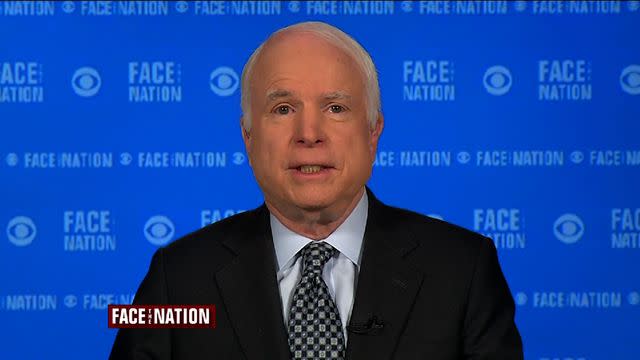
Source: http://news.yahoo.com/john-mccain-m-ashamed-country-m-ashamed-president-175342180.html

What is Russian President Vladimir Putin’s grand strategy? It may get lost in the headlines about the murder of an opposition leader just outside the Kremlin walls and the grinding horrors of the Ukraine war, but from the shores of the Black Sea here in Georgia the outlines are painfully obvious. While the world’s attention has focused on eastern Ukraine over the last year, the Kremlin has been maneuvering to take something far more valuable than the war-torn sliver of outdated industrial territory known as Donbass around Luhansk and Donetsk.
Source: http://www.thedailybeast.com/articles/2015/03/01/putin-s-power-projection-it-s-all-about-energy-and-the-black-sea.html?

According to the report from the State Department, Russia has 528 carriers of strategic nuclear weapons that carry 1,643 warheads. The United States has 794 vehicles and 1,652 nuclear warheads.
It just so happens that today, Russia's strategic nuclear forces (SNF) are even more advanced in comparison with those of the US, as they ensure parity on warheads with a significantly smaller number of carriers of strategic nuclear weapons. This gap between Russia and the United States may only grow in the future, given the fact that Russian defense officials promised to rearm Russia's SNF with new generation missiles.
The progress was made possible thanks to the treaty on the limitation of nuclear weapons, also known as START-3. The treaty was signed by Dmitry Medvedev and Barack Obama on 8 April 2010 in Prague (came into force on 5 February 2011). In accordance with the document, nuclear warheads of the parties are to be reduced to 1,550 by 2021. The number of carriers (intercontinental ballistic missiles, submarine-launched ballistic missiles and heavy bombers) is supposed to be cut to 700 units.
It was the first strategic agreement, after the treacherous policy of democrats, in which Russia managed to win significant advantages. In the treaty, the Americans, for the first time in history, undertook to reduce their strategic nuclear potential, while Russia won an opportunity to increase it. Furthermore, the new treaty removed important limitations that existed in the previous START 1 and START 2 treaties. It goes about the size of areas for the deployment of mobile ICBMs, the number of multi charge ICBMs, and the possibility to build railway-based ICBMs. Russia did not make any concessions.
Having written off Moscow as a serious geopolitical rival, flying on the wings of inaccessible military and technological superiority, Washington drove itself into a trap, from which it does not see a way out even in a medium-term perspective.
Recently, a lot has been said about so-called "sixth-generation wars" and high-precision long-range weapons that should ensure victory over enemy without coming into direct contact with its armed forces. This concept is highly questionable (The US failed to achieve victory in such a way both in Iraq and Afghanistan). Yet, this is the point, where Russia enters the parity line as well. The proof is long-range cruise missiles of a new generation that will soon be deployed on submarines of the Black Sea Fleet and missile ships of the Caspian Flotilla.
In today's Russia, many find this hard to believe. This is a common belief for many of those, who still enthusiastically remain in captivity of the myths about the absolute "weakness" of Russia and the absolute "superiority" of the West. The myth was made up in the 90's under the influence of Boris Yeltsin and his betrayal of Russian national interests. One has to admit that during that time, the myth was real, if one may say so.
Times have changed. One can easily understand the new state of affairs. For example, let's consider the potential of conventional weapons of Russia and the West in the European Theater of Operations (ETO). In this area, it is generally believed that NATO is a lot stronger than Russia. Yet, a first encounter with reality smashes this misbelief into pieces. As is known, the main striking force, the core of combat power of the ground forces is tanks. By the time of the collapse of the Soviet Union, the Russian Armed Forces had about 20,000 tanks in the ETO.
The Americans, in turn, deployed 6,000 heavy Abrams tanks on the territory of the allied group. Despite this, the combined potential of NATO forces in Europe was still significantly inferior to the Soviet potential. To compensate this imbalance, NATO strategists were forced to resort to tactical nuclear weapons (TNW).
In the first half of the 1950s, NATO conducted a research about what kind of forces the bloc should have to show reliable resistance to large-scale ground offensive of superior forces of the Soviet Union and Warsaw Pact countries. The calculations showed then that one required at least 96 full-fledged divisions for the purpose. Yet, the cost of armament for one of such divisions exceeded $1 billion. Plus, one required two or three more billion to maintain such a large group of troops and build appropriate infrastructure. This burden was clearly beyond the power of the economy of the West.
The solution was found in a move to deploy a group of US tactical nuclear weapons on the continent, and that was done soon. By early 1970s, the US arsenal of tactical nuclear weapons counted about 7,000 units of ammunition. The highest achievement in the area was the creation of weapons of selective action - neutron warheads (for guns of 203-mm and 155-mm caliber, and for Lance missiles) with a capacity from 1 to 10 kilotons. The warheads were seen as the key in combating land forces personnel, particularly Soviet tank crews.
Given the nuclear factor, to reflect "Soviet aggression," NATO required to deploy only 30, rather than 96 divisions, and so they were deployed.
How do things work in this area now? In early 2013, the Americans withdrew the last group of heavy Abrams tanks from Europe. In NATO countries, over the last 20 years, one new tank would replace 10-15 old, yet still capable, tanks. At the same time, Russia was not decommissioning its tanks. As a result, today Russia is the absolute leader in this regard. In mid-2014, the balance of the Defense Ministry had as many as 18,177 tanks (T-90 - 400 pcs., T-72B - 7,144 pcs., T-80 - 4,744 pcs, T-64 - 4,000 pcs, T-62 - 689 pcs, and T-55 - 1200 pcs.).
Of course, only a few thousand tanks are deployed in permanent readiness units, and most of them remain at storage bases. Yet, NATO has the same picture. Therefore, the decisive superiority of Russian tanks has not gone anywhere since the times of the USSR. Here is another surprise. As for tactical nuclear weapons, the superiority of modern-day Russia over NATO is even stronger. The Americans are well aware of this. They were convinced before that Russia would never rise again. Now it's too late.
To date, NATO countries have only 260 tactical nuclear weapons in the ETO. The United States has 200 bombs with a total capacity of 18 megatons. They are located on six air bases in Germany, Italy, Belgium, the Netherlands and Turkey. France has 60 more atomic bombs. That is pretty much it. Russia, according to conservative estimates, has 5,000 pieces of different classes of TNW - from Iskander warheads to torpedo, aerial and artillery warheads! The US has 300 tactical B-61 bombs on its own territory, but this does not change the situation against the backdrop of such imbalance. The US is unable to improve it either, as it has destroyed the "Cold War legacy" - tactical nuclear missiles, land-based missiles and nuclear warheads of sea-based Tomahawk cruise missiles.

Source: http://rt.com/news/236573-russia-repel-nuclear-strike/

The field-type exercises of the air defense forces will be taking place until April 10 in twelve military firing ranges, located in Russia's South, the North Caucasus and Crimean Federal Districts, as well as at Russian military bases in Abkhazia, South Ossetia and Armenia. “Over 2,000 troops have been involved into the battle drills, and over 500 items of weaponry and military hardware are being used,” Interfax quoted a statement of the Southern Military District.

Source:http://www.wnd.com/2015/03/russia-preparing-final-assault-to-take-back-georgia/


Pavlenko, 35, was one of four volunteers to be buried in the past two weeks from the northwestern city, where organisations helping Russians of all ages with everything from military training to making the journey to the battleground, have sprung up in recent months. "Yevgeny could not have acted otherwise when Russians are being killed in Donbass," the eastern region of Ukraine, Markin told AFP, his eyes glistening with tears as he spoke of the former professor of literature and member of the banned National Bolshevik Party - which combines radical nationalism with communist ideals.

Forty-six percent of European Union citizens argue that the 28-member bloc should act more independently from the United States, while only 28 percent think that Brussels is independent enough in its actions, a poll conducted by ICM Research exclusively for the Sputnik news agency revealed. The ICM Research questioned over 3,000 people in Germany, the United Kingdom, and France. Telephone interviews with adults in the three countries were conducted in December 2014.
According to the poll, the vast majority of German citizens, 62 percent, think that Brussels should become more independent from Washington, while only 15 percent of Germans believe that the European Union has already been acting independently enough from the United States. Opinions shared on the same topic in France and the United Kingdom were similar, where 38 and 39 percent of respondents respectively thought that the countries should be more independent of the United States. Thirteen present of residents in both countries said the EU should act less independently from the US.
The European Union coordinates most of its foreign activities with the United States, including the recently imposed sanctions against Russia over Moscow’s alleged interference in Ukraine’s internal affairs – a claim the Kremlin has repeatedly denied. The sanctions particularly targeted Russia's energy, defense and banking sectors. Economic sanctions imposed in July were preceded by several rounds of restrictions imposed by the EU, the US and their allies against Russian and Crimean officials and individuals that Brussels believed to have played a role in "destabilizing" Ukraine. A lot of EU citizens, particularly Germans, whose businesses and work depend on cooperation with Russia, expressed their dissatisfaction over their governments’ actions, saying that they have blindly followed US policies.
Have Anti-Russian Sanctions Been Implemented by EU Under US Influence, Jointly, or Independently?
When
asked by ICM Research whether sanctions against Russia have been
implemented by the EU under the US influence, jointly, or independently,
27 percent of European citizens polled said that the restrictions had
been imposed under Washington’s influence. Another 37 percent of EU residents said that the European Union and
the United States had acted together when imposing anti-Russian
sanctions, while in Germany 47 percent of respondents thought that
Washington and Berlin had taken the decision jointly.
In France, 33 percent of those polled argued that the United States had influenced the bloc’s decision to join the sanctions against Russia, while only 24 percent said that the European Union had maken the decision independently. In the United Kingdom, 17 percent expressed no opinion, while a quarter of the respondents said the European Union’s decision was affected by Washington.
Have Sanctions Against Russia Affected the Ukrainian Conflict Settlement in Positive or in Negative Way?
The ICM Research poll for Sputnik revealed that over half of the German citizens polled, 54 percent, believed that sanctions imposed by the West negatively affected the Ukrainian conflict settlement. Only 16 percent of German citizens thought the sanctions had affected the situation positively, while 24 percent said the measures had no effect at all. British residents polled had a completely different opinion. Forty percent of British respondents said that sanctions had positively affected the situation in Ukraine, while only 21 percent argued that the impact had been negative.
Thirty-seven percent of French citizens claimed that anti-Russian sanctions had played no role in the Ukrainian crisis settlement, and 30 percent said the measures had played a negative role. Overall, 35 percent of Europeans said sanctions had had a negative impact on the Ukrainian crisis settlement, while 26 percent had expressed opposite opinion.
Should Sanctions Against Russia Stay in Place?


It is often believed that these NGOs are either naïve, or driven by ideology, or both, and they have oftenbeen accused of being one-sided in their studies and publications, carefully choosing data that supports their positions and ignoring contrarydata. Nevertheless, they continue to exert substantial influence over many areas of public debate, often because they provide ammunition to government officials and bureaucrats, as well as to candidates and political parties supposedly comingfrom "objective" sources.
Recently, however, a more serious charge is being leveled at some of these NGOs--namely, that their activities on behalf of certain causes are bought and paid for by interested parties. Martin Indyk, former US negotiator for the still-born Israeli-Palestinian "peace process" inthe Obama Administration, was forced to resign when it was revealed that his organization, the highly-respected and influential Brooking Institution, had received very significant funding from the government of Qatar, whichseemed to explain the infamous meeting that Secretary of State Kerry had in Paris with the foreign ministers of Qatar and Turkey, whom heproposed act as"objective"intermediaries between the two sides.
In the past few weeks it has transpired that several respected environmental NGOs, such as the Sierra Club, one of the largest and most respected, had been receiving millions of dollars from various Bermuda-based companies and funds, the ultimate source of which was non-other than the government of Russia. The purpose of this support was to increase public and government opposition to fracking technologies, which have resulted in substantial competition to those countries dependent on oil and gas revenues, such as Russia. The curious failure for yearsof the Obama Administration to approve the oil pipeline from Western Canada to heavy-oil refineries in Texas, despite two favorable environmental impact reports from the State Department, may be traced to the influence of environmental NGOs, the activities of which are, in turn, financed by Russia.
The financier George Soros has been funding Jewish organizations opposed to the current government of Israel, such as J Street and others, in an attempt to assure the defeat of Prime Minister Netanyahu in the impending election. The lessons to be learned from these and other examples are, first: take all studies, reports and allegations with a large grain of salt until confirmed by alternative and non-related sources, especially when it comes to "scientific" evidence that it may turn out is not so much scientific as purchased. Secondly, all NGOs should be forced not only to reveal funding sources, but to identify who or what is behind some benign-sounding funders, such as "Earth-Friendly Fund of the Cayman Islands" (or whatever).
A final note on other, related,Russian activities outside the motherland. In addition to the flexing of military muscle in Ukraine and Georgia, as well as overflights, naval exercises and other actions, as well as the cyber attack some years ago on Estonia, Russia under Putin has been developing a huge, sophisticated externalpropaganda campaign. Examples of such uses of "soft" power in the Western Hemisphere have recently been detailed in think-tank reports, but by far the most significant target of these activities is Europe, and especially with reference to the parties of the extreme left and right, which are increasing exponentially in coverage and significance. One such party just came to power in Greece, and several otherelections are scheduled elsewhere in Europe this year and next, including in such major countries as Great Britain, Spain and France. In the last, the extreme-right Front National partywas the recipient of funding from a bank associated with the Russian government.

Vestnik Kavkaza further wrote: “The term ‘democracy’ in Armenia has long been exploited for information wars. For quite a while, Washington has been hesitating whether to support President Serzh Sargsyan or put bets on the opposition. After the victory of Sargsyan in early presidential polls, it seemed that the power was in the hands of a politician loyal to Moscow. However, it is hard to say that Armenia has a pure pro-Russian position. Sargsyan himself is trying to gain the support of both Russia and the U.S.”
According to the Center for World Journalism and Research, the work of non-governmental organizations in Armenia has reached “a grand scale in recent years.” The Justice Ministry has registered thousands of NGOs. The magazine also noted: “After the collapse of the USSR, the Armenian Assembly of America, a structure related to the State Department … has been in the avant-garde of American influence in Armenia.”
The article pointed out the fact that millions of dollars have been dumped in Armenia to fund the activities of NGOs that are loyal to western donors’ agenda. “Open Society Institute, a Soros Fund founded in Armenia in 1997, has already spent over $24 million in Armenia. … The Investigative Journalists got $187,400, the Asparez Journalist Club got $58,650, and the Independent Network of Journalists got $83,200 for creating a negative image of Russian-Armenian cooperation.”
Back in 2012, I wrote: “Not all NGOs in Armenia are completely devoted to their stated missions. Some of them have raised several ‘red flags’ because of their activities. They may have been set-up to pursue hidden agendas that are detrimental to Armenia’s national security. … Given the fact that sizable segments of the Armenian society continue to be politically illiterate they can be easily influenced and misguided by individuals or non-governmental organizations that may present themselves as ‘well-meaning’ but in reality they can pursue hidden goals. They may sound very empathetic towards the general populace, yet they care less about Armenia and its future. They publicly discuss burning issues and gain political mileage, yet their main intention is not democracy as they claim to be.”
I further underlined: “Can Armenia mitigate the negative impact of certain NGOs that play the role of Trojan horses from within? It can and it should. Armenia Should Emulate Russia in Qualifying Foreign-Funded NGOs as ‘foreign agents.’ … It would be strongly effective if all NGOs whether engaged in political activities or humanitarian endeavors be required to publicly present every year the sources of their income and itemize their expenditures. Transparency at NGO level can be utilized as a great example to follow.”
A few years ago, in an interview with the REGNUM News Agency titled, “LOOK OUT! ETHNIC ESPIONAGE,” Igor Muradyan, a widely recognized expert on the politics of the Caucasus region, stressed: “First of all, you should take into account the continuing political struggle in Armenia and view the stance of the Armenian Assembly of America also in this light. I don’t think that ethnic NGOs enjoy full independence in the US, but the point is that the Armenian Assembly of America is more than dependent. Even more, the Assembly is functionally dependent. The Assembly directors and employees don’t just look down on Armenia’s political class and leaders; they look down on them with disdain.”
He elaborated: “In 2001 the Assembly’s board decreed ‘to fight Armenian nationalism.’ This implies suppression of any instance of patriotism, especially over the Karabakh problem and Armenian-Turkish relations. … Gathering information on the state of the armed forces of Armenia, including armaments, information on senior officers, on the import of military hardware (invoice numbers, payment terms, transportation routes), receiving analytical notes on the fighting capacity of the Armenian army, information and assessment of typical conflicts inside the military command, the concerns and plans of different groups in the military circles; gathering information on the leaders and activists of political parties, the mass media and political leaders of Armenia, including economic interests, ties with foreign countries.”
He concluded: “Of certain interest is the impression I got personally from such contacts. Strange but true: Assembly representatives get openly malicious and bilious over the fact that the Armenian armed forces are highly capable of discharging many combat operations on their own. Would they be more comfortable if the army of their ‘historical homeland’ had other characteristics and was like the armies of some other states? Altogether incompetent, the Assembly representatives were as much annoyed to know that Armenia is not a perishing country and is successfully developing economically.”
Many Armenia-based NGOs are well-organized and genuinely transparent, and continue making transformational contributions to Armenia’s present and future. Armenian society can achieve optimum results through social, political, spiritual and economic activism. There is no question that civil society in Armenia is in need of non-governmental organizations (NGOs). However, some NGOs can prove to be a curse if they are not regulated properly and their activities watched closely.


It's
no secret that the Armenian media space contains pro-Western,
anti-Russian mass media. There are two ways to spread anti-Russian
information, and the aforementioned media are divided into two
categories. The first category includes the mass media which openly,
strictly and even thoughtlessly criticize all things connected with
Russia. That is why they are not taken seriously even in Armenia, and
their work is like a proverb – the dog’s barking is for the wind to
carry. The second category of the mass media treats its mission more
seriously and is very dangerous. In such media projects, criticism of
Russia is added to criticism of the native government, criminal stories
and the gutter press. If we exclude the gutter press aspect, the
Armenian radio “Freedom” belongs to the second category.
The Armenian media – Azatutyun – is financed directly, but unofficially, by the American embassy in Armenia. And the consequences are clear. The edition works solidly, steps are highly coordinated, and information is well-thought through. Almost all the correspondents of “Freedom” go to various conferences on one and the same day and ask one and the same question. Usually the question touches on Russia’s activities or reaction to a certain problem which often has nothing in common with Armenia. It means the edition fulfills a clear plan which hasn’t been developed by it. “Freedom” floods the Armenian media space with false information to promote an atmosphere of mistrust of Russia and all its projects in the region.
After Serge Sargsyan’s statement on intention to join the Eurasian projects of Moscow, the activity of the aforementioned media had improved. Most of the anti-Russian articles and reports are absurd. For example, the authors state that a possible Armenian-Azerbaijani military conflict will be beneficial for Russia. Information on Moscow’s plans to “give away Karabakh” can be seen in publications of the mass media in the last 20 years. In January 2014 there was information that a group came from Russia and jabbed residents of Yerevan with HIV-contaminated syringes. “We don’t comment on rubbish,” the police of Armenia told Vestnik Kavkaza.
Now the radio is very concerned about the situation surrounding the status of the Armenian language and violations of the country's Language Law. Among such violations, according to Freedom radio, is the fact that a number of Russian-language international conferences are being held in Armenia. According to the law, all public events should be held with simultaneous translation into Armenian. The radio station's official website is now full of anti-Russian comments concerning this topic provided by various experts. The same is happening on air.
The radio has also paid special attention to the Rossiya Segodnya's chief executive Dmitry Kiselyov's remarks made in the Armenian parliament. Kiselyov and Armenian lawmakers who were taking part in the event, are still being stigmatized and accused of all possible and impossible transgressions. This also promotes an atmosphere of distrust and fear.
The last event, which caused an immediate reaction in the pro-Western media, was the Armenian president's visit to Georgia. It's quite clear that the massive Russian Railways' project launched in the region is unfavorable to the United States. That is why such media could not hide their delight when the president failed to reach an agreement with the Georgian authorities. According to such authors, there is now no chance that the railway connection between Georgia and Abkhazia can be resumed since Georgia agreed to join the European customs space. It seems like no comment is necessary.

During the Soviet era in Armenia, there were virtually no non-governmental organizations (NGOs). After the devastating earthquake of December 1988 and during the years of the war in Artsakh (Karabagh), NGOs began to form and were heavily involved with relief and humanitarian efforts. The government of Armenia was unable to cope with the dire situation resulting from the earthquake and the war, and therefore had to accept the active participation of civil society organizations (CSOs).
Alongside humanitarian aid, major international organizations and NGOs started contributing to the development of the local non-government sector. Major Armenian organizations from the diaspora also provided humanitarian aid and contributed greatly to the reconstruction process. The focus of these new NGOs was on refugees, women, children, the elderly, and the disabled, but their activities were somewhat limited. Their inability to meet the growing demand for emergency services and operations, for example, was due to a lack of local NGO skills, knowledge, and capabilities, and the absence of an appropriate legal framework. This period can be considered the first stage in the formation of local NGOs.
Even though most of the NGOs were located in Yerevan, local NGOs began emerging in the marzes (provinces), too, and implementing projects in education, health, culture, community development, and income generation. In 1997, the number of local NGOs passed 500. By 2001, data from the state register showed that 2,585 NGOs were officially registered. In 2010, the state register reported 45 international NGOs and 5,700 local NGOs. However, out of the total number of local NGOs registered, only 15 percent can be considered operational; most in that percentage are small outfits that are not active, and some have vague and obscure missions. The following are the mission statements of a few such NGOs:
–The main goal of the organization is to participate actively in the social and legal life of the country in order to promote a free and safe life for the youth.

International NGOs can be classified under the same categories as local NGOs, but have two additional categories—(1) infrastructure development and construction, and (2) capacity building and technical assistance for local CSOs, self-governing bodies, and community councils. A survey conducted by World Learning revealed that in the 1990’s, 70 percent of NGO leaders were women. However, by 2001, 58 percent of NGO leaders were men, and by 2009, the percentage of male NGO leaders had increased to 63. The shift might have occurred as men came to view NGOs as a job opportunity and a means to further their careers. Yet, while in 2004, approximately 75 international NGOs were operating in Armenia, that number has since decreased. The reason for this decline may be the stable economic growth seen in Armenia in 2006 and 2007.
Government involvement
The gradual increase in the number of international NGOs in Armenia and the corresponding need to regulate the activities of all types of CSOs led to the Armenian government adopting its first Law on Civil Society Organizations in 1996. The law encouraged international NGOs to shift their activities from emergency response to development, the protection of human rights, and enhancing the capacity of local NGOs. The law states that Armenia recognizes the crucial role of NGOs in the development of civil society and aims to promote the establishment of NGOs as legal entities. The government has also passed decrees, regulations, memorandums, and agreements related to cooperation with NGOs, and formed institutional bodies and units on community and national levels.
Voluntarism
When interacting with society, NGOs in Armenia, in comparison to NGOs in the Armenian Diaspora, use an informal and less structured process for volunteering. NGOs in Armenia also have greater issues with volunteer mismanagement; sporadic volunteer recruitment; lack of skills assessment, orientation, and training for volunteers; and recognizing volunteer contributions. Engaging volunteers in long-term regular commitments, instead of ad hoc projects, could better utilize this important resource.
Because voluntarism for society was not a common practice during the Soviet era, there is a need to widely publicize the value of volunteerism to get more people interested. Presently this important human resource is underutilized by NGOs in Armenia. NGOs should realize the expectations of the volunteer in order to retain their involvement and commitment over time. A non-profit organization with a strong and committed volunteer base is also more likely to attract new funds.
Democratic governance
The internal democratic governance of NGOs in Armenia is another issue that needs to be addressed. NGOs have developed written policies for democratic governance, but often do not follow these policies. They hold elections to select their internal leadership, yet the rotation rate of such leadership is low. Typically, the founders of NGOs hold their positions for a long time, which affects the formation of an independent Board of Directors.
While most Armenian NGOs have bylaws and constitutions that outline their governance mechanisms, it sometimes seems as though these mechanisms are developed only to get the required permits and to attract new funds, rather than from a genuine interest in democratic management. Members are also often excluded from decision-making processes. Unless NGOs embrace democratic procedures into their regular operations, they will not be able to establish a credible reputation in the community.
Funding sources
Financial sustainability is one of the main challenges that local NGOs in Armenia face. It is this challenge that limits their capacity for impact and distorts the image of civil society as a financially dependent sector. It is necessary to diversify funding sources by fostering partnerships with a full variety of potential funders, whether they are individuals, corporations, or governments. NGOs in Armenia undertake fundraising activities through various events, exhibitions, concerts, and other activities. However, the majority of NGOs have difficulty with fundraising because they lack experience in fundraising methods, basic marketing, and financial management skills.
The activities of Armenian NGOs are heavily reliant on external funding. Some donor organizations work directly with NGOs, while others operate on a bilateral or multilateral basis. The Armenian Diaspora also assists the local NGO sector by allocating funds or providing in-kind assistance. Many NGOs believe that if donor organizations leave Armenia, the scope of their activities will be curtailed and they will become non-operational due to a lack of funding. The Civil Society Fund is one of several programs supported by the World Bank, which has provided grants since 1999 to NGOs and other CSOs in Armenia. The grants support activities related to civic engagement, and focuses on empowering people who have been excluded from society’s decision-making processes. The individual grants are between $8,000 and $10,000.
Today’s unfavorable legislative framework related to donations to non-profit organizations does not provide the NGO sector with an opportunity to acquire alternative financing. Therefore, limited and unsustainable funding from donors and the government make the NGO sector more dependent, which in turns affects their independence and sustainability. Furthermore, the Armenian business sector does not invest in NGO development. (If it does, the investment is limited to a one-time project or event-based charitable contributions.) Often NGOs are forced to accept funding for projects that are not in line with their mission, values, or principles; the project requirements are often determined by the donor’s agenda, and this greatly affects credibility of the organization. Armenia’s state budget allocates some funds for NGOs on a competitive basis.
Lack of transparency and accountability is another issue facing NGOs, which generally do not produce and disseminate annual reports and financial statements. The majority of NGOs claim that their financial information is publicly available; yet, on closer inspection, it becomes clear that they rarely report to their beneficiaries when it comes to the finances and the quality of their work. The majority of Armenian NGOs think that the preparation of reports requires additional financial expenditure. Reporting of finances and activities would improve the public’s perception of NGOs.
Effectiveness
One of the underlying causes of civil society’s weak effect on policy and social issues is that NGOs have failed to extend their outreach and rally greater support and higher levels of citizen participation in their activities. Long-term financial insecurity stands as another hindrance to the number of CSO’s in Armenia. NGOs have relied solely or predominantly on international donor funding, without diversifying their income sources or developing a long-term strategy to change this situation. As a result, the instability of work in the NGO sector has not attracted young specialists.
Increasing the professional skills of CSOs through trainings and staff development could help strengthen the level of organizational development and achievement. What is critical is focusing on staff retention, as well as establishing a culture of information sharing and knowledge transfer. Fragmentation and competition among NGOs occur frequently, resulting in an ineffective system for Armenian CSOs. Because of limited coordination among NGOs, the sector lacks updated information and a database of NGOs. This creates an inadequate picture of these organizations and, consequently, gives people a poor perception of NGOs. This also affects the ability of NGOs to influence the decision-making process in the public sphere.
Some issues facing civil society include a short-term approach, lack of strategic thinking, clustering around pro-government or opposition groups, and poor organizational capacity. In order to increase citizen participation and sponsorship, NGOs must realize that they should be deriving their legitimacy from society, as they depend on popular support. Increased transparency and accountability are vital to support this action. This includes reporting to beneficiaries just as they do to funders, and presenting an inclusive account of all aspects of their activities. Improvements in these fields will contribute to increased levels of trust with the civil society sector and the broader society, and will foster increased citizen participation.

Marianna Grigoryan is a freelance reporter based in Yerevan and editor of MediaLab.am.

Sargisian’s Republican Party and the Prosperous Armenia Party formed the ruling coalition initially, with the understanding that the Putin-style transition would be implemented in Armenia, with Sargisian serving out his term and paving the way for a Kocharian’s return. Relations began souring when the plan did not work the way it was supposed to; Sargisian did not relinquish the reins of power and the coalition began to splinter. For a long time, Levon Ter-Petrosian courted Tsaroukian to no avail. Now that Tsaroukian has become a target of the president’s criticism threw the gauntlet and rallied the opposition parties around him and called for a nationwide rally on February 20, calling for he president’s resignation. Prosperous Armenia joined the Armenian National Congress and Raffi Hovannisian’s Heritage Party to use all means, including “civil disobedience” to bring down Mr. Sargisian. The rally will prove to be a litmus test of the opposition’s power.
Politics in Armenia are the mirror-image of those in Russia. Putin jailed oligarch Mikhail Khodorkovski, who had opposed him politically, usurped his assets worth over $10 billion and let him leave the country almost penniless after 20 years of incarceration. The same tactics are replayed in Armenia now. Tsaroukian was removed from the National Security Council, he was stripped of his presidency of the National Sports Agency and now the president has sent a formal letter to the speaker of parliament, Galust Sahakian, to take away Mr. Tsaroukian’s protection as a member of parliament. Meanwhile, all of his businesses have been investigated for potential tax evasion. Thus far, Mr. Tsaroukian has conducted his businesses in Armenia, employing some 20,000 people, now all of a sudden, he has become a suspect upon a fallout with the president. The current administration has been able to destroy more sophisticated oligarchs, like Khacahdour Soukiasyan, who left the country with his huge capital, instead doing business in Europe and the Gulf states, to the detriment of Armenia’s economy.
But despite his macho image, Mr. Tsaroukian thus far is behaving smartly. It is apparent that he is being coached by much more experienced political minds in the opposition. For example, in his response to the president’s criticism, he said that he is not a politician in the classic sense, but that he wishes to help his people. Tsaroukian has crossed the Rubicon and with his help, the opposition will fight the administration with renewed vigor. Observers and the general public are stunned at this conflict taking place at this time, which may lead to a new Maidan which, Mr. Tsaroukian, has said he has avoided thus far. Why is the president so emboldened when the country’s problem persist? Emigration is continuing on a dangerous scale, the economy is staggering and above all, the border with Azerbaijan is again becoming a war zone.
The president’s domestic challenges are coupled with a foreign relations challenge, when he suddenly decided to withdraw the Protocols from the Parliament’s agenda. He took the last initiative the moment Mr. Davutolgu had adopted a more conciliatory tone toward Armenia. The Turkish prime minister reiterated his previous offer of relinquishing one region in Karabagh to open the border with Armenia. It is a different matter that the offer would not be a starter because the give and take are not equivalent. Swapping territory for lifting the blockade could prove to be an illusion, because the borders can be closed at will any time, but land could be taken “only by blood,” as noted Turkish dictator Kenan Evren.
This crisis is ill-timed, when the entire diaspora will be converging to Armenia, too for the centennial commemoration of the Genocide. Not only the diaspora, but also many dignitaries like President Francois Hollande and others will arrive at a crisis-ridden country. We do not want to see another Maidan reenacted. But who needed this crisis at this time?

***


Source: http://www.bostonglobe.com/opinion/2015/02/25/putin-reaction-ukraine-about-russian-security/uM3Ipc7lWPgWbpiIWBJSxI/story.html

Opinion Journal Video
Mr. Putin may be an autocrat, but he finds weak democracies convenient to his purpose. Their frail institutional and rule-of-law regimes make his favored forms of subversion easier. Thus, Moldova, Bulgaria and Serbia are particularly at risk while Romania, a member of the European Union since 2007 and far more stable than Bulgaria, is less so.
Mr. Putin has a North European Plain strategy in the Baltic states and Poland, which emphasizes dependence on natural gas and the manipulation of Russian minorities in the Baltic states. He also has a Black Sea strategy, as seen in his annexation of Crimea last year, his desire for a land bridge between Crimea and separatist eastern Ukraine, his military pressure on Georgia, and his friendship with Turkey’s President Recep Tayyip Erdogan—it all advances Russian influence in the adjacent Balkans, thus inside Europe. Western sanctions against Russia and the weakening of the Russian currency (because of the fall in oil prices) may constrain Mr. Putin a bit, but Russian history reveals a strong tendency for hardship at home and adventurism abroad. Dialing up nationalism amid economic turmoil is the default option for autocrats.


At the end of last year, the US Congress passed the Ukraine Freedom Support Act, which mandates the supply of $350 million in lethal and non-lethal aid to the Kiev regime. The Obama administration maintains the fiction that it has not yet acted on the «non-lethal» provisions in the Act, but that is stretching credulity to breaking point. The notion that Washington and its NATO allies, including Britain, the Baltic states and Poland, are now – only now – mulling the possibility of furnishing lethal material to the Kiev regime is simply laughable.
We can go further back to the CIA-inspired «colour revolution» of 2004, or even as far back as 1991, when the Soviet Union collapsed and the US began infiltrating Ukraine with $5 billion to foment «civil society groups». That is a euphemism for the USAID, CIA, George Soros umbrella of destabilising agents. We have knowledge of the $5 billion fund courtesy of the clumsy admission from neocon State Department siren Victoria Nuland, who actually bragged about the fact during the Maidan Square protests at the end of 2013. This week, Nuland’s minion at the State Department Jan Psaki again disclosed to reporters that the US has long been involved in «working with the Ukrainian opposition» to ensure the country was «on track» for «transition».


But if such aid were sent, "Russia would reasonably consider the U.S. to be a direct participant in the conflict," said Evgeny Buzhinsky, a former lieutenant general on Russia's General Staff now at Moscow-based think tank the PIR Center. Speaking to The Moscow Times on a condition of anonymity, a member of the Russian Defense Ministry's public advisory board warned that Moscow would not only up the ante in eastern Ukraine, "but also respond asymmetrically against Washington or its allies on other fronts."
The proposal is set to be discussed with all parties in the Belarussian capital of Minsk on Wednesday, but some consider peace talks hopeless, and advocate military measures. The U.S.-led NATO military alliance says Moscow has sent troops and arms to aid pro-Russian rebels fighting in eastern Ukraine — which Russia denies. Calls to arm Ukraine are seen as a way to even the odds for the Ukrainian army, enabling Kiev to halt rebel advances and force them — and the Kremlin — to negotiate.
U.S. think tank the Atlantic Council called last month for Washington to give $3 billion in lethal and non-lethal military aid to Ukraine over the next three years. But Russian defense analysts polled by The Moscow Times said unanimously that U.S. arms transfers to Ukraine would be interpreted in Moscow as a declaration of open proxy war with Russia and inevitably lead to escalation of the conflict.
"It would become tit-for-tat," said Maxim Shepovalenko, an analyst at the Moscow-based Center for the Analysis of Strategy and Technology (CAST). "Moscow will not just sit by calmly and see what happens, it will counteract," he said.
Who Are We Giving This to?
Only one of the units was reportedly destroyed by rebel fire. The other was reportedly dropped by Ukrainian soldiers — underscoring the difficulty of providing aid and ensuring it gets put to good use. "You might give aid to the regular armed forces, not the volunteer battalions, but you still need trained operators. Training takes time, additional money, and more than anything else — it takes practical experience," said Shepovalenko.
U.S. deployment of trainers to Ukraine would mean sending U.S. military personnel into Ukraine — which could easily be construed by Moscow as U.S. involvement in the war. Beyond training, there is no guarantee that weapons and hardware will not fall into enemy hands or wet the beaks of corrupt Ukrainian army personnel. Corruption in the ranks cannot be discounted, according to the PIR Center's Buzhinsky: "It is absolutely certain that at least fifty percent of what is delivered will be stolen and then sold on the side," he said.


Ukraine has been losing ground in its eastern regions to the pro-Russian separatists, who are apparently armed with advanced armor from Russia. Ukrainian President Petro Poroshenko over the weekend made an emotional appeal to western leaders for defensive weapons to help counter the separatists’ assaults.
“We are an independent nation and we have a right to defend our people,” Poroshenko said Saturday at a high-level security conference in Munich. “Over the course of the offensive we have proved to be responsible and we will not use the defensive equipment for attack.”

Ukraine has been losing ground in its eastern regions to the pro-Russian separatists, who are apparently armed with advanced armor from Russia. Ukrainian President Petro Poroshenko over the weekend made an emotional appeal to western leaders for defensive weapons to help counter the separatists’ assaults. “We are an independent nation and we have a right to defend our people,” Poroshenko said Saturday at a high-level security conference in Munich. “Over the course of the offensive we have proved to be responsible and we will not use the defensive equipment for attack.”

As they spoke, Chancellor Angela Merkel and French President Francois Hollande held talks in Moscow with Putin to try to end the conflict in Ukraine that has killed more than 5,000 people and driven Russia's relations with the West to new lows. Their initiative was partly prompted by the debate about arming Kiev.
NATO's top military commander, Gen. Philip Breedlove, gave the strongest indication so far that he is - as the New York Times reported this week - among the U.S. officials who favor providing defensive arms and equipment to Ukraine's military. The West has tried using diplomatic and economic measures to put pressure on Putin, he said. "But if what is being done is not producing what you want to gain from the conversation, then maybe all tools in the tool bag should be used and conventional means should not be outwardly discounted," Breedlove added.
Germany's von der Leyen questioned the strategic sense of providing weapons to Kiev when the separatists were so well-supplied by the Russians. "The support with arms from Russia to the separatists is potentially unlimited," she said. "And do we really count on being able to provide as many arms to the Ukrainian army that they could potential conquer the other side?"
Source: http://www.reuters.com/article/2015/02/06/us-ukraine-crisis-germany-minister-idUSKBN0LA1S420150206

European leaders can wring their hands. They can threaten to ratchet up the sanctions they have imposed against Russia. But the damage has been done ever since March 2014, when Putin annexed Crimea. Through its weak response to Russian aggression, the E.U. has discarded the rules of the post–Cold War era. Even the 1975 Helsinki Final Act, in which Western and Communist bloc leaders pledged to respect the inviolability of borders, has been torn up. Europe is entering a new and dangerous era for which it is completely unprepared.
Other European leaders, who seem to forget that a war is being waged on the E.U.’s borders, have no qualms either in dealing with Putin. Nicos Anastasiades, the president of Cyprus, is scheduled to visit Moscow on February 25. For many years, Cyprus has been providing Russian oligarchs with a safe haven for their riches.
Source: http://www.newsweek.com/europe-throws-ukraine-under-bus-308853

Source: http://news.yahoo.com/russian-diplomat-slams-destructive-us-stance-164159631.html
Sorry, Ukraine, You Can't Beat Putin
The Russian opposition figure Alexei Navalny recently said
that were it not for Western economic sanctions, Russian tanks would
already have swept west to the port city of Odessa, occupying a huge
swath of Southern Ukraine and cutting off the rest of the country from
the Black Sea. He's probably right, yet it won't count for much if
Ukraine's government doesn't take advantage of the respite sanctions
have provided by changing course. Russian president Vladimir Putin has in recent weeks rekindled the
war in Eastern Ukraine, and it's important to understand the role that
Ukrainian actions have played in this. It's equally important to
recognize that sanctions can't defeat Putin; they can only make him more
cautious and open to a settlement.
It was just last September that Putin initiated the Minsk cease-fire agreement,
halting his tanks after they had reversed many of the gains Ukraine's
military had made against Eastern separatists over the summer. And it's a
fair assumption that Europe's threat to impose heavier economic
sanctions influenced his decision to stop his advance. Putin had demonstrated that Ukraine's military simply isn't capable
of standing up to Russian regulars, and that his tanks could indeed roll
on to Odessa if he chose to give the order. In return for stopping,
though, he expected Ukrainian President Petro Poroshenko to sue for a
political settlement of the conflict, beyond the localized Minsk
cease-fire.
Instead, Poroshenko had Ukraine's parliament rescind a law that had
committed the country to military neutrality and announced its formal
intention to join the North Atlantic Treaty Organization. This was a serious misstep that made a return to war all but inevitable. If one thing is clear in this contest, it is that Putin will not -- and politically cannot -- make peace without some form of public assurance that Ukraine won't join NATO.
Another step Ukraine took after the Minsk deal was to build a
defensive line around separatist territory. This it had to do. The city
of Mariupol, the first stop on any Russian road to Odessa and Crimea,
had been left defenseless before last summer's Russian assault, and the
Ukrainian government had a duty to remedy that. Nevertheless, the place
where Ukraine's military chose to dig in said a lot about whether its
goal was purely to defend itself, or also to prepare to retake
rebel-held areas by force. The decision to hold on to Donetsk airport at
any cost, despite having agreed at Minsk that this would fall on the rebel side of the cease-fire line, suggested the latter.
Next, Ukraine trumpeted its efforts to resupply its forces with new
weaponry from NATO members, including the U.S., which sent radar systems
for guiding responsive fire at enemy artillery positions. This set the clock running for Putin to begin an assault before Ukraine's military could be rearmed and retrained.
So it was that, as early as October, Russian armor was heading back
into Ukraine. The rebels announced an offensive to take Mariupol and
other towns, and it looked as if the war would start again. Collapsing
oil prices intervened, and by November the front was relatively quiet
again. Yet this was unsustainable. Putin had still not blocked Ukraine from
turning West. What's more, he looked weak. And to make matters worse on
that front, U.S. President Barack Obama, in his State of the Union address, portrayed him as defeated:
Mr. Putin’s aggression, it was suggested, was a masterful display of strategy and strength. That’s what I heard from some folks. Well, today, it is America that stands strong and united with our allies, while Russia is isolated, with its economy in tatters.
As fantasies go, this was right up there with George W. Bush's
"mission accomplished" boast after the initial invasion of Iraq. Putin
hadn't given up. And if Obama had the first inkling of Putin's
character, he would understand that the best way to push him to attack
is to boast of beating him.
So Ukraine and its partners lost an opportunity this winter, even if
it's impossible to know whether Putin would himself have been willing to
make the compromises needed for a settlement. It's also hard to know
how far Putin will let his tanks go this time. If he believes there will
be no more sanctions, or decides it's worth weathering them, Russian
forces could take Mariupol, build a land corridor to Crimea or make the
final push to Odessa.
Alternatively, he might merely help the rebels take the key positions
-- such as the Donetsk airport, the Debaltseve rail junction and the
Luhansk power station -- which they need to make their territory survivable, and then give Poroshenko another chance to sue for peace.
This is Putin's war. He contrived it when his ally Viktor Yanukovych
was driven from power in Ukraine, and he largely controls it. Yet so
long as the U.S. and NATO aren't willing to fight Russia over Ukraine
(and they shouldn't be), they should help Poroshenko understand that
this conflict can end only with a settlement that involves politically
painful Ukrainian concessions. Such was the terrible squeeze that Georgia existed in for nearly two
decades. Once Russia had secured control over separatist territories in
Abkhazia and South Ossetia, it could demand a political settlement on
its terms. When Georgia refused and tried to resolve the problem
militarily, it was crushed. (NATO did not come to the rescue.)
It is understandable that Ukraine doesn't want a super-sized Abkhazia
or South Ossetia in Eastern Ukraine, but it is also too late to stop
Russia from creating one. The longer Poroshenko pretends to his people
that Ukraine can seize Donestsk and Luhansk back by force, the bigger
Ukraine's Abkhazia will become and the more lives, sovereignty and
wealth Ukraine will lose.
Putin’s push into Ukraine is rational
A hyper-aggressive
Russia, in the view of some Americans, is setting off a new and
dangerous Cold War. Loud voices in Washington depict the Russian leader,
Vladimir Putin, as a richly empowered thug who is using his vast
resources to lash out against his neighbors, Europe, the United States
and the world. In fact Putin is a dangerously weak thug who is
desperately trying to prevent the consummation of a Washington-based
plan to surround his country with unfriendly forces.
The immediate
reason for American outrage at Russia is its intervention in Ukraine.
Washington’s goal is to turn Ukraine and other countries bordering on
Russia into political partners. That would bring Western power directly
to Russia’s borders. American weaponry already stares into Russia from
Latvia and Estonia. If Ukraine can be brought into NATO, as some in
Washington openly hope, that would be another step toward the
encirclement of Russia.
Rather than allow this to happen, Russia has mobilized its allies in
Ukraine to resist. Russia’s enemies, based principally in Washington,
consider this a form of aggression. Yet any Russian leader who allowed
Ukraine to join an enemy alliance would be betraying his country’s vital
security interests. All countries try to prevent the emergence of
enemies on or near their borders. They seek what geo-politicians call
“strategic depth.” It means the seizure, overtly or covertly, of control
over enough adjacent territory to protect their homeland.
Russia
knows the value of “strategic depth” as well as any country on earth.
It was invaded by Napoleon’s army in the 19th century and by Nazi
Germany in the 20th century. The reason it brutally subjugated nations
in Eastern Europe after World War II was that it wanted a buffer to
prevent history from repeating itself.
After the Soviet Union collapsed in 1991, the NATO alliance, which is
dominated by the United States, saw its chance to advance against a
prostrate Russia. Taking advantage of the trusting and naive Mikhail
Gorbachev, one of the worst negotiators in modern history, NATO pushed
Western military power into the Baltic states. The next step in this
plan was to advance that power into Ukraine, the Caucasus, and Central
Asia. The Ukraine piece of this strategy nearly worked. In 2013
American-supported protesters succeeded in overthrowing Ukraine’s
elected government. The new regime endorsed the idea of inviting
anti-Russian forces into Ukraine. That raised the specter of more
American weapons directly on Russia’s borders. No responsible Russian
leader could tolerate this.
The United States, unlike Russia, respects the sovereignty of
its neighbors — but only because they are friendly. If Mexico were to
invite Russia to build a military base in Tijuana, or if Canada were to
allow Chinese missiles to be deployed in Vancouver, the United States
would certainly react. We would not wait to be attacked but would
preempt the threat — by military means if necessary. This is precisely
what Russia is doing in Ukraine. Rather than wait to be encircled, it is
acting to defend its security perimeter.
These cold calculations
are little comfort to suffering Ukrainians. Both of Ukraine’s main
political factions — those favoring and opposing Russia — are
sacrificing their country’s stability to big-power conflict. This does
not perturb politicians or generals in Moscow and Washington. They are
engaged in a high-stakes political battle in which the lives of ordinary
people are expendable. Behind their crocodile tears, few Russian or
American leaders care about Ukraine itself. They treat it as a pawn in
big-power rivalry.
In the West, President Putin is often
portrayed as a scheming despot determined to project Russian power as
far as he can. That he is — but it is not the whole story. Putin leads a
declining nation that is politically and militarily weak, riddled with
corruption, and on the brink of economic collapse. By pushing
potentially hostile power onto Russia’s borders, Western leaders give
Putin a chance to divert public attention away from his failures and
cloak himself in the garb of Russian nationalism. Putin now enjoys
sky-high approval ratings despite having guided his country into a
pitiful morass.
Putin rules Russia in ways most Americans find repugnant, but his
job is not to please Americans. Like any head of state or government,
though, he must devote himself above all to defending his country
against foreign power. Western support for Ukraine may be aimed in part
at promoting democracy, but the parallel goal is to intimidate Russia.
Putin is responding to this challenge. Before the United States sends
weapons or military advisers to Ukraine, we should stop to consider how
we would react if Russia did that in Mexico or Canada.
Stephen Kinzer is a visiting fellow at the Watson Institute
for International Studies at Brown University. Follow him on Twitter @stephenkinzer.
Source: http://www.bostonglobe.com/opinion/2015/02/25/putin-reaction-ukraine-about-russian-security/uM3Ipc7lWPgWbpiIWBJSxI/story.html
Countering Putin’s Grand Strategy
The heavy fighting in eastern Ukraine this week isn’t the only reason
to be skeptical about the prospects for the peace summit that began
Wednesday in Minsk, Belarus. Even if the meeting among Ukrainian
President
Petro
Poroshenko, Russian President
Vladimir Puti
n, German Chancellor
Angela Merkel
and French President François Hollande produces a cease-fire
agreement that holds up—unlike the one signed last fall—the conflict’s
underlying reality will remain unchanged: The Russian-backed separatist
revolt in eastern Ukraine is part of Moscow’s larger grand strategy. President
Putin, who is consumed by historical humiliations, knows that Russia
was invaded not only by Napoleon and
Hitler,
but before that also by the Swedes, Poles and Lithuanians. And so
the Russian president seeks a post-Warsaw Pact buffer zone in Central
and Eastern Europe. The Kremlin play book: imperialism by way of forcing
energy dependence, intelligence operations, criminal rackets, buying
infrastructure and media through third parties, the bribing of local
politicians and playing off the insecurities of ethnic minorities.
Opinion Journal Video
Mr. Putin may be an autocrat, but he finds weak democracies convenient to his purpose. Their frail institutional and rule-of-law regimes make his favored forms of subversion easier. Thus, Moldova, Bulgaria and Serbia are particularly at risk while Romania, a member of the European Union since 2007 and far more stable than Bulgaria, is less so.
Mr. Putin has a North European Plain strategy in the Baltic states and Poland, which emphasizes dependence on natural gas and the manipulation of Russian minorities in the Baltic states. He also has a Black Sea strategy, as seen in his annexation of Crimea last year, his desire for a land bridge between Crimea and separatist eastern Ukraine, his military pressure on Georgia, and his friendship with Turkey’s President Recep Tayyip Erdogan—it all advances Russian influence in the adjacent Balkans, thus inside Europe. Western sanctions against Russia and the weakening of the Russian currency (because of the fall in oil prices) may constrain Mr. Putin a bit, but Russian history reveals a strong tendency for hardship at home and adventurism abroad. Dialing up nationalism amid economic turmoil is the default option for autocrats.
Matching
Russia’s multifaceted imperialism requires a multifaceted U.S.
counterstrategy: the coordinated use of sufficient military aid,
intelligence operations, electronic surveillance, economic sanctions,
information and cyberwarfare, and legal steps. The
Obama
administration is already pursuing in part such a strategy, but
without the intensity and commitment necessary for success. This isn’t
about going to war, but about making Russia respect limits. The
Obama administration should intensify economic sanctions that further
squeeze Russia’s ability to do business with U.S. banks; help allies
build liquefied natural-gas terminals to reduce dependence on Russian
energy; offer more tools to allies to help them defend against Russian
cyberattacks; and launch a full-bore effort to get Ukraine to strengthen
its military and other institutions—call it nation-building lite.
Other
measures might include inviting recently elected Romanian President
Klaus Iohannis
and other deserving Central and Eastern European leaders on state
visits to Washington, an increased tempo of bilateral military
exercises with allies bordering Russia, and offering our friends more
intelligence against Russian criminal organizations. Above all,
U.S. policy makers should understand that NATO’s Article 5—specifying
that an armed attack against one member state will be considered an
attack on all members—doesn’t protect members against Russian subversion
from within. Thus supporting Ukraine militarily means first getting the
Kiev government and its fighting forces to modernize by, among other
things, embedding experts from NATO and other organizations inside
Ukrainian ministries and army units. Only then will the Ukrainian
military be able to absorb the extra arms its allies should want to give
it. This is the narrative Washington needs to create. Ukraine’s best
defense against Russia is to become more of a viable Westernized state
itself.
But there is another problem: Europe. The EU bureaucracy
doesn’t want to absorb the troubles of Ukraine’s 45 million people with
their corrupt institutions, and neither do most NATO member states. The
European appetite for helping Ukraine has not measured up to Russia’s
appetite for destabilizing it. The problem cannot be decoupled from
Europe’s own inability, despite its recently launched version of
quantitative easing, to deal decisively with the EU’s flatlining
economy. The bitter European truth is that not enough individual
countries will sacrifice for each other. So why should they sacrifice
for Ukraine?
Thus the U.S., in addition to dealing with
an assertive yet economically crumbling Russia, must also cope with a
spineless Europe. To defeat Russia’s geopolitical ambitions, U.S.
strategy should concentrate on protecting and fortifying what the Polish
general and patriot of the interwar era,
Józef Pilsudsk
i, called the Intermarium (Latin for “between the seas,” between
the Baltic and Black seas, that is). Pilsudski envisioned a belt of
independent states stretching from Estonia south to Bulgaria that could
withstand Russian aggression from the east and German aggression from
the west. But because Chancellor Angela Merkel’s Germany is such
a benign and conflicted power, even as Mr. Putin seeks to expand
influence into the old Soviet Union, the Intermarium must now extend
from the Baltics to the Caucasus, where the Russian strongman, in
addition to putting military pressure on Georgia, has made Armenia a
virtual satellite hosting thousands of Russian troops.
This means
oil-rich Azerbaijan, its sorry human-rights record notwithstanding, is a
pivot state, along with Poland in northeastern Europe and Romania in
southeastern Europe. The recent flare-up in fighting between Armenia and
Azerbaijan over the disputed territory of Nagorno-Karabakh provides
Russia even greater opportunities for exerting influence, given that
Moscow has armed both sides. Meanwhile, Mr. Putin’s vision of an
ever-enlarging separatist Ukraine corresponds with what he has already
achieved in Russian-occupied Transnistria, a sliver of land virtually
annexed from Moldova in the early 1990s, where he has fashioned a murky
smugglers’ paradise; 2,500 Russian troops are stationed there.
Transnistria could be the future of Ukraine if Mr. Obama doesn’t act.
With Europe weak and distracted, and Mr. Putin stoking nationalism in
the midst of an economic crisis at home, only the U.S. can be the
organizing principle for strengthening the Intermarium.
Mr. Kaplan,
a senior fellow at the Center for a New American Security, is the
author of, among other books, “The Revenge of Geography: What the Map
Tells Us About Coming Conflicts and the Battle Against Fate” (Random
House, 2012).
Prof Chossudovsky: America on “Hot War Footing” as House Paves Way for War with Russia
America is on a war footing. While, a World War Three Scenario
has been on the drawing board of the Pentagon for more than ten years,
military action against Russia is now contemplated at an
“operational level”. Similarly, both the Senate and the House have
introduced enabling legislation which provides legitimacy to the conduct
of a war against Russia.
We are not dealing with a “Cold War”. None of the safeguards of the Cold War era prevail. There has been a breakdown in East-West diplomacy coupled with
extensive war propaganda. In turn the United Nations has turned a blind
eye to extensive war crimes committed by the Western military alliance.
The adoption of a major piece of legislation by the US House of Representatives on December 4th (H. Res. 758)
would provide (pending a vote in the Senate) a de facto green light to
the US president and commander in chief to initiate –without
congressional approval– a process of military confrontation with Russia.
Global security is at stake. This historic vote –which
potentially could affect the lives of hundreds of millions of people
Worldwide– has received virtually no media coverage. A total media
blackout prevails. The World is at a dangerous crossroads. Moscow has responded to US-NATO threats. Its borders are threatened. On December 3, the Ministry of Defence of the Russian Federation
announced the inauguration of a new military-political entity which
would take over in the case of war.
Russia is launching a new national defense facility,
which is meant to monitor threats to national security in peacetime, but
would take control of the entire country in case of war. (RT, December 3, 2014)
Timeline of War Preparations
In May 2014, the Russian Aggression Prevention Act (RAPA) was
introduced in the US Senate (S 2277), calling for the militarization
of Eastern Europe and the Baltic States and the stationing of US and
NATO troops on Russia’s doorstep:
Directs the President to: (1) implement a plan for increasing U.S. and NATO support for the armed forces of Poland, Estonia, Lithuania, and Latvia, and other NATO member-states; and (2) direct the U.S. Permanent Representative to NATO to seek consideration for permanently basing NATO forces in such countries. Directs the President to submit a plan to Congress for accelerating NATO and European missile defense efforts.
While The S 2277 resolution was sent to the Senate Foreign Relations
Committee for review, its essential premises are already in the process
of being implemented. In mid-July, NATO’s Europe commander General
Philip Breedlove in consultation with the Pentagon and Britain’s
Ministry of Defence, called for:
“stockpiling a base in Poland with enough weapons, ammunition and other supplies to support a rapid deployment of thousands of troops against Russia”.(RT, July 24, 2014).
According
to General Breedlove, NATO needs “pre-positioned supplies,
pre-positioned capabilities and a basing area ready to rapidly accept
follow-on forces”:
“He plans to recommend placing supplies — weapons, ammunition and ration packs — at the headquarters to enable a sudden influx of thousands of Nato troops” (Times, August 22, 2014, emphasis added)
Breedlove’s “Blitzkrieg scenario” –which could potentially lead to
military escalation– was reaffirmed at the September NATO Summit in
Wales. A so-called NATO action plan
directed against the Russian Federation was decided upon. The Wales
Summit had given the “green light”. Barely a month later, in October,
US-NATO military drills were held
in the Baltic States. In early November, a second round of drills was
held in both the Baltic States and Eastern Europe. As part of this
broader endeavour, NATO’s Iron Sword 2014 military exercises –involving the participation of nine member countries of the Atlantic Alliance– were launched in Lithuania in early November:
”US tanks rolled in to Lithuania earlier this month is a show of force to Russia that it’s not welcome in the region.”
The military exercises were explicitly directed against Russia. According to Moscow, they consisted in “increasing operation readiness”
as well the transfer of NATO “military infrastructure to the Russian
borders”. In response to NATO deployments on Russia’s borders, the
Russian
Federation also conducted in early November extensive war games in the
sea of Barent. The Russian drills consisted in testing “its entire nuclear triad consisting of strategic bombers; submarines” and the “silo-based Topol-M intercontinental ballistic missile launched from Plesetsk in Arkhangelsk Oblast” on November 1st.
The US House of Representatives H.Res. 758 Resolution
On 18 November, a major resolution H. Res. 758 was introduced in the
House of Representatives. Its main thrust consists in portraying Russia
as an “Aggressor Nation”, which has invaded Ukraine and calling for
military action directed against Russia:
H.RES.758 — Whereas upon
entering office in 2009, President Barack Obama announced his intention
to `reset’ relations with the Russian Federation, which was described
by former United States Ambassador… (Introduced in House – IH)
HRES 758 IH 113th CONGRESS 2d Session H. RES. 758
Strongly condemning the actions of the Russian Federation, under President Vladimir Putin, which has carried out a policy of aggression against neighboring countries aimed at political and economic domination.(The full text of H. RES. 758 is contained in annex to this article)
H. Res. 758 not only accuses Russia of having invaded Ukraine, it also invokes article 5 of the Washington Treaty, namely NATO’s doctrine of collective security.
An attack on one member of the Atlantic alliance is an attack on all members of the Alliance.
The underlying narrative is supported by a string of baseless
accusations directed against the Russian Federation. It accuses Russia
of having invaded Ukraine. It states without evidence that Russia was
behind the downing of Malaysian Airlines MH17, it accuses Russia of
military aggression. Ironically, it also accuses the Russian Federation of having imposed
economic sanctions not only on Ukraine, Georgia, Moldova but also on
several unnamed member states of the European Union. The resolution
accuses the Russian Federation of having used “the supply of energy for
political and economic coercion.” In essence, House Resolution 758 were it to become law would provide a de facto green light
to the President of the United States to declare war on the Russian
Federation, without the formal permission of the US Congress. In this
regard, it could be interpreted as “mildly unconstitutional”
in that it contravenes the substance of Article 1, Section 8, of the US
Constitution which vests in the Congress “the Power to declare war…”
The resolution urges the President of the United States in consultation
with the US Congress to:
“conduct a review of the force posture, readiness, and responsibilities of the United States Armed Forces and the forces of other members of NATO to determine if the contributions and actions of each is sufficient to meet the obligations of collective self defence under article 5 of the North Atlantic Treaty and to specify the measures needed to remedy any deficiencies” .
What the above paragraph suggests is that the US is contemplating the
use of NATO’s collective security doctrine under article 5 with a views
to triggering a process of military confrontation with the Russian
Federation. The structure of military alliances is of crucial significance.
Washington’s intent is to isolate Russia. Article 5 is a convenient
mechanism imposed by the US on Western Europe. It forces NATO member
states, most of which are members of the European Union, to act wage war
on Washington’s behalf. Moreover, a referendum on Ukraine’s membership in NATO is
contemplated. In case Ukraine becomes a member of NATO and/or redefines
its security agreement with NATO, article 5 could be invoked as a
justification to wage a NATO sponsored war on Russia.
“Fast Legislation”
The speed at which this legislation was adopted is unusual in US Congressional history. House
resolution 758 was introduced on November 18th, it was rushed off to
the Foreign Affairs Committee and rushed back to the plenary of the
House for debate and adoption. Two weeks (16 days) after it was first introduced by Rep. Kinzinger
(Illinois) on November 18, it was adopted by 411-10 in an almost
unanimous vote on the morning of December 4th. Members of Congress are puppets. Their vote is controlled by
Washington’s lobby groups. For the defence contractors, Wall Street and
the Texas oil giants, “war is good for business”. In the words of Dennis Kucinich in an open letter published on December 2:
Media BlackoutThe resolution demands Russia to be isolated … In other words, ‘let’s get ready for war with Russia.’ This is exactly the type of sabre rattling which led to the initiation and escalation of the Cold War. It is time we demanded that the US employ diplomacy, not more military expenditures, in the quest for international order.
One
would expect that this historic decision would has been the object of
extensive news coverage. In fact what happened was a total news
blackout. The nation’s media failed to provide coverage of the debate in
House
of Representatives and the adoption of H Res 758 on December 4. The
mainstream media had been instructed not to cover the Congressional
decision. Nobody dared to raise its dramatic implications. its impacts
on “global security”. ”World War III is not front page news.” And
without mainstream news concerning US-NATO war preparations, the
broader public remains unaware of the importance of the Congressional
decision. In Annex to this article is
the google news feed for H. Rep. 758 (7pm ET prior to the publication
of this article). We suggest that readers check the news feed on online
search engines as well as print media.
Spread the word. Reverse the tide of war. Break the mainstream media blackout.
NATO is Already at War in Ukraine… and it is Losing
In yet another sleight of hand, Western news media are this
week spinning the notion that the US and NATO are «considering sending
lethal military aid» in order «to defend» the Kiev regime from «Russian
aggression».
That’s a pathetic joke. The real explanation is that NATO is losing
its war in Ukraine and needs to send more military fuel in order to
salvage the mounting losses. First, the Western media slyly acknowledge that US-led NATO has so
far «only dispatched non-lethal military equipment». That rhetorical
ruse is used to pretend that non-lethal material is somehow not really
military grade. But whether non-lethal or lethal, military equipment is
military equipment. So, let’s just dispense with that bunch of
semantics. The US and its public-relations alter-ego, NATO, are already
deeply involved militarily in Ukraine, supporting the Kiev regime whose
10-month offensive on eastern Ukraine has resulted in over 5,300 deaths.
Secondly,
the notion that Washington is «reconsidering» whether to
send «lethal aid», as reported in the New York Times on Monday, is
another risible illusion. The US and its NATO allies are already sending
lethal military equipment to the Ukraine. US President Obama said this
week that «pouring more weapons into Ukraine» will not resolve the
conflict. While German Chancellor Angela Merkel also vowed that Germany
would not be supplying weapons to the Kiev regime, adding that the
conflict cannot be solved by military means. Both Obama and Merkel are
either woefully deceptive or living in cloud-cuckoo land. Probably both.
Let’s cut to the chase. NATO is at war in Ukraine and has been so for
the past year, if not covertly for the past two decades
Wayne Madsen in his SCF column this week provides detailed evidence
that a giant military transport plane, a Ukrainian Antonov AN124, has
been tracked while flying weapons from the US and several NATO countries
into Kiev for at least the past four months. The transporter plane –
the world’s biggest such aircraft – has been spotted carrying out cargo
runs in the US, Norway, Italy and Romania on a secret mission to funnel
heavy weapons to the Kiev regime. Prior to that, the Russian government has claimed that US
mercenaries, possibly belonging to Pentagon security contract firm,
Blackwater/Academi, have been recorded operating inside Ukraine
alongside Kiev’s military units, including the Nazi SS-styled National
Guard. This week, a senior spokesman for the self-declared Lugansk People’s
Republic, Alexei Karyakin, said that NATO munitions have been recovered
from various battle zones. «Fragments recovered from munitions bear NATO
marks… Now NATO is killing our countrymen», said Karyakin.
Earlier this month, when pro-Russian self-defence militia retook the
Donetsk International Airport from Kiev forces, who had been using the
facility to shell Donetsk City for the past several months, it was
reported that among the charred remains were NATO manuals in several
European languages and other items identified as NATO-standard
equipment.
At the end of last year, the US Congress passed the Ukraine Freedom Support Act, which mandates the supply of $350 million in lethal and non-lethal aid to the Kiev regime. The Obama administration maintains the fiction that it has not yet acted on the «non-lethal» provisions in the Act, but that is stretching credulity to breaking point. The notion that Washington and its NATO allies, including Britain, the Baltic states and Poland, are now – only now – mulling the possibility of furnishing lethal material to the Kiev regime is simply laughable.
Indeed, according to reliable reports, the neo-Nazi paramilitary
Right Sector shock-troops that were used to incite the lethal Maidan
protests in November 2013, which eventually led to the coup against the
Yanukovych government in February last year, had spent months in
preparation at military camps in Poland, learning the techniques of
subversion and terrorism. NATO member Poland and the American CIA were
thus instrumental in supplying the «dogs of war» that precipitated the
regime-change crisis and the ongoing civil war.
We can go further back to the CIA-inspired «colour revolution» of 2004, or even as far back as 1991, when the Soviet Union collapsed and the US began infiltrating Ukraine with $5 billion to foment «civil society groups». That is a euphemism for the USAID, CIA, George Soros umbrella of destabilising agents. We have knowledge of the $5 billion fund courtesy of the clumsy admission from neocon State Department siren Victoria Nuland, who actually bragged about the fact during the Maidan Square protests at the end of 2013. This week, Nuland’s minion at the State Department Jan Psaki again disclosed to reporters that the US has long been involved in «working with the Ukrainian opposition» to ensure the country was «on track» for «transition».
The interesting question is the timing of the latest supposed
musings about «lethal» support. The New York Times, cites top
influential present and former officials who are now advocating the
sending of such military equipment. They include Secretary of State John
Kerry, Chairman of the Joint Chiefs of Staff General Martin Dempsey,
NATO military commander General Philip Breedlove and his predecessor
Admiral James Stravidis. Other luminaries are members of the Brookings
Institute and the Atlantic Council. These think-tanks recommend the
White House supply $3 billion in military aid to the Kiev regime over
the next three years – 10 times what the gung-ho Republican-controlled
Congress mandates.
The CIA-linked Radio Free Europe news outlet «explains» that the
debate on ramping up military aid to the Kiev regime has «intensified»
because: «The Ukrainian government [Kiev regime] has suffered
significant military setbacks in recent weeks as it has become
increasingly clear that the ceasefire is not working». In other words, the Western-backed junta is losing the war – in spite
of already having NATO military support and in spite of the pseudo
ceasefire to re-group offensive forces. Also, the New York Times added a further factor for why Washington is
now stepping up the military agenda, namely, that US and EU economic
sanctions imposed on Russia «have not dissuaded» the government of
President Vladimir Putin. Or as US State Department spokeswoman Jan
Psaki would say, Russia has «not changed its behaviour» – that is, has
not capitulated to Western demands to adopt a servile role to comply
with Washington’s hegemonic global ambitions.
Washington and its European vassals are thus realising that their
nefarious scheme for regime change in Ukraine is in danger of hitting a
dead-end crash. Washington is therefore now trying to salvage its
disastrous gambit to subjugate Ukraine, and by extension Russia, by
escalating the military stakes. But Washington can’t very well escalate its military involvement
openly for invidious political reasons, both domestically and
internationally. Washington has to be careful not to divulge too openly
that it is already militarily involved in Ukraine, along with its NATO
gang members. Therefore, Washington is seeking to portray the situation as one of
«defending» an EU-seeking, democracy-loving Kiev that is pitted against
superior Russian-backed proxy insurgents. Hence the US officials and
their trusty Western media mouthpieces are emphasising a faux
ambivalence in «considering» supplying «lethal defensive military aid».
The tortuous language and reasoning reflects the systematic
lies that Washington and NATO have been telling for months over the
Ukraine conflict. The plain truth is that US-led NATO is up to its eyes in fuelling the
Ukraine war, and it is losing the war it launched in the first place.
That’s why Washington is now desperately performing all sorts of
rhetorical gymnastics to deceive the Western public into acquiescing to a
major military escalation of its war under the guise of supplying
«defensive lethal weapons».
The View From NATO’s Russian Front
‘I believe the Russians are mobilizing right now for a war that they
think is going to happen in five or six years—not that they’re going to
start a war in five or six years, but I think they are anticipating that
things are going to happen, and that they will be in a war of some
sort, of some scale, with somebody within the next five or six years.”
So
says Lt. Gen. Frederick “Ben” Hodges, commander of U.S. Army Europe.
It’s Monday evening at the Army’s Lucius D. Clay garrison near
Wiesbaden, a small town in southwest Germany. The air outside is
freezing, the ground coated by a thin layer of snow. Moscow lies 1,500
miles east, but Russia comes up almost immediately as I sit down to
dinner with Gen. Hodges and one of his aides in a cozy dining room at
the base.
“Strong
Europe!” reads a sign on one of the walls. Next to it is the U.S. Army
Europe insignia, a burning sword set against a blue shield. The two
signs represent the strategic framework the three-star general has
introduced—building on America’s decades-long role on the
Continent—since taking command last year of the 30,000 or so U.S.
soldiers stationed in Europe.
The U.S. military presence in
Europe is more vital at this moment than it has been in many years.
American engagement is essential if the West is to deter a revanchist
Russia that has set out to “redraw the boundaries of Europe,” Gen.
Hodges says with a native Floridian’s drawl. He points to the
recent increase in violence in eastern Ukraine, where pro-Kremlin forces
in January assaulted the Black Sea port of Mariupol, killing 30
civilians, and are now consolidating their gains.
“What’s
happening in eastern Ukraine is very serious,” the 56-year-old West
Point alumnus says. “When they fired into Mariupol that got my
attention. Mariupol is an important place, city of 500,000 on the Black
Sea. Russia has to resupply Crimea by sea or air, and that is very
expensive, so obviously they would like to do it overland. Mariupol sits
right in the way. They would really like to drive right through there.”
What
Russian President Vladimir Putin “has done in Ukraine,” he says, “is a
manifestation of a strategic view of the world. So when you look at the
amount of equipment that has been provided, and the quality and
sophistication of the equipment that has been provided to what I would
call his proxies . . . they clearly have no intention of leaving there.”
The
new weapons Mr. Putin has supplied to these proxies include “some of
the latest air-defense systems,” says Gen. Hodges. “They also have
brought in some of the latest, most-effective jamming, what we would
call electronic-warfare, systems.” This level of assistance suggests
Ukraine “is not a foray, not a demonstration. They are deploying
capabilities way above and beyond anything that any militia or rebel
organization could ever come up with.”
The fact that the
political class in the West is still splitting hairs about the nature of
the insurgency in Ukraine is testament to the success of the Kremlin’s
strategy of waging war without admitting it. “When you saw video of the Spetsnaz
[Russian special forces], the so-called little green men” in eastern
Ukraine, the general says, “unless you absolutely know nothing about
military stuff, how they carry themselves, the fact that they were all
perfectly in uniform, that’s hard to do. It’s hard to get soldiers to
stay in uniform and everybody carrying their weapon the right way all
the time. That’s how you tell the difference between a militia, or
rebels who have a variety of uniforms, and this group who are all
perfectly in uniform.”
Gen. Hodges then strips his own Ranger
badge from a Velcro patch on his uniform sleeve, just as those
well-organized soldiers aiding the Ukrainian insurgents are badgeless.
“I can take my patch off my uniform and say I’m not in the Army
anymore,” he chuckles. “So there’s a reluctance to acknowledge it. I can
understand that. This has huge implications. But that’s what so-called
hybrid warfare is all about. It’s about creating ambiguity, giving
people who don’t want to believe it an excuse to not believe. Or to
create enough uncertainty so that the responses are slow, delayed,
hesitant.”
Such hesitation has already worked for Mr. Putin, and
contrasting Russia’s military buildup with anemic military spending in
the West gives the general further reason for concern.
The
Russians have “got some forces in Transnistria,” he says of the state
that broke away from Moldova in the 1990s. “They’ve got forces in
Georgia. And I think they view China as their existential threat, so
they’ve got a lot of capacity out there.” The Russian military is thus
already somewhat stretched, and Moscow had to carve out from existing
units the battalion task groups currently arrayed near eastern Ukraine.
Yet “they are clearly on a path to develop, to increase, their
capacity,” Gen. Hodges says. Add to this expansion that “they’ve got
very good equipment, extremely good communications equipment, their
[electronic-warfare] capability, T-80 tanks.” How long will it take for
Russia to reach its desired military strength? “I think within another
two or three years they will have that capacity,” he says.
Gen.
Hodges notes that the Russians already have an advantage in the
information battleground: “They’re not burdened with the responsibility
to tell the truth. So they just hammer away, and whenever somebody in
the West puts out a blog or a tweet, there’s an immediate counterattack
by these trolls.”
Russia Today, the Kremlin’s foreign-language
television service, is estimated to be within reach of 600 million
viewers world-wide. Russia Today’s YouTube channel has received a
billion views, making it one of the most-watched channels on the
online-video platform.
Then there is the Kremlin’s sheer
aggressiveness, not least on the nuclear front. The Pentagon last year
announced that it is removing missiles from 50 of America’s underground
silos, converting B-52 long-range bombers to conventional use and
disabling 56 submarine-based nuclear-launch tubes—all well ahead of the
2018 New Start treaty deadline. Moscow, by contrast, has been simulating
nuclear strikes on Western capitals as part of annual exercises.
Gen.
Hodges won’t comment on the U.S. strategic-force posture in Europe
other than to say he is “confident in that process.” But he adds that
the fact that the Russians rehearse nuclear-strike scenarios “shows that
they’re not worried about conveying a stark message like that. You
know, frankly, you hear this often from many people in the West, ‘Oh, we
don’t want to provoke the Russians.’ I think concern about provoking
the Russians is probably misplaced. You can’t provoke them. They’re
already on a path to do what they want to do.”
Fear of provoking
Russia has been part of the recent debate over providing lethal aid to
Kiev. As a member of the military, Gen Hodges won’t weigh in directly in
the Washington policy debate. “What’s more important is this,” he says.
“We have to have a strategy. Just military aid is not a strategy.”
Western leaders should first determine what outcome they’d like to see
emerge in the region, he says, and then apply a “whole-of-government”
approach, including a military dimension, to achieve it.
Before
being posted here, and in between multiple post-9/11 deployments to the
Middle East, Gen. Hodges served as an Army congressional liaison in
Washington. What he learned was that lawmakers’ “interests will tend to
be domestic,” he says.
“If you’re the delegation from North
Carolina that cares about Fort Bragg, you’re going to want to see as
much capability as possible and money spent in North Carolina. Same
thing at Fort Hood, Texas; Fort Campbell, Kentucky; Fort Lewis,
Washington,” he says. “But there is no congressman for Wiesbaden, no
senator for Bavaria.”
Many Americans and their representatives
are tempted to regard Crimea as a distant geographical abstraction—and
to say that it’s about time Europeans met their own defense needs
instead of financing bloated welfare states. “It’s a fair question,”
Gen. Hodges says. “Why won’t the Germans do more? Why won’t the Brits do
more? You’ll get that from people in the States. I’ve never been
bashful about telling allies, ‘Hey, you have a responsibility here, too.
You all agreed to spend 2% of your GDP on defense. Right now only four
countries are doing it.’”
Yet the failure of many of European
leaders to live up to their defense commitments “doesn’t change our
interest,” Gen. Hodges says. “And the U.S. economic link to Europe, to
the EU, dwarfs any other economic link in the world, anywhere in the
Pacific, China, India, you name it. So if for no other reason it’s in
our interest that Europe be stable, that people make money so they can
buy U.S. products. . . . We provide capability assurance here by being
present here.”
Gen. Hodges says there is also a huge payoff in
U.S. security from U.S.-European cooperation. The main lesson of the
post-9/11 wars is that “we are not going to do anything by ourselves
militarily,” he notes. The U.S. “needs the capacity that other countries
can bring.” These benefits come “from a relatively small investment—I
mean, U.S. Army Europe is 2% of the Army’s budget and about 5% of the
Army’s manpower. . . . You can’t sit back in Virginia, Texas or Oregon
and build relationships with people here.” He quotes his predecessor,
Lt. Gen. Donald Campbell: “You can’t surge trust.”
Nor can the
U.S. project national power world-wide, as it has since the end of World
War II, with an overstretched Army. “There are 10 division headquarters
in the Army,” he says. “Nine of them are committed right now. I’ve
never seen that. I don’t think at the height of Iraq and Afghanistan you
had nine out of 10 division headquarters committed against some
requirement.” That leaves little in reserve if another conflict breaks
out.
To a commander like Gen. Hodges, the strain on the Army
caused by budget sequestration is palpable. “With the possibility of
sequestration hanging over our head, the Army will have to go to
420,000” personnel, he says. “That’s about another 80,000 below where we
are now. . . . The strength of the Army at the height of the buildup
was about 560,000.”
What Gen. Hodges fears is a “hollow”
Army, in which commanders will have to forego a capable and
sufficiently large personnel, readiness or modernization to meet budget
requirements. To serve its purpose, however, an Army needs a depth of
resources at its disposal.
“We’re not a business,” he says. “If
you run a Napa [auto parts] franchise, the last thing you want is
anything on the shelf. You basically want it coming out of the delivery
truck to the customer, so you don’t have money tied up in inventory. In
the military, that’s exactly what you want. You want stuff on the shelf,
because you can’t possibly know how many customers you might have.”
In
the Army, “customers” are global crises. “What are the three biggest
things that have been on the news this past year?” Gen. Hodges asks.
“Russia in Ukraine. Ebola. ISIL. A year ago, who had that on their list
of things that are going to go wrong? Not all the geniuses in the think
tanks and in all the agencies. I certainly didn’t.”
Even with
supplies on the U.S. military’s shelves thinning, there is no bigger
deterrent to Vladimir Putin and other bad actors than the knowledge that
men like Gen. Hodges and the forces he commands are working in customer
service.
Mr. Ahmari is a Journal editorial-page writer based in London.
Source: http://www.wsj.com/articles/weekend-interview-gen-frederick-hodges-on-natos-russian-front-1423266333
Russia Would See U.S. Moves to Arm Ukraine as Declaration of War
U.S. provision of military aid to Ukraine would be seen
by Moscow as a declaration of war and spark a global escalation
of Ukraine's separatist conflict, Russian defense analysts said. With Russia-backed rebels in eastern Ukraine seizing new
territory from the Ukrainian army, voices in Washington are demanding
that Kiev be given defensive weapons and hardware — including lethal
equipment — to hold the line.
But if such aid were sent, "Russia would reasonably consider the U.S. to be a direct participant in the conflict," said Evgeny Buzhinsky, a former lieutenant general on Russia's General Staff now at Moscow-based think tank the PIR Center. Speaking to The Moscow Times on a condition of anonymity, a member of the Russian Defense Ministry's public advisory board warned that Moscow would not only up the ante in eastern Ukraine, "but also respond asymmetrically against Washington or its allies on other fronts."
Crossroads
Ukraine is at a crossroads. With rebel forces reportedly
massing for a renewed assault on the strategically valuable railroad hub
of Debaltseve and the port city of Mariupol, the West is racing to find
the best means to bring a swift end to the conflict. German Chancellor Angela Merkel and French President
Francois Hollande traveled to Moscow last week to attempt to hash out
a peace proposal with Russian President Vladimir Putin.
The proposal is set to be discussed with all parties in the Belarussian capital of Minsk on Wednesday, but some consider peace talks hopeless, and advocate military measures. The U.S.-led NATO military alliance says Moscow has sent troops and arms to aid pro-Russian rebels fighting in eastern Ukraine — which Russia denies. Calls to arm Ukraine are seen as a way to even the odds for the Ukrainian army, enabling Kiev to halt rebel advances and force them — and the Kremlin — to negotiate.
U.S. think tank the Atlantic Council called last month for Washington to give $3 billion in lethal and non-lethal military aid to Ukraine over the next three years. But Russian defense analysts polled by The Moscow Times said unanimously that U.S. arms transfers to Ukraine would be interpreted in Moscow as a declaration of open proxy war with Russia and inevitably lead to escalation of the conflict.
"It would become tit-for-tat," said Maxim Shepovalenko, an analyst at the Moscow-based Center for the Analysis of Strategy and Technology (CAST). "Moscow will not just sit by calmly and see what happens, it will counteract," he said.
Asymmetric Response
The Russian counterstrike could take the conflict far beyond
Ukraine, according to the source on the Defense Ministry's public
advisory board. Pointing to one possible avenue of asymmetrical retaliation,
the source said Moscow could give in to long-standing Chinese requests
for sensitive defense technologies that would aid in its development
of high-tech weapons capable of doing serious damage to U.S. naval
forces in the Asia-Pacific. Moscow has so far declined China's requests on "politically correct pretenses," the source said. "That's just one example. We can also encourage Iran, or
even back Iran in a fight — a military operation — with Saudi Arabia, so
then the prices for oil will skyrocket," the source said, explaining
that these were just two possible responses.
Who Are We Giving This to?
The U.S. has already given a modest amount of non-lethal
military aid to Ukraine, such as the delivery of three counter-battery
radar systems to help identify the point of origin of pro-Russian rebel
artillery fire. The CAST think tank wrote on its Russian-language blog last
week that two of the three radars had already been destroyed, citing
the outfit's sources on the ground in eastern Ukraine.
Only one of the units was reportedly destroyed by rebel fire. The other was reportedly dropped by Ukrainian soldiers — underscoring the difficulty of providing aid and ensuring it gets put to good use. "You might give aid to the regular armed forces, not the volunteer battalions, but you still need trained operators. Training takes time, additional money, and more than anything else — it takes practical experience," said Shepovalenko.
U.S. deployment of trainers to Ukraine would mean sending U.S. military personnel into Ukraine — which could easily be construed by Moscow as U.S. involvement in the war. Beyond training, there is no guarantee that weapons and hardware will not fall into enemy hands or wet the beaks of corrupt Ukrainian army personnel. Corruption in the ranks cannot be discounted, according to the PIR Center's Buzhinsky: "It is absolutely certain that at least fifty percent of what is delivered will be stolen and then sold on the side," he said.
Europeans warn Washington: arming Kiev will backfire
European defense officials warned on Friday that arming Ukraine
in its fight against pro-Russian separatists would only inflame the
conflict, but were told by NATO's top soldier, an American general, that
the West should consider using "all tools" if diplomacy with Moscow
wasn't working.
The debate at the Munich
Security Conference highlighted an emerging rift between Europe and
Washington over how to confront Russian President Vladmir Putin as
Moscow-backed rebels make territorial gains in eastern Ukraine.
President Barack Obama is under pressure from some in Congress to
provide Kiev with lethal weapons.
German
Defense Minister Ursula von der Leyen voiced Europe's misgivings about
this strategy: "Are we sure we would be improving the situation for the
people in Ukraine by delivering weapons? Are we really sure that Ukraine
can win against the Russian military machine?" "And would this not be
an excuse for Russia to intervene openly in the conflict?" asked the
German minister. Britain
also fears that sending weapons could "escalate the conflict", her
British counterpart Michael Fallon told the conference.
As
they spoke, Chancellor Angela Merkel and French President Francois
Hollande held talks in Moscow with Putin to try to end the conflict in Ukraine
that has killed more than 5,000 people and driven Russia's relations
with the West to new lows. Their initiative was partly prompted by the
debate about arming Kiev. NATO's
top military commander, Gen. Philip Breedlove, gave the strongest
indication so far that he is - as the New York Times reported this week -
among the U.S. officials who favor providing defensive arms and
equipment to Ukraine's military.
The
West has tried using diplomatic and economic measures to put pressure
on Putin, he said. "But if what is being done is not producing what you
want to gain from the conversation, then maybe all tools in the tool bag
should be used and conventional means should not be outwardly
discounted," Breedlove added. Germany's
von der Leyen questioned the strategic sense of providing weapons to
Kiev when the separatists were so well-supplied by the Russians. "The support with arms from Russia
to the separatists is potentially unlimited," she said. "And do we
really count on being able to provide as many arms to the Ukrainian army
that they could potential conquer the other side?"
If the U.S. Arms Ukraine, Russia Vows Retaliation
espite
President Obama’s claim on Monday that he has not yet made a decision
about supplying defensive weapons to the Ukrainian army, which is
battling Russia-backed separatists who want an independent region within
that country, the Russian media is full of predictions. They’re warning
of the terrible impact further U.S. involvement in the conflict might
have. Quoting a member of the Russian Defense Ministry's public advisory board who requested anonymity, The Moscow Times reported
Monday that if the U.S. supplied arms to Ukraine, it would be viewed as
an act of war. That action would not only increase the tension in the
region, it would also force the Kremlin to “respond asymmetrically
against Washington or its allies on other fronts,” the publication
reported.
Evgeny
Buzhinsky, a former lieutenant general in the Russian Army who is now
at the Moscow-based PIR Center, told the publication, “Russia would
reasonably consider the U.S. to be a direct participant in the
conflict.” Also on Monday, the government-owned news agency ITAR-TASS reported
that Vitaly Churkin, Russia’s Permanent Representative to the United
Nations, said, “We see major pressure on the issue in the United States,
especially in Congress.”
“If the U.S., following a request from
the Ukrainian government, starts supplying weapons to Kiev, it will
violate a number of international documents,” Churkin said. “The U.S.
has repeatedly chosen a graded approach to rules of international law.” The
government news agency also quoted Ruslan Bortnik, director of the
Ukrainian Institute of Policy Analysis and Management, as calling the
U.S. position a bluff. “It is just a kind of poker bidding up, it is a
bluff, an attempt to press Putin to be more tractable,” Bortnik
reportedly said.
Will
the U.S. supply arms to Ukraine? “Of course not,” Bortnik told TASS.
“It might trigger an arms race bound to end up in Ukraine’s complete
military defeat.” Bortnik and his organization, it should be
noted, are difficult to find in news archives, except in stories
published by Russia’s government-friendly media. The Obama
administration’s position on arming Ukraine is actually still far from
clear. While
Obama held open the possibility during Monday’s joint press conference
with German Chancellor Angela Merkel, who arrived in Washington, D.C.
Sunday evening, he was also dismissive of the Ukrainian army’s ability
to effectively counter a “determined” Russian advance. U.S. aid, Obama
suggested, would be aimed at raising the costs to Russia of further
aggression, not actually preventing it entirely.
“The
prospect for a military solution to this problem has always been low,”
he said. “Russia obviously has an extraordinarily powerful military and
given the length of the Russian border with Ukraine, given the history
between Russia and Ukraine, expecting that if Russia is determined that
Ukraine can fully rebuff a Russian army has always been unlikely.”
Ukraine has been losing ground in its eastern regions to the pro-Russian separatists, who are apparently armed with advanced armor from Russia. Ukrainian President Petro Poroshenko over the weekend made an emotional appeal to western leaders for defensive weapons to help counter the separatists’ assaults.
“We are an independent nation and we have a right to defend our people,” Poroshenko said Saturday at a high-level security conference in Munich. “Over the course of the offensive we have proved to be responsible and we will not use the defensive equipment for attack.”
Russian official: We could help Iran attack Saudi Arabia if US arms Ukraine
Despite President Obama’s claim on Monday that he has not yet made a
decision about supplying defensive weapons to the Ukrainian army, which
is battling Russia-backed separatists who want an independent region
within that country, the Russian media is full of predictions. They’re
warning of the terrible impact further U.S. involvement in the conflict
might have. Quoting a member of the Russian Defense Ministry's public advisory board who requested anonymity, The Moscow Times reported
Monday that if the U.S. supplied arms to Ukraine, it would be viewed as
an act of war. That action would not only increase the tension in the
region, it would also force the Kremlin to “respond asymmetrically
against Washington or its allies on other fronts,” the publication
reported.
"We can also encourage Iran, or even back
Iran in a fight — a military operation — with Saudi Arabia, so then the
prices for oil will skyrocket," the source said. Evgeny Buzhinsky, a former lieutenant general in the Russian Army who
is now at the Moscow-based PIR Center, told the publication, “Russia
would reasonably consider the U.S. to be a direct participant in the
conflict.” Also on Monday, the government-owned news agency ITAR-TASS reported
that Vitaly Churkin, Russia’s Permanent Representative to the United
Nations, said, “We see major pressure on the issue in the United States,
especially in Congress.”
“If the U.S., following a request from the Ukrainian government,
starts supplying weapons to Kiev, it will violate a number of
international documents,” Churkin said. “The U.S. has repeatedly chosen a
graded approach to rules of international law.”
The
government news agency also quoted Ruslan Bortnik, director of
the Ukrainian Institute of Policy Analysis and Management, as calling
the U.S. position a bluff. “It is just a kind of poker bidding up, it is
a bluff, an attempt to press Putin to be more tractable,” Bortnik
reportedly said. Will the U.S. supply arms to Ukraine? “Of course not,”
Bortnik told
TASS. “It might trigger an arms race bound to end up in Ukraine’s
complete military defeat.” Bortnik and his organization, it should be
noted, are difficult to
find in news archives, except in stories published by Russia’s
government-friendly media. The Obama administration’s position on arming
Ukraine is actually still far from clear. While Obama held open the
possibility during Monday’s joint press
conference with German Chancellor Angela Merkel, who arrived in
Washington, D.C. Sunday evening, he was also dismissive of the Ukrainian
army’s ability to effectively counter a “determined” Russian advance.
U.S. aid, Obama suggested, would be aimed at raising the costs to Russia
of further aggression, not actually preventing it entirely.
“The prospect for a military solution to this problem has always been
low,” he said. “Russia obviously has an extraordinarily powerful
military and given the length of the Russian border with Ukraine, given
the history between Russia and Ukraine, expecting that if Russia is
determined that Ukraine can fully rebuff a Russian army has always been
unlikely.”
Ukraine has been losing ground in its eastern regions to the pro-Russian separatists, who are apparently armed with advanced armor from Russia. Ukrainian President Petro Poroshenko over the weekend made an emotional appeal to western leaders for defensive weapons to help counter the separatists’ assaults. “We are an independent nation and we have a right to defend our people,” Poroshenko said Saturday at a high-level security conference in Munich. “Over the course of the offensive we have proved to be responsible and we will not use the defensive equipment for attack.”
European Warn Washington: Arming Kiev Will Backfire
European defense officials warned on Friday that arming
Ukraine in its fight against pro-Russian separatists would only inflame
the conflict, but were told by NATO's top soldier, an American general,
that the West should consider using "all tools" if diplomacy with Moscow
wasn't working.
The debate at the Munich
Security Conference highlighted an emerging rift between Europe and
Washington over how to confront Russian President Vladmir Putin as
Moscow-backed rebels make territorial gains in eastern Ukraine.
President Barack Obama is under pressure from some in Congress to provide Kiev with lethal weapons. German Defense Minister Ursula von der Leyen voiced Europe's misgivings about this strategy: "Are we sure we would be improving the situation for the people in Ukraine by delivering weapons? Are we really sure that Ukraine can win against the Russian military machine?"
"And would this not be an excuse for Russia to intervene openly in the conflict?" asked the German minister. Britain also fears that sending weapons could "escalate the conflict", her British counterpart Michael Fallon told the conference.
President Barack Obama is under pressure from some in Congress to provide Kiev with lethal weapons. German Defense Minister Ursula von der Leyen voiced Europe's misgivings about this strategy: "Are we sure we would be improving the situation for the people in Ukraine by delivering weapons? Are we really sure that Ukraine can win against the Russian military machine?"
"And would this not be an excuse for Russia to intervene openly in the conflict?" asked the German minister. Britain also fears that sending weapons could "escalate the conflict", her British counterpart Michael Fallon told the conference.
As they spoke, Chancellor Angela Merkel and French President Francois Hollande held talks in Moscow with Putin to try to end the conflict in Ukraine that has killed more than 5,000 people and driven Russia's relations with the West to new lows. Their initiative was partly prompted by the debate about arming Kiev.
NATO's top military commander, Gen. Philip Breedlove, gave the strongest indication so far that he is - as the New York Times reported this week - among the U.S. officials who favor providing defensive arms and equipment to Ukraine's military. The West has tried using diplomatic and economic measures to put pressure on Putin, he said. "But if what is being done is not producing what you want to gain from the conversation, then maybe all tools in the tool bag should be used and conventional means should not be outwardly discounted," Breedlove added.
Germany's von der Leyen questioned the strategic sense of providing weapons to Kiev when the separatists were so well-supplied by the Russians. "The support with arms from Russia to the separatists is potentially unlimited," she said. "And do we really count on being able to provide as many arms to the Ukrainian army that they could potential conquer the other side?"
Source: http://www.reuters.com/article/2015/02/06/us-ukraine-crisis-germany-minister-idUSKBN0LA1S420150206
Europe Throws Ukraine Under the Bus
The battle for Debaltseve is over. On February 18, Petro Poroshenko,
the Ukrainian president, ordered his troops to withdraw from the city
in the Donetsk region in eastern Ukraine. The soldiers hadn’t a chance
of winning. They were easily
outnumbered by pro-Russian forces, whom Moscow has supported throughout
the conflict. As the Ukrainian soldiers made their way out of the bombed
city, the ceasefire accord reached in Minsk on February 12 was in tatters.
Repeated calls by Angela Merkel,
the German chancellor, to Vladimir Putin, the Russian president, to
implement the ceasefire have gone nowhere. Diplomacy has failed. What is
more, Europeans have not grasped the implications of Ukraine losing its
territorial integrity.
European leaders can wring their hands. They can threaten to ratchet up the sanctions they have imposed against Russia. But the damage has been done ever since March 2014, when Putin annexed Crimea. Through its weak response to Russian aggression, the E.U. has discarded the rules of the post–Cold War era. Even the 1975 Helsinki Final Act, in which Western and Communist bloc leaders pledged to respect the inviolability of borders, has been torn up. Europe is entering a new and dangerous era for which it is completely unprepared.
When it comes to facing real threats on their Eastern
borders—meaning from Russia—European leaders still cling to the idea of
soft power. Yet at the same time, several governments have joined the
U.S.-led coalition to fight the terrorist threat coming from the Islamic
State in Iraq and Syria.
Ursula von der Leyen, the German defense minister, who is overseeing a new white paper
that refers to Russia as a threat, tried to explain the difference in
approach between Russian aggression and jihadism. Speaking at the
February 6–8 Munich Security Conference, von der Leyen said diplomacy
could not work with the Islamic State because there was no one with whom
to negotiate. Therefore, force was a viable option. That, she said, was
not the case with Russia: there, the West had a negotiating partner.
Not any more, it seems. The failure of the latest ceasefire
agreement in eastern Ukraine shows the futility of talking to the
Russian president. Some European leaders would beg to differ. The fulsome ways
in which some leaders deal with Putin are shameful. They make a mockery
of European unity and the appalling suffering of civilians in eastern
Ukraine.
Viktor Orbán, the prime minister of Hungary, who feted Putin on February 18, is willing to make his country even more dependent on Russian energy by agreeing to Russian loans to build a new nuclear reactor
near the central Hungarian town of Paks. That dependence carries a high
price in the form of political interference. So far, Orbán has backed
E.U. sanctions against Russia and NATO’s new reassurance role in Eastern
and Central Europe. But that continuing support cannot be taken for
granted.
Other European leaders, who seem to forget that a war is being waged on the E.U.’s borders, have no qualms either in dealing with Putin. Nicos Anastasiades, the president of Cyprus, is scheduled to visit Moscow on February 25. For many years, Cyprus has been providing Russian oligarchs with a safe haven for their riches.
Alexis Tsipras,
the newly elected prime minister of Greece, has nonchalantly implied
that he could turn to Russia for financial assistance if his talks with
E.U. finance ministers over amending the terms of Greece’s bailout
program fail. And don’t forget Miloš Zeman, the president of the Czech
Republic, who is known for his pro-Russian stance. With leaders like
these, it’s a wonder that the E.U. ever managed to push through its
sanctions.
But
there is a wider issue at stake: the Europeans’
unwillingness to defend Ukraine’s territorial integrity has set a
precedent. Some would say that Russia tested the E.U.’s resolve in 2008
after its short invasion of Georgia. Then, the response by the E.U. and
by the West in general was weak. And as Russia over the past year began
chiseling away at parts of eastern Ukraine, in November 2014 the Kremlin signed a security pact with the self-declared republic of Abkhazia, which Russia prized away from Georgia during the 2008 war.
With the fall of Debaltseve, Poroshenko had no option but to call on the United Nations and the E.U. to send peacekeepers to eastern Ukraine.
Whatever the response to that request, the record of peacekeepers is to
consolidate facts on the ground, not to undo them. That could suit
Putin. Poroshenko’s call also confirms how the E.U. and the United
States failed to give the Organization for Security and Cooperation in
Europe (OSCE) sufficient personnel and support to monitor either the
September 2014 Minsk Protocol or the February 2015 ceasefire agreement. Pro-Russian separatists have done everything possible to hinder the OSCE monitors.
That aside, Europeans’ unwillingness to defend Ukraine’s
territorial integrity is due to more than the reluctance of most E.U.
governments to provide Ukraine with weapons. Apart from the endless
arguments over whether sending arms would encourage Putin to escalate or
de-escalate the war, this unwillingness also stems from the fact that
most European governments do not believe Ukraine’s territorial integrity
matters that much to their own security. For most Europeans, the war in Ukraine—unlike the Islamic
State—does not pose a threat to their way of life and their values. Yet
the war has already called into question Europe’s values and the
principle of inviolable borders. What European leader would deny that?
Judy Dempsey is a nonresident senior associate at Carnegie Europe and author of The Merkel Phenomenon (Das Phänomen Merkel, Körber-Stiftung Edition, 2013). This article first appeared on the Carnegie Europe website.
Source: http://www.newsweek.com/europe-throws-ukraine-under-bus-308853
Russian diplomat slams "destructive" US stance
A senior Russian diplomat on
Friday accused the U.S. administration of taking a "destructive" stance
in bilateral relations and warned that Moscow could deal "painful"
counterblows. Deputy Foreign
Minister Sergei Ryabkov said that Secretary of State John Kerry breached
"diplomatic ethics" when he told U.S. lawmakers earlier this week that
Russian officials had lied to him about support for separatists in
eastern Ukraine. Ryabkov added in remarks carried by Russian news
agencies that Washington "lacks moral right" to make such judgment.
Ukraine
and the West have accused Russia of backing the rebels with troops and
weapons. Moscow denies that, and Ryabkov again dismissed the U.S.
accusations as "absolutely unfounded" and "unacceptable." He warned that
Moscow could retaliate to potential new U.S. sanctions, but wouldn't
necessarily make them public. "We
are working on them, but it would be wrong to announce them in advance,
and, in fact, announce some of them at all," Ryabkov said. "We are
leaving all options for ourselves. We have used and, if necessary, will
use quite painful countermeasures."
"Our
bilateral agenda with the United States has become utterly negative
because of the destructive course taken by Washington," Ryabkov said,
adding that there are few issues on which Moscow and Washington could
still cooperate. He said that the Iranian nuclear talks remained
one of those areas and voiced hope that an agreement could be reached
before a March 31 deadline.
The U.S. and Iran have reported
progress on a deal that would clamp down on Tehran's nuclear activities
for at least 10 years but then slowly ease restrictions on programs that
could be used to make atomic arms. Ryabkov
said the latest round of talks has proven that "a chance for reaching
agreement on time far exceed the probability of a failure or a delay." He
said that once U.N. sanctions against Iran are lifted, Moscow expects
to expand its military and nuclear cooperation with Iran. Russia, which
built Iran's first nuclear power plant in the southern port of Bushehr,
signed a deal last November to build two more reactors, which would be
possibly followed by another six.
Source: http://news.yahoo.com/russian-diplomat-slams-destructive-us-stance-164159631.html
Chaotic Retreat Follows
Ukrainians’ Withdrawal From Donetsk Airport
The
ruins of the once gleaming and modern Donetsk airport, site of near
relentless fighting in recent days, finally fell on Thursday to
pro-Russian rebel forces who then paraded captured Ukrainian soldiers
through the streets of the embattled city. The
airport, which had been claimed by both sides, is nonfunctional, the
terminal and runways having been destroyed months ago. Nonetheless, it
has retained high symbolic value in the continuing hostilities as the
government’s last toehold in the city, the largest in the contested
territory of southeastern Ukraine.
By
dawn on Thursday, it was clear the Ukrainian Army was in a chaotic and
bloody retreat, leaving behind their dead in the ruins of the main
terminal, a Russian news video showed. Later in the day, in an official
statement, Ukrainian military officials acknowledged that they had lost
the battle. In
Donetsk, rebels forced a dozen captured Ukrainian soldiers to kneel on
the streets near where artillery fire had gutted a trolley bus, killing
at least eight people, encouraging passers-by to beat and spit on them.
“Fascists!” one old woman yelled at them. “Who are the terrorists now?”
The
renewed violence, in Donetsk and at a remote checkpoint north of
Luhansk, another major separatist-held city, threatened to plunge the
region into ever-deepening chaos. Deepening
the sense that the region might be descending into a fresh period of
bloodshed, Gen. Philip Breedlove, NATO’s top commander in Europe, said
that the alliance’s analysts had noted the presence of sophisticated
Russian military systems, electronic warfare and air defense systems, in
the conflict zone. Previously, he said, the presence of these systems
has been associated with an incursion of Russian troops and presaged a
fresh round of fighting.
Speaking
at a meeting of security officials in Kiev after the capture of the
airport and public humiliation of its last, captured defenders,
Ukraine’s president, Petro O. Poroshenko, vented frustration with a
broken peace process. “If
the enemy does not want to abide by the cease-fire, if the enemy
doesn’t want to stop the suffering of innocent people in Ukrainian
villages and towns, we will give it to them in the teeth,” Mr.
Poroshenko said in a statement on his website.
The
Ukrainian Army and volunteer soldiers had held the airport through
months of close combat. At times, Russian-backed rebels and Ukrainian
soldiers occupied different floors in the same building. Holes in the
floor and stairwells became front lines. The
turning point came when rebels exploded one of the floors, raining
concrete and debris onto the heads of Ukrainian forces on the level
below. The
airport fell as months of continual rebel shelling had destroyed all of
its defensible positions, wrote Yuri Butusov, the editor of a Ukrainian
military news portal, censor.net.
“The
new and old terminals, the control tower and everything that could
serve as a point of defense was destroyed,” he wrote. “And the airport
is under direct fire, and the last surviving defenders left the new
terminal only today.”
For
Ukraine, the airport was laden with symbolic value as the site of the
first in a string of military victories last summer that ended in August
with a Russian intervention and cease-fire. “Ukrainian
soldiers defending the Donetsk airport were compelled to surrender what
just a year ago was a wonderful, modern airport,” one volunteer unit,
the Azov Battalion, posted on its website. Andriy Lysenko, a spokesman for Ukraine’s military, said Ukrainian soldiers still defended some airport is still a battlefield,” he said.
In
the city, an angry crowd of Donetsk residents pounced upon a Ukrainian
soldier marched by rebel troops to the site of the bus-trolley
explosion. People screamed angrily at the soldier as he was held by
rebels, some reaching out to slap him across the face, or punch the back
of his head. At one point, the crowd surged in so close that the
soldier bent over to escape their pokes and punches and was pummeled on
his back until the rebels holding him managed to squeeze him through the
crowd and into the front seat of a waiting S.U.V.
Pro-Russian
separatist leaders and senior Ukrainian government officials were quick
to trade accusations over who was responsible for the assault on the
bus, with the foreign ministries of Ukraine and Russia issuing nearly
identical statements calling for an objective investigation.
A
video taken in the aftermath of the early morning explosion showed the
bus, which ran from an electrical connection to overhead lines, with its
tires flattened, its sides punched in, filled with shards of concrete
and stone and all of its windows either shattered or pocked with holes. A
burned out car sat in the street nearby, and the building opposite had
its front gate smashed and most of its windows blown out. There were
conflicting reports of eight to 13 people killed.
In
Moscow, the Russian foreign minister, Sergey V. Lavrov, issued a
statement blaming the Ukrainian government and calling the bus attack “a
crime against humanity, a rude provocation aimed at undermining the
efforts on a peace settlement.” Mr.
Lavrov added: “It is becoming obvious that the party of war in Kiev,
and its foreign patrons, are not stopped by fatalities. Everything must
be done to stop the shelling by Kiev of towns in southeastern Ukraine
and to prevent the further pointless casualties among the civilians.”
With
both sides equipped with heavy weapons, artillery duels all too often
miss by hundreds of yards or more, killing bystanders.
The
strike in Donetsk came the day after President Poroshenko, addressing
the World Economic Forum in Davos, Switzerland, held up a piece of
wreckage from another public bus, destroyed in an artillery attack on
Jan. 13 near the town of Volnovakha, in which 13 people were killed. In
his speech, Mr. Poroshenko said that thousands of regular-duty Russian
troops had been moved across the border into eastern Ukraine, escalating
the conflict.
Fighting
also intensified early Thursday in an area of remote Ukrainian
checkpoints and small villages along the northern approach to the rebel
stronghold of Luhansk. Ukraine military officials had said they were
convinced they were facing regular Russian troops when the engagement
began on Tuesday.
Late
Wednesday night and into Thursday morning, both Checkpoints 29 and 31,
north of Luhansk, and the nearby villages of Krymske and Nizhneye were
subjected to persistent shelling. This was followed, Thursday afternoon,
by what Ukrainian military officials described as a tank assault, which
they said their forces were able to repel.
The
three days of fighting, though, resulted in widespread damage to the
two villages, said Yaroslav Galas, head of the department of
communications for the regional administration. Only about 150 residents
were left in Krymske, he said, about 10 percent of the usual
population, and a huge fire at the local power station, visible for
miles around, made it unlikely the village would ever be reinhabited, he
said. “You can say the situation there is an emergency,” Mr. Galas said.
Ukraine's President Is Trapped With His Troops
Two days after the belligerent parties in eastern Ukraine were
supposed to suspend fighting, the truce is not holding. The agreement
sealed last Thursday has hit the first of several predictable snags:
Kiev refuses to recognize that a large number of its troops are
encircled near the railroad junction of Debaltseve, and fighting rages
on as these troops try to break out. Although both sides are guilty of
violating the cease-fire, responsibility for preserving it is now in the
hands of Ukrainian President Petro Poroshenko.
Between Saturday and Sunday, the residents of Donetsk, eastern
Ukraine's biggest city, now held by the pro-Russian rebels, experienced
their first quiet night in months. It looked as though the fragile cease-fire was
for real -- until reports started coming in from Debaltseve. Here's one
from photographer Max Avdeev, who was in the area: In another post,
Avdeev wrote that several thousand Ukrainian soldiers were surrounded
at Debaltseve. "Experts who seriously discuss a cease-fire and all sorts
of political factors deserve a good kick," he added. "There's no
politics there, just lots of fighting men who are mad and who don't want
to stop.
He's probably wrong about that, though: A lot of this is about
politics. There are plenty of authoritative Western press reports
(here's one from The New York Times and one from The Wall Street Journal), as well as Ukrainian reports citing military sources in the area,
confirming that a sizable Ukrainian contingent -- up to 8,000 troops --
has been encircled by separatist forces. (To use military parlance,
Ukraine's forces were originally positioned as a salient -- a fragile extension into rebel territory -- but now they are completely surrounded, forced into what Russians call a kotyol, or cauldron.)
The pro-Russian rebels have been talking openly about the
encirclement since last week, demanding the Ukrainian troops lay down
their weapons and leave Debaltseve. Yet official Kiev -- meaning
Poroshenko and the military command -- have never admitted Ukrainian
troops are trapped. Today, Kiev's defense ministry confirms street
fighting in Debaltseve and says "bandits" now control part of the town.
Yet it still stops short of an admission that thousands of its troops
have been cut off.
The matter came up during the cease-fire talks in Minsk, but
Poroshenko adamantly denied the problem existed. Coming out of the
marathon negotiations, Russian President Vladimir Putin ordered military
experts to figure out what was going on. Whatever they reported back,
and whatever other orders Putin may have given, the Ukrainian troops
clearly never ceased in their efforts to fight out of the "cauldron",
and the rebels -- possibly aided by Russian soldiers -- remained
similarly stubborn in keeping them sealed in.
Both sides have been acting in bad faith. The rebels and their
Russian backers demanded an extra two days of fighting before the
cease-fire, presumably so they could seal the encirclement, and they now
consider the Debaltseve area their legitimate conquest to which the
cease-fire terms must apply -- meaning Ukrainian forces must pull back
to a mutually agreed upon separation line. Kiev, for its part, has
been trying to wriggle out of an embarrassing military defeat that would
have symbolic importance for the country's fiercely patriotic
electorate. Poroshenko seems to be hoping that the cease-fire's European
guarantors will intervene and force Putin to unblock Debaltseve.
So far, that hope has been futile. German Chancellor Angela Merkel
talked to Putin and Poroshenko on Sunday and Monday, but they didn't
come to any agreement on Debaltseve.
The most obvious way to save the cease-fire would be for Poroshenko
to acknowledge the encirclement and save his troops from almost certain
death by negotiating their safe passage. Russia and its proxies in the
area have signaled that they are willing to stop the fighting once that
happens: Things have been relatively peaceful along the rest of the
separation line. Once the Debaltseve boil is lanced, the sides can
execute the artillery pull-back outlined in the cease-fire agreement,
originally scheduled to begin in the early morning hours of Wednesday,
but now certain to be delayed. Though there are plenty of other traps in
the Minsk agreement, there would be time to deal with them later.
The alternative is harrowing. The Ukrainian troops could keep
fighting to get out of Debaltseve, but nothing short of direct
intervention by NATO troops could save them from taking the heaviest
casualties of the entire campaign. The cease-fire would be shattered,
and it would either be renegotiated on even more favorable terms for
Putin and the rebels, or the war would escalate with unpredictable
consequences for both Russia and Ukraine.
Putin, who in his conversations with Merkel and Poroshenko still
maintains the fiction that his country is not a party to the conflict,
appears to be prepared for this scenario. With the military advantage on
his side, he can afford to press ahead. That may change as the West
decides on a response to further escalation, but with the situation on
the ground changing hourly, that is not an immediate obstacle for the
Russian leader.
Poroshenko's problem is that he cannot be sure Putin will stop even
if the Ukrainian troops at Debaltseve surrender, rather than continue on
to other strategic areas, including the port city of Mariupol. Then,
Ukrainians would hold Poroshenko responsible for caving in and achieving
nothing. There is no good way out for the Ukrainian president. All he can do
now is try to save his soldiers' lives and hope Putin is satisfied with
winning one last military victory in his hybrid war before the conflict
is effectively frozen until the end of this year. What happens next
turns on whether the Ukrainian leader can stifle his pride and put his
political support in jeopardy by taking a plunge into uncertainty.
Source: http://www.bloombergview.com/articles/2015-02-17/ukraine-s-president-is-trapped-with-his-troops?cmpid=yhoo

In August of 2014, the Georgian Prosecutor-General’s Office requested an Interpol warrant for Saakashvilii’s arrest. The former president is facing several charges in his home country over his alleged abuse of power, the use of excessive force against protesters, embezzlement, and ordering politically motivated killings. Now that Saakashvili is in Ukraine, Tbilisi has asked for his extradition. Kiev has refused to comply.
If this is yet another State Department recommendation, it is poorly timed and ill-conceived. This seems to be the norm when it comes to Washington’s suggestions for Kiev. Indeed, Victoria Nuland was in Tbilisi on February 17th as part of her South Caucasus tour. When asked about Georgia’s request of Ukraine to extradite Saakashvili, she replied that Ukraine and Georgia “need each other and should support one another in this ‘very important moment’ in their history”. It is true that both countries are at a crossroads and can use all the help they can garner. But appointing Saakashvili as an advisor was a very poor decision. For starters, what sage advice can a man who permanently lost two provinces of his country, yet refuses to admit his mistakes, provide? If Ukrainian officials wish to make smart choices when dealing with their Russian counterparts then the selection of the former Georgian leader – blindly anti-Russia and anti-Putin – is a poor one. More importantly, officials in Tbilisi feel slighted by the Ukrainians, a state they see as a kindred spirit of sorts. Meanwhile the Kremlin has a new example for an old argument it uses in its ongoing negotiations with Georgian diplomats: that the West does not take Georgia’s concerns seriously. Russia’s ultimate goal is to lure Tbilisi away from the West and into the Russian camp, primarily through Georgia’s inclusion into the nascent Eurasian Economic Union. This will be a medium to long term goal and may take years but that is the endgame.
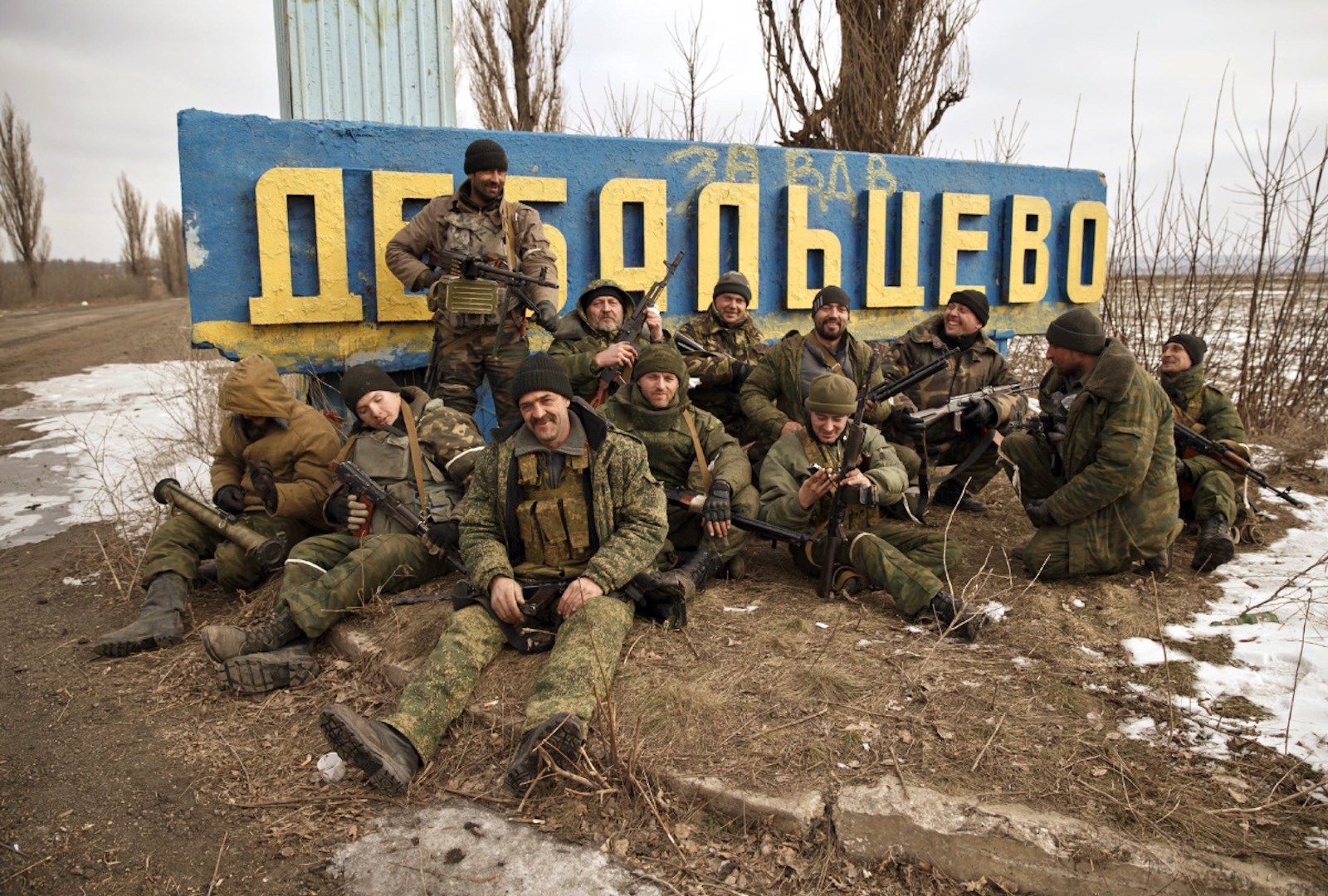
Source: http://uk.businessinsider.com/reports-pro-moscow-rebels-captures-railway-town-of-debaltseve-2015-2
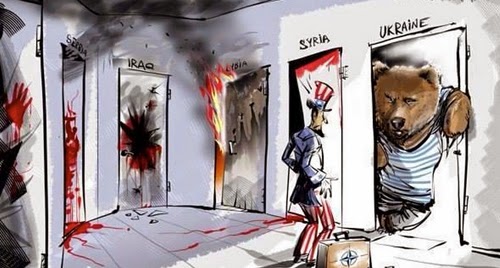
Agreeing to a compromise might be as hard for Washington as Kiev. The latter has more to lose, but U.S. policymakers have come to believe that they have been anointed to govern the entire Earth. However, while the U.S. and Europe can weaken Russia's economy and target Moscow's elite, they are not willing to risk military conflict with a nuclear-armed power, nor should they.
Ukraine's most fervent advocates assume anyone not ready to commit self-immolation on Kiev's behalf must be a Russian asset left over from Soviet times. However, Washington policymakers should put America's interests before those of other nations, in which case there's no justification for jumping into the Ukraine-Russia imbroglio.
There are at least a baker's dozen good reasons for the U.S. to avoid the fight. I recently covered the first six elsewhere: Ukraine isn't important geographically; Russia matters to America more than Ukraine does; blame is widely shared for Ukraine's travails; Washington never guaranteed Ukraine's security; Vladimir Putin is not Hitler, and Russia is not Nazi Germany (or Stalin's Soviet Union); and there's no genocide. But these are just the start. Seven more complete the baker's dozen.
1) Russia isn't Serbia, Iraq, Afghanistan, or Libya.
Americans have come to expect quick, easy, almost costless victories. The Pentagon hasn't had a tough time defeating another government since Vietnam. It is the aftermath that has been difficult, an important reason that Washington didn't try to occupy Libya. While the Obama administration has resisted proposals for military confrontation with Moscow, a gaggle of ivory tower warriors has pushed to arm Ukraine, bring Kiev into NATO, and station U.S. men and planes in Ukraine. These steps could lead to war.
However, Russia would be no pushover. The U.S., especially in alliance with Europe, should be able to defeat any nation in full-scale combat. However, Moscow has improved its conventional forces since their mixed performance in the 2008 war with Georgia. Russia has an air defense system that would preclude America's usual costless control of the skies. Worse, Moscow has a full range of nuclear weapons. It could respond to allied conventional superiority with use of tactical nukes. It's one thing to play military chicken with an impoverished third-world nation. It's quite another to challenge a nuclear-armed state.
2) Moscow has more at stake in Ukraine than the West has and will act accordingly.
America's war-happy chattering classes often assume that but one harsh word from Washington will cause other nations to beat a swift retreat. If only President Barack Obama would "exercise leadership" and "demonstrate resolve," Vladimir Putin would admit he was wrong, abandon Ukrainian separatists, disgorge Crimea, and go into exile in Siberia.
In fact, the status of Ukraine matters far more to Moscow than to Washington. America has no interests of comparable strength regarding Ukraine. Imagine if the Soviet Union had proposed bringing Mexico into the Warsaw Pact after having helped oust a democratically elected government allied with America. Washington's reaction would have been swift, strong, and exceedingly hostile.
Since Russia has far more at stake in Ukraine's orientation, the former will devote far greater resources and take far greater risks than will the allies. Ukraine is a minor economic and security issue for Europe and of marginal concern for America. That's why no allied government is prepared to take military action in Ukraine. In fact, Kiev can expect only limited financial transfers along with financial sanctions against Russia. In contrast, the Putin government has accepted financial losses, economic isolation, human casualties, and political hostility.
3) Alliances should enhance U.S. security, not provide foreign charity.
In 2008 NATO first agreed in principle to bring Ukraine into the alliance. Several European nations remain opposed, but Ukraine's most fervent advocates continue pushing to include Kiev. Last month Ukraine's Rada repealed the law barring membership, and President Petro Poroshenko advocated joining.
It's impossible to blame Kiev for wanting the West to protect it. But it makes no sense for the allies to do so. Indeed, Washington has played the sucker throughout NATO's expansion. Adding new nations did not make America more secure. Rather, the U.S. treated its premier military alliance like international charity, bringing in nations that amount to security black holes. Washington paid to upgrade small militaries with minimal capabilities while promising to protect new members from threats irrelevant to America.
Adding Ukraine (and Georgia) would be even more dangerous. Both have been at war with Russia. Both have had irresponsible political leadership. Both have an incentive to entangle the globe's superpower in their territorial disputes. Bringing them into NATO would dramatically degrade U.S. security by transforming minor conflicts irrelevant to Washington into potential military disputes between America and Russia.
4) Security guarantees and alliance commitments often spread, rather than deter, conflict.
NATO advocates presume that membership would dissuade Russia from taking military action. Alas, deterrence often fails. History is replete with examples of alliances that did not stop conflict. And when deterrence fails, alliances become transmission belts of war. The worst war in human history, World War II, began despite defense promises made to Poland by France and Great Britain in an attempt to forestall a German invasion. World War I provided an even more dramatic example of alliances expanding rather than restricting conflict. An assassination in Sarajevo, Bosnia, spread war to most of Europe as well as to parts of Asia and North America. In many cases contending parties either discount the likelihood of countries acting on their promises or believe the stakes warrant risking war. Both likely apply to Russia in Ukraine.
Source: http://www.huffingtonpost.com/doug-bandow/seven-reasons-why-us-shou_b_6763732.html?ncid=txtlnkusaolp00000592

Saakashvili to the Rescue, or not
Over the past decade Ukraine has
undergone a series of economic and political setbacks. The 2004 Orange
Revolution quickly turned into a fiasco that ushered in four years of
utter cronyism, monopoly consolidation, and geopolitical mismanagement
that was excessive even by Ukrainian standards. And now the situation
has gone from bad to worse. Kiev is fighting and losing a war in its
eastern provinces, facing bankruptcy, a negative growth economy, lacks
prudent leadership, and is at present alienating a state that
understands Ukraine’s predicament better than most.
Kiev’s appointment of former Georgian
president Mikheil Saakashvili as the head of Ukraine’s newly created
International Advisory Council on Reforms has strained
Georgian-Ukrainian ties. His task is to create proposals and
recommendations for implementing reforms in Ukraine based on leading
international practices. Since 2013 Saakashvili has been living in
self-imposed exile in the United States. He faces arrest if he returns
to Georgia.
In August of 2014, the Georgian Prosecutor-General’s Office requested an Interpol warrant for Saakashvilii’s arrest. The former president is facing several charges in his home country over his alleged abuse of power, the use of excessive force against protesters, embezzlement, and ordering politically motivated killings. Now that Saakashvili is in Ukraine, Tbilisi has asked for his extradition. Kiev has refused to comply.
Why Petro Poroshenko would name
Saakashvili as an advisor when doing so risks antagonizing the only
post-Soviet state that unconditionally supports Kiev remains a mystery.
Officially Saakashvili will be advising on economic matters, not
military, but his presence in Kiev brings more trouble than it is worth
because he risks upsetting a friendly country and further stoking
Russian fears that the West is determined to create a rabidly Russophobe
regime in Ukraine. There is a common thread that connects the new
government in Ukraine with that of Saakashvili’s 2004-2013 government:
Washington’s war-hawk community. Both the Rose Revolution and the
Euromaidan received moral and political support from American liberal
interventionists and neoconservatives. Victoria Nuland, the wife of
prominent neocon Robert Kagan and the U.S. assistant secretary of state
for European and Eurasian affairs, openly supported the Maidan
protestors in the fall of 2013. For better or worse she remains the face
White House policy in Ukraine. Likewise, Kagan was an admirer of
Saakashvili’s presidency and remains an advocate of his within
Washington policy making circles. He also served as a foreign policy
advisor to John McCain during the 2008 election. McCain is a strong
proponent of a bellicose American foreign policy and is quite fond of
Saakashvili or Misha as he adoringly calls him.
It is an open secret that the U.S. has
taken the lead among Western powers in advising and training the
Ukrainian government in how to deal with the separatist conflict in the
Donbas region as well as with economic, legal, and military reforms.
This may explain why Poroshenko decided to hire the former Georgian
president, a polarizing figure in his native country and among foreign
dignitaries. Saakashvili continues to enjoy cordial relations with
leading American think-tanks and policy-makers at the State Department.
Just as the events of the Euromaidan were supported overtly and covertly
by the West, the 2003 Rose Revolution in Georgia, which brought
Saakashvili to power, was also backed by Western capitals. Unlike a
number of Western European states that are eager to restore some
normalcy in relations with Moscow, Washington is not. The 2016 election
is right around the corner and no potential presidential candidate or
party would like to seem soft on Russia.
If this is yet another State Department recommendation, it is poorly timed and ill-conceived. This seems to be the norm when it comes to Washington’s suggestions for Kiev. Indeed, Victoria Nuland was in Tbilisi on February 17th as part of her South Caucasus tour. When asked about Georgia’s request of Ukraine to extradite Saakashvili, she replied that Ukraine and Georgia “need each other and should support one another in this ‘very important moment’ in their history”. It is true that both countries are at a crossroads and can use all the help they can garner. But appointing Saakashvili as an advisor was a very poor decision. For starters, what sage advice can a man who permanently lost two provinces of his country, yet refuses to admit his mistakes, provide? If Ukrainian officials wish to make smart choices when dealing with their Russian counterparts then the selection of the former Georgian leader – blindly anti-Russia and anti-Putin – is a poor one. More importantly, officials in Tbilisi feel slighted by the Ukrainians, a state they see as a kindred spirit of sorts. Meanwhile the Kremlin has a new example for an old argument it uses in its ongoing negotiations with Georgian diplomats: that the West does not take Georgia’s concerns seriously. Russia’s ultimate goal is to lure Tbilisi away from the West and into the Russian camp, primarily through Georgia’s inclusion into the nascent Eurasian Economic Union. This will be a medium to long term goal and may take years but that is the endgame.
One way to go about reversing Georgia’s
Western orientation is to pit the Georgian political establishment
against itself. It ought to be noted that it is Georgian Prime Minister
Irakli Garibashvili who is the one pushing for Saakashvili’s
extradition, and the investigation of other former high ranking members
of the United National Movement Party. In contrast, President Giorgi
Margvelashvili comes across as more ambivalent. He claimed that ‘it is
Ukraine’s internal matter and a sovereign right’ to appoint Saakashvili.
Whereas Garibashvili is keener on re-establishing ties with the
Kremlin, Margvelashvili leans toward shoring up existing Euro-Atlantic
relations. For well over a year the Georgian President and Prime
Minister have faced off over various issues, domestic and foreign. The
power struggle between these two men will decide in which geopolitical
direction Georgia will go. It will also determine whether Tbilisi takes
offense at Kiev’s decision or not, and if so, what repercussions will
follow. Although this one event is unlikely to rupture ties between
Ukraine and Georgia, it will unnecessarily create tensions between two
states that strive for a similar geopolitical outcome.
If Ukrainian officials want to restore
order and bring sustained growth to their country they must stop looking
toward foreigners to solve their woes and instead begin the process of
harnessing the creative energies of the Ukrainian people. Sadly, past
performances are often good indicators of future actions thus Ukraine
will continue to stumble from one misstep to another – Saakashvili’s
appointment being the most recent example.
Vilen Khlgatyan is the Vice Chairman of the Political Developments Research Center (PDRC).
Pro-Moscow rebels capture key Ukrainian town
Reports in Russian media suggest that pro-Russian rebels have taken
the railway town of Debaltseve from besieged Ukrainian government
forces. The rebels claim that most of the city is now under the control of
armed groups loyal to the breakaway Donetsk People's Republic, according to Riga-based online newspaper and news aggregator Meduza.io.
The article cites Ukrainian journalist Andrew Tsaplienko as saying that
the police department and the railway station have been taken.
Independent Russian news service Interfax is reporting that 300 Ukrainian soldiers have given themselves up to become prisoners in the town, citing a representative of the separatist militia. Debaltseve is of central strategic importance to both sides as it is a
key railway hub and sits deep in an area that is mostly controlled by
the separatists. Its loss would signal a consolidation of the gains made
by the rebels against government forces over recent months, that NATO,
the US and Europe believe was achieved with Russian assistance.
The official Twitter account of the National Security and Defense
Council of Ukraine has acknowledged that there has been heavy fighting
around the town but earlier claimed that Ukrainian forces had been able
to hold their positions. The move comes just days since a new ceasefire agreement came into effect in the country. Ukraine's President Petro Poroshenko ordered his troops to stop firing at 10pm on Saturday local time. However, there have been widespread reports that fighting continued between government forces and pro-Moscow rebels around Debaltseve.
Even as the deal was being signed, Kiev reported that 50 tanks and 40 missile systems were
spotted crossing the border into Ukraine from Russia, in what many saw
as an effort to shore up the rebel position in disputed areas before the
ceasefire came into force. Poroshenko has asked for a comprehensive ceasefire to be
respected in order for peace monitors from the Organisation for Security
and Co-operation in Europe (OSCE) to be able to enter the town. Yesterday the European Union increased the number of people and groups targeted under its sanctions regime. A number of militia groups currently participating in the fighting around Debaltseve were included.
7 Reasons the U.S. Should Stay Out of the Ukraine-Russia Fight
The ceasefire between Ukraine and Russia appears to be holding, after
Kiev's forces lost ground in a recent spate of fighting. Fortune could
yet smile upon Ukraine, but as long as Russia is determined not to let
the separatists fail, the former's efforts likely will be for naught.
Only a negotiated settlement, no matter how unsatisfying, offers the
possibility of a stable resolution of the ongoing conflict. Indeed, the
alternative may be the collapse of the Ukrainian state and long-term
confrontation between the West and Russia, at great cost to all sides.
Agreeing to a compromise might be as hard for Washington as Kiev. The latter has more to lose, but U.S. policymakers have come to believe that they have been anointed to govern the entire Earth. However, while the U.S. and Europe can weaken Russia's economy and target Moscow's elite, they are not willing to risk military conflict with a nuclear-armed power, nor should they.
Ukraine's most fervent advocates assume anyone not ready to commit self-immolation on Kiev's behalf must be a Russian asset left over from Soviet times. However, Washington policymakers should put America's interests before those of other nations, in which case there's no justification for jumping into the Ukraine-Russia imbroglio.
There are at least a baker's dozen good reasons for the U.S. to avoid the fight. I recently covered the first six elsewhere: Ukraine isn't important geographically; Russia matters to America more than Ukraine does; blame is widely shared for Ukraine's travails; Washington never guaranteed Ukraine's security; Vladimir Putin is not Hitler, and Russia is not Nazi Germany (or Stalin's Soviet Union); and there's no genocide. But these are just the start. Seven more complete the baker's dozen.
1) Russia isn't Serbia, Iraq, Afghanistan, or Libya.
Americans have come to expect quick, easy, almost costless victories. The Pentagon hasn't had a tough time defeating another government since Vietnam. It is the aftermath that has been difficult, an important reason that Washington didn't try to occupy Libya. While the Obama administration has resisted proposals for military confrontation with Moscow, a gaggle of ivory tower warriors has pushed to arm Ukraine, bring Kiev into NATO, and station U.S. men and planes in Ukraine. These steps could lead to war.
However, Russia would be no pushover. The U.S., especially in alliance with Europe, should be able to defeat any nation in full-scale combat. However, Moscow has improved its conventional forces since their mixed performance in the 2008 war with Georgia. Russia has an air defense system that would preclude America's usual costless control of the skies. Worse, Moscow has a full range of nuclear weapons. It could respond to allied conventional superiority with use of tactical nukes. It's one thing to play military chicken with an impoverished third-world nation. It's quite another to challenge a nuclear-armed state.
2) Moscow has more at stake in Ukraine than the West has and will act accordingly.
America's war-happy chattering classes often assume that but one harsh word from Washington will cause other nations to beat a swift retreat. If only President Barack Obama would "exercise leadership" and "demonstrate resolve," Vladimir Putin would admit he was wrong, abandon Ukrainian separatists, disgorge Crimea, and go into exile in Siberia.
In fact, the status of Ukraine matters far more to Moscow than to Washington. America has no interests of comparable strength regarding Ukraine. Imagine if the Soviet Union had proposed bringing Mexico into the Warsaw Pact after having helped oust a democratically elected government allied with America. Washington's reaction would have been swift, strong, and exceedingly hostile.
Since Russia has far more at stake in Ukraine's orientation, the former will devote far greater resources and take far greater risks than will the allies. Ukraine is a minor economic and security issue for Europe and of marginal concern for America. That's why no allied government is prepared to take military action in Ukraine. In fact, Kiev can expect only limited financial transfers along with financial sanctions against Russia. In contrast, the Putin government has accepted financial losses, economic isolation, human casualties, and political hostility.
3) Alliances should enhance U.S. security, not provide foreign charity.
In 2008 NATO first agreed in principle to bring Ukraine into the alliance. Several European nations remain opposed, but Ukraine's most fervent advocates continue pushing to include Kiev. Last month Ukraine's Rada repealed the law barring membership, and President Petro Poroshenko advocated joining.
It's impossible to blame Kiev for wanting the West to protect it. But it makes no sense for the allies to do so. Indeed, Washington has played the sucker throughout NATO's expansion. Adding new nations did not make America more secure. Rather, the U.S. treated its premier military alliance like international charity, bringing in nations that amount to security black holes. Washington paid to upgrade small militaries with minimal capabilities while promising to protect new members from threats irrelevant to America.
Adding Ukraine (and Georgia) would be even more dangerous. Both have been at war with Russia. Both have had irresponsible political leadership. Both have an incentive to entangle the globe's superpower in their territorial disputes. Bringing them into NATO would dramatically degrade U.S. security by transforming minor conflicts irrelevant to Washington into potential military disputes between America and Russia.
4) Security guarantees and alliance commitments often spread, rather than deter, conflict.
NATO advocates presume that membership would dissuade Russia from taking military action. Alas, deterrence often fails. History is replete with examples of alliances that did not stop conflict. And when deterrence fails, alliances become transmission belts of war. The worst war in human history, World War II, began despite defense promises made to Poland by France and Great Britain in an attempt to forestall a German invasion. World War I provided an even more dramatic example of alliances expanding rather than restricting conflict. An assassination in Sarajevo, Bosnia, spread war to most of Europe as well as to parts of Asia and North America. In many cases contending parties either discount the likelihood of countries acting on their promises or believe the stakes warrant risking war. Both likely apply to Russia in Ukraine.
5) U.S. foreign policy should be based on the interests of America, not on those of other nations.
Perhaps
the greatest distortion to U.S. foreign policy comes from ethnic
lobbying. There's nothing wrong with having affection for one's
ancestral homeland. But there's a lot wrong in designing U.S. foreign
policy to benefit another nation rather than America, such as pushing
Washington to risk war on behalf of Kiev. Doing so clearly is not in the
interests of America or Americans.
Of course, advocates of
Ukraine are not the only offenders. Lots of ethnic Americans seem to
forget who their government is supposed to represent. Descendants of
Eastern Europeans were among the most fervent advocates of NATO
expansion. For a half century the voting clout of Cuban Americans in
Florida held U.S. policy toward Havana hostage. There is no worse
political cat fight than between Greek and Turkish Americans. Ethnic
Koreans express horror at proposals to shift responsibility for South
Korea's defense to Seoul. There are several other examples. Ukrainian
Americans are only the latest to urge Washington to risk war for their
friends, family, and heritage.
Some advocates for Kiev argue that
Ukraine deserves support since France helped the American colonists win
their independence during the American Revolution. Of course it makes
sense for Kiev to ask for U.S. support, just as it made sense for the
American colonies to request aid from Paris. But a request does not
require a yes. France intervened in the American Revolution because
Paris believed it was in France's interests to weaken Britain by
splitting off one of its most important colonies. Going to war with
Moscow would offer Americans no similar benefit. Indeed, France's aid to
America pulled a weak monarchy into a much larger global conflict --
which Paris lost. That further weakened the monarchy, hastening the
French Revolution. France might have avoided that horror had it not
intervened on America's behalf!
6) It's Europe's turn to act.
If
Ukraine matters geopolitically, it is to Europe. If anyone should be
providing subsidies and weapons to Kiev, it is Europe. If anyone should
be offering military guarantees to Ukraine, it is Europe. If anyone
should be introducing forces into Ukraine, it is Europe. If anyone
should be bolstering Europe's military defenses, it is Europe.
But
Europe can't seem to be bothered. Just three European countries meet
NATO's suggested level of military spending, 2 percent of GDP. Even
Poland, demanding "reassurance" in the face of potential Russian
aggression, fell short of that anemic level last year. The Baltic states
are even worse: Among the three, only Estonia hits 2 percent.
Nor
is anyone else in Europe much interested in doing anything more, even
for NATO states. When Poland and the Baltics insisted that other members
station troops in their nations, Germany, the Cold War border state
protected for decades by American, British, and other personnel, said,
"Nein!" Other NATO members continue to shrink their militaries. Ukraine
poses a crisis, the Europeans say, but, as always, the U.S. is supposed
to do any military heavy lifting.
7) A negotiated settlement is the only solution.
Ukrainians
insist that Ukraine must be free to decide its own future. Yes, after
the Second Coming, when the lion has lain down with the lamb. After
people representing all the world's religions, ethnic groups, political
philosophies, races, and everything else have joined together to sing
"Kumbaya" around a global bonfire. After men and women again live in the
Garden of Eden.
The world is an unfair place, and many people are
stuck in bad neighborhoods. Weaker parties must make accommodations as
necessary. During the Cold War Finland maintained its domestic liberties
by not antagonizing the Soviet Union. Taiwan lives in the shadow of an
ever-more-powerful China. Qatar abandoned its independent foreign policy
under pressure from its Gulf neighbors. Small Caribbean and European
nations are bullied by America and the European Union on tax matters.
The
world is similarly unfair to Ukraine today. America and Europe will not
go to war on Kiev's behalf. Ukrainians must recognize their limitations
in deciding what to do. Military victory is unlikely. On their own, the separatists would lose
to Ukraine's central government. But Moscow will not allow Ukraine to
defeat its allies. In fact, in December President Poroshenko admitted,
"There's no military solution in Donbas," since his nation lacked the
resources to win. Even more so, Kiev will not recover Crimea --
militarily, at least.
Stalemate is no solution either. Ukraine
faces economic crisis. Government expenditures are up, revenues are
down, and foreign investment is on hold. The economy has tanked. Ukraine
needs to reform and rebuild, which will be difficult as long as the
crisis persists.
Kiev can't afford the war, which is costing $10
million a day. This year Kiev faces a $15-billion financing gap. Moody's
warned of a possible debt default. Some economists worry about
hyperinflation. The head of Ukraine's central bank spoke of a
"full-blown financial crisis." Famed currency speculator George Soros
argued that Kiev needed at least $50 billion in support. But neither
America nor Europe is going to come up with anything close to that --
they currently have offered about $4 billion total.
The allies
hope that sanctions will force Russia to concede. Before Christmas
Congress approved a new round of penalties without debate. The West's
sanctions have been painful for Moscow, especially combined with the
fall in energy prices. Still, Putin won't be retreating voluntarily. His
term runs until 2018, and no one, in or out of government, appears able
to challenge him.
Massive public discontent could spark a
popular revolution. However, foreign sanctions cause people to rally
around their governments more often than they cause people to abandon
their governments. As of December Putin's popularity remained at 85
percent, with the majority of Russians opining that their country was on
the right track. If Putin's support starts to fall as the economy
continues its downward slide, pressure on Putin to act will rise.
However, he is not likely to yield to the West, which would be
catastrophic politically. It's more likely that he would tighten
authoritarian controls at home to stifle opposition activists and strike
overseas to revive nationalist sentiments.
An extended conflict
would continue to spread economic pain well beyond Russia, especially as European economies continue to stall. Some European states already are
lobbying to lift or moderate sanctions. In early January French
President François Hollande called for dropping the penalties. In
December the Czech Republic's finance minister, Andrej Babiš,
complained, "It brings nothing, these sanctions. They will only have a
negative impact."
Perhaps even worse than sanctions that do not
force Moscow to its knees would be those that do. The prospect of Weimar
Russia should cause Ukrainians and their friends in the West to be
careful what they wish for. Europe especially has much at stake in
Russia economically. Worse, there is little reason to expect a
Russia in crisis to be democratic and docile. Greater nationalism at
home and adventurism abroad would be more likely. Western-style liberals
would not be the natural beneficiaries of an implosion at home.
With
no one prepared to yield, prospects increase for a "frozen conflict"
involving Ukraine and ethnic-Russian separatists. Worse is unending
confrontation between America/Europe and Russia. Who gains from a
Ukraine that's bankrupt and divided? Who benefits from a Europe that's
bleeding economically and a Russia that's responding sullenly? What of
the future if the U.S. and Russia are increasingly at economic,
political, and military odds? Warned Henry Kissinger, "[A] resumption of
the Cold War would be a historic tragedy."
A modus vivendi won't
be easy, but it is essential. Ukrainians could say no, but they should
do so in realization that they would be acting on their own. Their
destiny is in their hands, but they cannot expect everyone else to back a
destructive outcome.
America and Europe should initiate
discussions with Moscow, using sanctions as a negotiating tool rather
than an endless penalty. A ceasefire should be policed by international
monitors. Russia should acknowledge Ukraine's sovereignty and end
military support for the rebels. Kiev should halt military operations
and formalize further devolution of power on the Donbas. Ukraine should
declare its military neutrality, endorsed by the West. Russia should
accept Kiev's economic orientation both west and east.
Of course,
Moscow also could say no. However, such an agreement would meet Putin's
security concerns and halt Russia's economic slide. He is an
authoritarian, not a fool. And if a diplomatic resolution is impossible,
it is better to find out now than to do so only after suffering through
an extended Cold War lite.
The Ukraine-Russia conflict is an
unnecessary tragedy. But the only ending in something other than
disaster is likely to come through negotiation. That might not satisfy
any of the parties, but it likely is better than the alternative for all
of them. Thankfully the ongoing battle doesn't much threaten
America. But the U.S. still would benefit from peace between the two, as
would the Ukrainian people, in particular. Instead of acting as a
belligerent party, Washington should focus on shaping a diplomatic
solution. Doing so won't be easy, but the Obama administration should
make the attempt.
Source: http://www.huffingtonpost.com/doug-bandow/seven-reasons-why-us-shou_b_6763732.html?ncid=txtlnkusaolp00000592
Moscow protesters strike out against Ukraine and the West
For the thousands of Russians gathered near Red Square on Saturday, Maidan — the square in Kiev synonymous with pro-European protests last year — is nothing to celebrate. "Maidan is a festival of death ... Maidan is the smile of the American ambassador who, sitting in his penthouse, is happy to see how brother is killing brother ... Maidan is the concentration of everything anti-Russian ... Maidan is the embryo of Goebbels," the organizers of Russia's new Anti-Maidan movement shouted from the stage.
Demonstrators vowed that last year's protests in Kiev — centered in the Maidan square which ultimately forced Ukaine's pro-Russian president to flee on Feb. 21 — would never be repeated in Russia. "Maidan" is the Ukrainian word for "square" and in common usage refers to Maidan Nezalezhnosti (Independence Square). The protesters in Moscow were an assortment of ultranationalist bikers, pensioners, war veterans, members of student organizations and activists from other pro-Kremlin groups. Many of them waved Russian flags, others bore banners that said "Die, America!" or "U$A, Stop the War!" Police said that 35,000 people attended, though those numbers were impossible to verify independently.
In the year since Ukraine's transformation, anti-Western sentiment in Russia has spiked, largely over what many perceive as the West's hand in fomenting the protests in Kiev in order to gain a foothold of control near Russia.
"The United States is the world's
biggest terrorist. ... We believe we can rise up again if they leave us
alone, but they are always trying to teach us how to live," said
65-year-old Nina Kishkova, a retired teacher who was at the protest with
her friend. Another Maidan "will never win in Russia. I will bring the
ammunition myself."
According
to a poll conducted this month by the independent Levada Center, 81
percent of Russians feel negatively about the United States — the
highest figure since the early 1990s — and 71 percent feel negatively
about the European Union. The
number of Russians who dubbed relations between Russia and the U.S. as
that of "enemies" leapt from 4 percent in January 2014 to 42 percent.
The poll has a margin of error of about 3 percentage points.
"There has been no empire in
history that did the kind of things to its colonies that America does to
the world today," said Alexander Zaldostanov, the leader of the
pro-Kremlin Night Wolves biker gang widely known by his nickname, the
Surgeon.
The anti-Western
sentiment, sparked by the West's wholehearted backing of the protests in
Kiev, has only deepened as the U.S. and the European Union have imposed
sanctions on Russia for annexing the Ukrainian region of Crimea and for
supporting the separatists fighting in east Ukraine.
"There's
nothing new about anti-Western sentiments in Russian society, the thing
was to bring them to the fore," said Maria Lipman, an independent
analyst. "People have said for a long time that the West is there to do
harm to Russia. ... Now this sounds like a self-fulfilling prophecy
because now the West is always discussing how to punish Russia so that
it will hurt more."
Source: http://news.yahoo.com/thousands-gather-moscow-protest-fascist-coup-kiev-125253591.html
Russia, South Ossetia step toward annexation
Georgia condemned on Thursday the
signing of a border agreement between its breakaway region of South
Ossetia and Russia, accusing Moscow of moving closer to annexing a
territory it supported in a five-day conflict in 2008. Georgia, which has ambitions to join NATO, and Russia
fought that war over South Ossetia and another separatist region,
Abkhazia. After it ended, Moscow recognized both regions as independent
countries.
Moscow went further by signing a
"strategic partnership" agreement with Abkhazia last November, seven
months after annexing Ukraine's Crimea peninsula and throwing its weight
behind separatists battling in eastern Ukraine. Russia says it wants to sign a similar document to integrate its
security forces and military with South Ossetia's, and Foreign Minister
Sergei Lavrov signed a preliminary agreement with his counterpart in the
separatist region on Wednesday.
"It's yet another
action directed against the sovereignty and territorial integrity of
Georgia and an attempt to artificially redraw internationally recognized
borders," the Georgian foreign ministry said. The foreign ministry in Moscow had no immediate comment on the remarks. Abkhazia and South Ossetia survive on financial support
from Russia, and Moscow has promised not to cut aid for Abkhazia this
year. Lavrov also said on Wednesday that Russia
would "take measures to prevent the negative effect of attempts to drag
Tbilisi into NATO."
Georgia, a South Caucasus
country crossed by pipelines that carry Caspian oil and gas from
Azerbaijan to Europe, said on Thursday that Russia was a threat to
stability in the region and had no influence on the process of Georgia's
integration into NATO. Tbilisi's government has long hoped to join the military
alliance, and NATO has agreed in principle that it should one day become
a member and plans to open a training center in Georgia by the end of
the year. Analysts say the integration process has been delayed by member countries' reluctance to further provoke Russia.
John McCain: ‘I’m Ashamed Of My Country, I’m Ashamed Of My President, I’m Ashamed Of Myself’
Arizona U.S. Sen. John McCain
said something on CBS’s “Face the Nation” Sunday about the U.S.’s
handling of the ongoing standoff between Russia and Ukraine that
surprised host Bob Schieffer. “I’m ashamed of my country, I’m
ashamed of my president and I’m ashamed of myself that I haven’t done
more to help these people,” McCain said. “It is really, really
heartbreaking.”
McCain was expressing his
frustration with how the U.S. and major European powers like France and
Germany have failed to stop Russian president Vladimir Putin’s advance
on Ukraine. “I believe that German chancellor and president of France legitimized
for the first time in 70 years the dismemberment of a country in
Europe. It’s shameful. Vladimir Putin has not paid any price,” McCain
said.
McCain supports providing weapons
to Ukraine to help fight against the Russians and pro-Russian
separatists. The Ukranians “are not asking for American boots on the
ground, but merely weapons to defend themselves against the Russian
onslaught,” McCain said. “Vladimir Putin wants Ukraine not
to be part of Europe, and he is succeeding in doing so,” McCain
continued, adding “this is really a dark chapter in the history of our
alliance.”
Schieffer circled back to
McCain’s comments about being ashamed because of the U.S.’s failure to
intervene, expressing just how surprised he was to hear the Republican
say that. “I’ll say this, senator, I’ve
known you for a long, long time, interviewed you many, many times, and
I’ve never heard you say I’m ashamed of my country, which you just
said,” said Shieffer. “And I’m ashamed of myself,” McCain responded.
Source: http://news.yahoo.com/john-mccain-m-ashamed-country-m-ashamed-president-175342180.html
Putin’s Power Projection: It’s All About Energy and the Black Sea
What is Russian President Vladimir Putin’s grand strategy? It may get lost in the headlines about the murder of an opposition leader just outside the Kremlin walls and the grinding horrors of the Ukraine war, but from the shores of the Black Sea here in Georgia the outlines are painfully obvious. While the world’s attention has focused on eastern Ukraine over the last year, the Kremlin has been maneuvering to take something far more valuable than the war-torn sliver of outdated industrial territory known as Donbass around Luhansk and Donetsk.
There
is a reason Putin has not agreed to annex parts of eastern Ukraine. It
has nothing to do with sanctions, oil or respect for any country’s
territorial sovereignty. Russia simply does not want to take on the
long-term economic burden
of the Donbass region and its people. Tearing up a country by sending
in troops and weapons is far less expensive than putting one (and its
broken economy) back together. Eastern Ukraine was not financially
solvent (without cheap Russian fuel) to begin with. Annexation of this
region, as many analysts have written, never was Putin’s intention. And
he could care less about the actual welfare those Ukrainian “Russians”
who believe they are fighting in his name.
So the war in Ukraine
will end exactly where it began: Crimea. Control of the Crimean
Peninsula probably was the strategic goal of the Kremlin even before its
tool, President Viktor Yanukovych, fled his ridiculous mansion. The war
in the East has provided a convenient theater for Russia at relatively
little cost. Yet convincing the world that Russia is a “mighty”
international bogeyman—inspiring extremist right- and left-wing
movements in neighborhoods near you—has only been a perk for Putin.
Control
of Crimea wasn’t actually the end goal of the larger strategy. The
objective all along has been control of the Black Sea region and the
ability to monopolize energy supplies sent to Europe via that corridor.
It seems so simple now. Unfortunately we’re not talking in
hypotheticals: the missiles already are in place and the oil pumps are
primed.
Russia’s recent economic maneuvers in the Black Sea region have been largely overlooked. Last month my colleagues at Georgian Journal, where I have been acting as a managing editor, ran a revealing article headlined “Rosneft Deal Jeopardizes Georgia’s Strategic Energy Transit Corridor”.
In a baffling move, the Georgian government allowed 49 percent of its
locally owned oil terminal in Poti—one of the few in the entire
country—to be sold directly to Rosneft, Russia’s largest state-owned oil
company. While owner David Iakobashvili, a murky figure who reportedly
made a ton of cash off the deal, gloated at the World Economic Forum in
Davos, boasting about the investment the deal would bring to Georgia,
the rest of Tbilisi’s normally intractable and politically combustible
political culture remained oddly silent.
As financial analyst Thomas Kapp put it in the journal article,
“Monopolies do not stop at 49 percent. In exchange for a small amount of
Russian investment, the Georgian government is allowing Russia to avoid
Western sanctions by bringing fuel directly through Georgia in a move
that will permanently result in Georgia’s national strategic detriment.
Meanwhile, the Georgian government is talking about land plots for NATO
training centers and making copious political claims about Western
integration. The problem here is that actions speak louder than words.
The irony is that those sanctions Georgia is now helping Russia
circumvent were intended to protect countries like Ukraine and Georgia
from Russian occupation and aggression. What’s even more unfortunate is
that those ‘strategic partners’ of Georgia, like Germany and the Baltic
states for instance, are paying a very heavy financial and political
price to push those sanctions through.”
The Rosneft deal isn’t just about Georgia, says Kapp: “The oil
behemoth has its eye on the entire trans-Caucasus region. Armenia,
specifically, depends heavily on imports through Georgia’s Poti
terminal, which is owned by Petrocas. Georgia is uniquely positioned to
be a significant and influential energy corridor, not just a consumer.” The acquisition is extremely alarming and the Georgian government, supposedly a staunch US ally, at best seems to be capitulating.
This
deal brings the fighting in Eastern Ukraine full circle and explains
how an eventual land bridge to Crimea is Putin’s long-term goal. He will
slowly and methodically make his way there in between the ceasefires.
Putin has the entire Black Sea to gain. This is why the Kremlin is
seeking not just economic dominance of the Black Sea corridor and energy
transit routes but also military dominance as well.
Last week
NATO Commander and Air Force Gen. Philip Breedlove raised further
concerns about the “transformation” of the Crimean peninsula and the
anti-air and anti-surface missile systems being deployed to the
peninsula. According to Breedlove, “These weapon systems — from air
defense systems that reach nearly half of the Black Sea to surface
attack systems that reach almost all of the Black Sea area — have made
the platform of Crimea a great platform for power projection into this
area.” According to USNI News, Iskander mobile ballistic missile systems (NATO code name: SS-26 Stone) have been moved into Crimea. “The missiles are capable of being redirected in flight and could strike a moving ship.”
In
essence the balance of power in the Black Sea has been tipping since
the “little green men” first moved into the Crimean Peninsula.
“Additionally,” says USNI News, “Russian signals intelligence ships have
reportedly shadowed U.S. and NATO ships in the Black Sea and could
reasonably provide highly accurate targeting information to land based
missile systems.” Any country on the Black Sea is now a target along
with any vessel deployed there. Putin has kept his eyes on the prize, the Black Sea. What the rest of the world is doing, alas, is anybody’s guess.
Source: http://www.thedailybeast.com/articles/2015/03/01/putin-s-power-projection-it-s-all-about-energy-and-the-black-sea.html?
Russia Prepares Nuclear Surprise for NATO
On September 1, 2014 the US State Department published a report, in
which it was stated that for first time since the collapse of the USSR,
Russia reached parity with the US in the field of strategic nuclear
weapons. Thus, Washington admitted that Moscow regained the status that
the Soviet Union had obtained by mid-70's of the XX century and then
lost.
According to the report from the State Department, Russia has 528 carriers of strategic nuclear weapons that carry 1,643 warheads. The United States has 794 vehicles and 1,652 nuclear warheads.
It just so happens that today, Russia's strategic nuclear forces (SNF) are even more advanced in comparison with those of the US, as they ensure parity on warheads with a significantly smaller number of carriers of strategic nuclear weapons. This gap between Russia and the United States may only grow in the future, given the fact that Russian defense officials promised to rearm Russia's SNF with new generation missiles.
The progress was made possible thanks to the treaty on the limitation of nuclear weapons, also known as START-3. The treaty was signed by Dmitry Medvedev and Barack Obama on 8 April 2010 in Prague (came into force on 5 February 2011). In accordance with the document, nuclear warheads of the parties are to be reduced to 1,550 by 2021. The number of carriers (intercontinental ballistic missiles, submarine-launched ballistic missiles and heavy bombers) is supposed to be cut to 700 units.
It was the first strategic agreement, after the treacherous policy of democrats, in which Russia managed to win significant advantages. In the treaty, the Americans, for the first time in history, undertook to reduce their strategic nuclear potential, while Russia won an opportunity to increase it. Furthermore, the new treaty removed important limitations that existed in the previous START 1 and START 2 treaties. It goes about the size of areas for the deployment of mobile ICBMs, the number of multi charge ICBMs, and the possibility to build railway-based ICBMs. Russia did not make any concessions.
Having written off Moscow as a serious geopolitical rival, flying on the wings of inaccessible military and technological superiority, Washington drove itself into a trap, from which it does not see a way out even in a medium-term perspective.
Recently, a lot has been said about so-called "sixth-generation wars" and high-precision long-range weapons that should ensure victory over enemy without coming into direct contact with its armed forces. This concept is highly questionable (The US failed to achieve victory in such a way both in Iraq and Afghanistan). Yet, this is the point, where Russia enters the parity line as well. The proof is long-range cruise missiles of a new generation that will soon be deployed on submarines of the Black Sea Fleet and missile ships of the Caspian Flotilla.
In today's Russia, many find this hard to believe. This is a common belief for many of those, who still enthusiastically remain in captivity of the myths about the absolute "weakness" of Russia and the absolute "superiority" of the West. The myth was made up in the 90's under the influence of Boris Yeltsin and his betrayal of Russian national interests. One has to admit that during that time, the myth was real, if one may say so.
Times have changed. One can easily understand the new state of affairs. For example, let's consider the potential of conventional weapons of Russia and the West in the European Theater of Operations (ETO). In this area, it is generally believed that NATO is a lot stronger than Russia. Yet, a first encounter with reality smashes this misbelief into pieces. As is known, the main striking force, the core of combat power of the ground forces is tanks. By the time of the collapse of the Soviet Union, the Russian Armed Forces had about 20,000 tanks in the ETO.
The Americans, in turn, deployed 6,000 heavy Abrams tanks on the territory of the allied group. Despite this, the combined potential of NATO forces in Europe was still significantly inferior to the Soviet potential. To compensate this imbalance, NATO strategists were forced to resort to tactical nuclear weapons (TNW).
In the first half of the 1950s, NATO conducted a research about what kind of forces the bloc should have to show reliable resistance to large-scale ground offensive of superior forces of the Soviet Union and Warsaw Pact countries. The calculations showed then that one required at least 96 full-fledged divisions for the purpose. Yet, the cost of armament for one of such divisions exceeded $1 billion. Plus, one required two or three more billion to maintain such a large group of troops and build appropriate infrastructure. This burden was clearly beyond the power of the economy of the West.
The solution was found in a move to deploy a group of US tactical nuclear weapons on the continent, and that was done soon. By early 1970s, the US arsenal of tactical nuclear weapons counted about 7,000 units of ammunition. The highest achievement in the area was the creation of weapons of selective action - neutron warheads (for guns of 203-mm and 155-mm caliber, and for Lance missiles) with a capacity from 1 to 10 kilotons. The warheads were seen as the key in combating land forces personnel, particularly Soviet tank crews.
Given the nuclear factor, to reflect "Soviet aggression," NATO required to deploy only 30, rather than 96 divisions, and so they were deployed.
How do things work in this area now? In early 2013, the Americans withdrew the last group of heavy Abrams tanks from Europe. In NATO countries, over the last 20 years, one new tank would replace 10-15 old, yet still capable, tanks. At the same time, Russia was not decommissioning its tanks. As a result, today Russia is the absolute leader in this regard. In mid-2014, the balance of the Defense Ministry had as many as 18,177 tanks (T-90 - 400 pcs., T-72B - 7,144 pcs., T-80 - 4,744 pcs, T-64 - 4,000 pcs, T-62 - 689 pcs, and T-55 - 1200 pcs.).
Of course, only a few thousand tanks are deployed in permanent readiness units, and most of them remain at storage bases. Yet, NATO has the same picture. Therefore, the decisive superiority of Russian tanks has not gone anywhere since the times of the USSR. Here is another surprise. As for tactical nuclear weapons, the superiority of modern-day Russia over NATO is even stronger. The Americans are well aware of this. They were convinced before that Russia would never rise again. Now it's too late.
To date, NATO countries have only 260 tactical nuclear weapons in the ETO. The United States has 200 bombs with a total capacity of 18 megatons. They are located on six air bases in Germany, Italy, Belgium, the Netherlands and Turkey. France has 60 more atomic bombs. That is pretty much it. Russia, according to conservative estimates, has 5,000 pieces of different classes of TNW - from Iskander warheads to torpedo, aerial and artillery warheads! The US has 300 tactical B-61 bombs on its own territory, but this does not change the situation against the backdrop of such imbalance. The US is unable to improve it either, as it has destroyed the "Cold War legacy" - tactical nuclear missiles, land-based missiles and nuclear warheads of sea-based Tomahawk cruise missiles.
Russia ready to repel any nuke strike, retaliate – missile forces command chief
Russia’s Strategic Missile Forces are ready to react to any nuclear
strike even if it is lightning fast, SMF Central Command chief said. A
retaliatory strike would take place in all circumstances, “without
hesitation,” he added. “If there’s a challenge to repel a lightning-fast nuclear in
any given conditions – it will be done in fixed time, that’s dead
true,” the Strategic Missile Forces Central Command’s chief,
Major-General Andrey Burbin, told Russian News Service on
Saturday.
Russia’s strategic missile forces are positioned geographically
in such a way that no global strike can knock them out
completely, Burbin said. In case an order is given to carry out a nuclear strike, Russian
nuclear weapons operators will fulfill it, he added.“There would be no hesitation, the task would be
executed,” he said.
The unavoidability of a retaliatory nuclear strike from Russia is
also guaranteed by the fully automatic and constantly modernized
‘Perimeter’ system, also known as “Dead hand.”The system collects data from various sources, such as
radioactivity and seismic sensors scattered throughout Russia, by
scanning radio frequencies and communication activities.
If pooled data indicates that Russia has suffered a nuclear
strike, the system launches special missiles that travel through
national airspace, sending launch signals to all surviving
strategic nuclear missile complexes. In this case a retaliatory
missile strike is launched without human input. Burbin also told RSN that rearmament of the Strategic Missile
Forces is ongoing as planned and by 2020 up to 98 percent of
Russia’s nuclear deterrent forces will be armed with brand new
weapons.
Nationwide war games of Strategic Nuclear Missile Forces were
conducted in February, with 30 missile regiments training in 12
regions of Russia. Missilemen performed ultimate combat operational readiness,
counteraction to subversive groups and perfected defenses against
airborne precision weapons. On any given day, over 6,000 servicemen are maintaining the
operational readiness of the Russian Strategic Missile Forces.
Source: http://rt.com/news/236573-russia-repel-nuclear-strike/
Russia Launches Massive Military Drills in South
The Russian Defense Ministry has launched large-scale military
exercises, involving over 2,000 troops and some 500 items of weaponry in
southern Russia, including in the Caucasus.
The field-type exercises of the air defense forces will be taking place until April 10 in twelve military firing ranges, located in Russia's South, the North Caucasus and Crimean Federal Districts, as well as at Russian military bases in Abkhazia, South Ossetia and Armenia. “Over 2,000 troops have been involved into the battle drills, and over 500 items of weaponry and military hardware are being used,” Interfax quoted a statement of the Southern Military District.
The training day will last for 10 hours, and half of the drills will take place at night. During
the month-long drills, Russian troops will be practicing tactical,
special and technical skills, alongside driving modern military
equipment, shooting and fire control. The drills involve self-propelled howitzers “Gvozdika”, multiple
artillery rocket systems “Grad”, mortars “Podnos”, anti-tank missile
systems “Konkurs”, and modern intelligence drones “Navodchik-2”.
“At
the end of the field drills, tactical maneuvers are planned,” the
statement said. “Combat units will repeal strikes from the aggressor’s
tactical aircraft, drones and precision weapon projectiles.” “They will
also carry out operational reconnaissance of the air
situation in conditions of the electromagnetic warfare”, it added.
Russia preparing 'final assault' to take back Georgia
As the focus of world attention remains
on ISIS, Russia’s aggression toward Ukraine and other countries that
once comprised the Soviet Union are receiving little notice,
particularly Moscow’s designs for Georgia, which will have ramifications
for the entire Caucasus region. “Russia might be preparing for a final assault on Georgia which
certainly may include overt military pressure,” said Vasil Rukhadze of
the Washington, D.C.-based think-tank Jamestown Foundation.
One of the reasons Russian President Vladimir Putin is looking critically at Georgia is that it has sought to join the North Atlantic Treaty Organization, or NATO, and continues to seek membership despite Kremlin warnings. Putin’s moves into Ukraine and now the threats toward Georgia are to maintain a buffer between the NATO countries and the Russian Federation. Putin has been critical of NATO’s “eastward expansion,” such as in the Baltic countries of Lithuania, Latvia and Estonia, where a significant number of ethnic Russians reside.
There also are mounting concerns that Moscow has targeted Estonia, because of its weak economy and political uncertainty, to force the country, along with the entire Baltic to leave NATO and rejoin its Eurasian Union. For now, however, the immediate concern after Ukraine is Georgia, with Russian troops occupying the two Georgian breakaway provinces of Abkhazia and South Ossetia.
“Russia’s recent activities in Georgia strongly suggest where the Kremlin may wish to move forward next, should Russia prevail in the Ukrainian war and succeed in dismembering this country or ensuring Kiev’s forced subjugation back into the Russian ‘sphere of privileged interest,” he said. The Russians are all but prepared to annex Abkhazia, now that Russian President Vladimir Putin has ratified the so-called “Alliance and Strategic Partnership Treaty” with that region.
Russian troops occupied Abkhazia and South Ossetia after the 2008 Russian invasion of Georgia, which lasted five days. Russian troops have never left. At the same time, Moscow is working, in effect, to annex South Ossetia, much as it did Ukraine’s Crimean Peninsula last year, with an Abkhazia-type Alliance and Strategic Partnership Treaty. Some regional observers say Russia’s 2008 advance into Georgia and takeover of its two breakaway provinces was just a warm-up to annex the Crimean Peninsula.
Now, the rest of Ukraine, especially in the East, is looking at the specter of Russia being called in to protect ethnic Russians there, much as it did in Crimea. Russia’s treaty with Abkhazia and South Ossetia, both of which the international community still regard as part of Georgia, underscores the priority it holds in regaining its hold on Georgia and the overarching importance the Caucasus holds for Moscow. “Needless to say, Russia does not intend to give up anything in Georgia and the Caucasus,” Rukhadze said. “Quite to the contrary, the Kremlin is actually consolidating, and rather successfully so, its position in the region.”
He said that after Ukraine, Georgia is perhaps the former Soviet republic that has been “vigorously” resisting membership in the Russian Eurasian Economic Union, which is supposed to be the economic counterpart to the West’s European Union. In Rukhadze’s view, the Eurasian Economic Union is nothing more than a cover for Putin to resurrect the Soviet Union. “So, by subduing Georgia, Putin will be able (to) obtain the last highly important piece to complete his Eurasian integrationist project,” Rukhadze said.
But Putin has other strategic designs for the region, which would give him access to one of the major oil and natural gas pipelines outside Ukraine to provide energy to Europe. It also would give Russia a long-sought direct land link to Armenia, which Rukhadze describes as a “key satellite” in the South Caucasus region. The landline would permit Moscow to resupply its only military base outside the Russian Federation, a request it has made to the Georgian government that consistently has been rejected. With such a land-link directly from the Russian Federation into Armenia, Moscow would geographically isolate Azerbaijan from the West, which then would prompt that country’s “inevitable return to the Russian orbit,” Rukhadze said. Neither Georgia nor the West seem to be prepared to respond to the prospect of a Russian takeover in Georgia, establishing a landline into Armenia and moving Azerbaijan back under Moscow’s influence.
“As a result, once Russia strikes, [the West is] likely to be caught by surprise, as was the case when Russia annexed Crimea and launched the war in eastern Ukraine,” Rukhadze said. “Hence, Russia’s every step in Georgia and in the entire Caucasus region will need to be carefully analyzed and counterbalanced,” he said. “Failure to do so, as recent history has already shown, may yield far-reaching, devastating results.”
One of the reasons Russian President Vladimir Putin is looking critically at Georgia is that it has sought to join the North Atlantic Treaty Organization, or NATO, and continues to seek membership despite Kremlin warnings. Putin’s moves into Ukraine and now the threats toward Georgia are to maintain a buffer between the NATO countries and the Russian Federation. Putin has been critical of NATO’s “eastward expansion,” such as in the Baltic countries of Lithuania, Latvia and Estonia, where a significant number of ethnic Russians reside.
There also are mounting concerns that Moscow has targeted Estonia, because of its weak economy and political uncertainty, to force the country, along with the entire Baltic to leave NATO and rejoin its Eurasian Union. For now, however, the immediate concern after Ukraine is Georgia, with Russian troops occupying the two Georgian breakaway provinces of Abkhazia and South Ossetia.
“Russia’s recent activities in Georgia strongly suggest where the Kremlin may wish to move forward next, should Russia prevail in the Ukrainian war and succeed in dismembering this country or ensuring Kiev’s forced subjugation back into the Russian ‘sphere of privileged interest,” he said. The Russians are all but prepared to annex Abkhazia, now that Russian President Vladimir Putin has ratified the so-called “Alliance and Strategic Partnership Treaty” with that region.
Russian troops occupied Abkhazia and South Ossetia after the 2008 Russian invasion of Georgia, which lasted five days. Russian troops have never left. At the same time, Moscow is working, in effect, to annex South Ossetia, much as it did Ukraine’s Crimean Peninsula last year, with an Abkhazia-type Alliance and Strategic Partnership Treaty. Some regional observers say Russia’s 2008 advance into Georgia and takeover of its two breakaway provinces was just a warm-up to annex the Crimean Peninsula.
Now, the rest of Ukraine, especially in the East, is looking at the specter of Russia being called in to protect ethnic Russians there, much as it did in Crimea. Russia’s treaty with Abkhazia and South Ossetia, both of which the international community still regard as part of Georgia, underscores the priority it holds in regaining its hold on Georgia and the overarching importance the Caucasus holds for Moscow. “Needless to say, Russia does not intend to give up anything in Georgia and the Caucasus,” Rukhadze said. “Quite to the contrary, the Kremlin is actually consolidating, and rather successfully so, its position in the region.”
He said that after Ukraine, Georgia is perhaps the former Soviet republic that has been “vigorously” resisting membership in the Russian Eurasian Economic Union, which is supposed to be the economic counterpart to the West’s European Union. In Rukhadze’s view, the Eurasian Economic Union is nothing more than a cover for Putin to resurrect the Soviet Union. “So, by subduing Georgia, Putin will be able (to) obtain the last highly important piece to complete his Eurasian integrationist project,” Rukhadze said.
But Putin has other strategic designs for the region, which would give him access to one of the major oil and natural gas pipelines outside Ukraine to provide energy to Europe. It also would give Russia a long-sought direct land link to Armenia, which Rukhadze describes as a “key satellite” in the South Caucasus region. The landline would permit Moscow to resupply its only military base outside the Russian Federation, a request it has made to the Georgian government that consistently has been rejected. With such a land-link directly from the Russian Federation into Armenia, Moscow would geographically isolate Azerbaijan from the West, which then would prompt that country’s “inevitable return to the Russian orbit,” Rukhadze said. Neither Georgia nor the West seem to be prepared to respond to the prospect of a Russian takeover in Georgia, establishing a landline into Armenia and moving Azerbaijan back under Moscow’s influence.
“As a result, once Russia strikes, [the West is] likely to be caught by surprise, as was the case when Russia annexed Crimea and launched the war in eastern Ukraine,” Rukhadze said. “Hence, Russia’s every step in Georgia and in the entire Caucasus region will need to be carefully analyzed and counterbalanced,” he said. “Failure to do so, as recent history has already shown, may yield far-reaching, devastating results.”
Source:http://www.wnd.com/2015/03/russia-preparing-final-assault-to-take-back-georgia/
UK Vulnerable to Russian Attack
UK Vulnerable
Russia
has naturally stated that the flight was simply a planned
patrol, and that it has not violated any aspect of international law.
The British prime minister, however, was moved to comment that Russia
was “trying to make some sort of point,” but other military personnel
have suggested that the threat to the UK mainland is much more serious.
Graydon stated in an interview with the British tabloid the Daily
Mail that he doubted whether it would be possible for the UK to sustain a
“shooting war” against Russia. He stated that the capabilities of the
United Kingdom is roughly half what it was previously, and that Russia
was probably engaging in these reconnaissance missions in order to
monitor the defenses in Britain.
The former member of the RAF hierarchy went on to suggest that the
mission Russia had engaged in probably revealed to them that the UK is
by no means as sharp in this area as it once was. Graydon stated that it
would be clear to the Russians that they knew they were engaged in a
provocative act, and that it could be a timely one from a Russian
perspective considering that Western air defense is relatively minimal
compared to its past might. Other RAF personnel suggested that the situation is even more grim.
But are these fears actually based in reality, or is it completely
ludicrous alarmism?
BRIC World Order
To understand the situation with Russia, it is first important to familiarise one’s self with the BRIC nations. On 16th June, 2009, in Yekaterinburg, Russia the leaders of Brazil,
Russia, India and China met for a conference that is now referred to as
the BRIC summit. The acronym BRIC was first used in a Goldman Sachs
Group Inc (NYSE:GS)
thesis projecting that the economic potential of these nations is such
that they will be ranked as four of the five most dominant economies in
the world by the year 2050. More on that later. The first BRIC summit –
as with more secretive conferences such as Bilderberg – set the agenda
for the group, so it is enlightening to look at what was discussed.
Reuters described the conference as “seek[ing] global clout” and
“discuss[ing] reform of the world financial system”.
A joint statement released in advance of the conference stated that
“we, the leaders of the Federative Republic of Brazil, the Russian
Federation, the Republic of India and the People’s Republic of China,
have discussed the current situation in the global economy and other
pressing issues of global development, and also prospects for further
strengthening collaboration within the BRIC, at our meeting in
Yekaterinburg on June 16, 2009”.
Since
then there have been several BRIC meetings, and these are clearly
intended to strengthen the influence of China and Russia in the world,
and with regard to existing financial institutions, from which they feel
excluded. Additionally, it is often proposed that the BRIC nations will
attempt to set up their own financial institutions and central bank,
and in accordance with this will ramp up the pressure on the United
States and British economies and financial-led infrastructure in the
coming years. This has ensured that the United States and Britain,
traditional allies and trading partners, have become natural opponents
to Russia and China in what is effectively a trading and financial war.
It has been asserted that the tumbling price of oil in recent months has
been a calculated attack by financial interests rooted in the United
States to weaken the position of Russia, which is hugely reliant on oil
and gas reserves.
Russian Retaliation
Considering that Russia has just had effectively 60 percent of its
mineral wealth wiped out, at least in market terms, it is perhaps
natural that the Eastern European nation is feeling a little twitchy.
What complicates the situation is that European nations in particular
have been, and still are, very reliant on a Russian oil and gas exports
(although that UK imports most of its oil from Norway). So such reconnaissance missions as the one which David Cameron
responded to could effectively be viewed as a show of strength by Russia
in the context of an aggressive economic situation. But do British
people actually have anything to worry about in terms of the physical
threat from Russia, or will this war be played out in financial markets
and other economic theaters?
Follow the Money
Of course, economics and warfare are inextricably linked, and one
should never underestimate the influence of the former on the latter.
But although what the former RAF personnel are stating about Britain’s
air defenses may very well be accurate, one has to understand that
Britain is the major ally of the united states, and any such attack on
the mainland of Britain is pretty much unthinkable. One has to bear in mind that even during the height of the Cold War,
which necessitated a huge amount of tension by its very nature, along
with massive distrust and rhetorical conflict, the Soviet Union still do
not come close to attacking the mainland of the United States. It must
be said in mitigation that the Cuban Missile Crisis nearly led to the
utterly disastrous prospect of a full-scale nuclear war, but no matter
how hawkish the Soviet Union became there was no prospect of it ever
attacking the mainland of the United States or one of its major allies,
as it knew that it would be completely obliterated.
While many people, including your humble author, bemoan the existence
of nuclear weapons, it can be argued that they have contributed to the
relatively uneasy peace between Russia and the United States. Both have
acted aggressively at times, but the potential consequences of a
full-scale conflict have arguably played a part in dissuading such an
unattractive proposition. The United States will never attack Russia
because it has 8,000 nuclear weapons.
By the same token, Russia will not dabble with a serious ally of the
United States for exactly the same reason. Military men such as Graydon
have a tendency to see things in rather
blinkered terms, and much though this former RAF head is painting a
negative picture of the situation, where Russia to actually carry out
what he is suggesting then the consequences would be considerably more
serious than he implies or seems to understand.
Patriotism, adventure lure Russian volunteers to Ukraine conflict
Filled with patriotic bravado
and a thirst for adventure, Yevgeny Pavlenko and his friend Yevgeny
Markin volunteered with dozens others to leave their home in Russia to
go and fight in eastern Ukraine. But only one
of the two would survive. Markin, 25, accompanied Pavlenko's remains
back to the city of Saint-Petersburg for burial after he was killed in
bitter fighting alongside pro-Russian separatists who seized the
Ukrainian town of Debaltseve in late February.
Pavlenko, 35, was one of four volunteers to be buried in the past two weeks from the northwestern city, where organisations helping Russians of all ages with everything from military training to making the journey to the battleground, have sprung up in recent months. "Yevgeny could not have acted otherwise when Russians are being killed in Donbass," the eastern region of Ukraine, Markin told AFP, his eyes glistening with tears as he spoke of the former professor of literature and member of the banned National Bolshevik Party - which combines radical nationalism with communist ideals.
"When my mother heard I was leaving she
burst into tears. But when I explained why I was going my parents gave
me their blessing." It is not
known how many Russian volunteers are fighting alongside the rebels and
what the US says are "thousands" of Russian troops heavily armed by
Moscow in the east of ex-Soviet Ukraine, where more than 6,000 are
believed by the UN to have died in less than a year of conflict. "Those who join the
rebels in Lugansk and Donetsk are those who understand that this is
their war, our common war against the enemies of Russia, against the
expansionism of the West," said Denis Gariyev, 36, who helps those in
Saint Petersburg who wish to go to Ukraine.
The historian and
member of the nationalist, monarchist Imperial Legion, said he has
himself been several times to the conflict zone, and his organisation
had helped some 140 volunteers to join the pro-Russian rebels. The
Imperial Legion website offers volunteers training to ready themselves
for life as a combatant, such as an initiation into shooting. The
organisation's headquarters are in the basement of a building in a
working-class suburb of the former capital of imperial Russia.
A doormat bearing the face of American President Barack Obama
lies at the entrance of the premises, which includes a gym and a
classroom where Russian history books and icons are on display. What
appears to be assault rifles lie on a table, but closer inspection
reveals they are merely paintball guns used in strategic military games.
Photographs of those who have been killed in the conflict hang on the
wall.
'Romance' of war
Gariyev, nicknamed "The Instructor", told AFP that 20 percent of those who sign up have no military training. "For
two weeks we try and teach them basic techniques," he said, before he
himself accompanies the fighters to Rostov-on-Don in southern Russia
where representatives of rebel units take them in hand. "Motivation
is essential for volunteers who leave. We only help Orthodox believers
who know they are fighting for great Russia," said Gariyev.
However not all the volunteers are as ideological. Vitaly,
19, who attended the funeral of his comrade-in-arms Pavlenko, spent
seven months fighting in eastern Ukraine. To him, those who fight for
political reasons are merely "romantics." "Quite
simply, war is a man's business," he said, adding that to him the main
draw was the friendship and camaraderie found on the battlefield. "And
the adrenalin isn't bad either," he grins, flicking through videos on
his telephone where, alongside images of his girlfriend and his dog, are
those of fighting at the Donetsk airport. "Look, that's me shooting! Not bad, hey?"
Source: http://news.yahoo.com/patriotism-adventure-lure-russian-volunteers-ukraine-conflict-095632074.html

Source: http://news.yahoo.com/russia-accuses-us-bringing-chaos-middle-east-185006081.html
Russia accuses US of bringing 'chaos' to Middle East
Russian Foreign Minister Sergei
Lavrov accused the United States on Monday of plunging the Middle East
into chaos and fueling the rise of extremists because of its drive to
dominate the world. Lavrov leveled the fierce criticism of Washington's
policies at a special UN Security Council debate on maintaining
international peace and security. The foreign minister cited the
US-led air strikes in Syria, the 2003 invasion of Iraq and the 2011
military intervention in Libya as examples of "violations of the
fundamental principles of the United Nations."
"All of this is
the result of attempts to dominate global affairs, to rule over all,
everywhere, to use military force unilaterally to push one's interests,"
Lavrov told the 15-member council. "These have plunged the Middle
East and North Africa into instability and chaos, and to a large extent
have created a breeding ground in which extremists thrive," he said.
Russia
and the United States have been at loggerheads over the war in Syria,
with Moscow supporting President Bashar al-Assad and opposing US air
strikes against Islamic State targets. Lavrov did not mention the United
States by name, but his remarks made clear he was targeting the US
administration. The
foreign minister spoke of "unsavory methods" being used such as "regime
change" and "open support for the unconstitutional state coup in
Ukraine a year ago."
Russia has repeatedly accused the United
States and its western allies of having engineered the ouster of
pro-Kremlin Ukrainian leader Viktor Yanukovych, which triggered the
separatist upheaval in Crimea and east Ukraine.
Lavrov said the
Security Council was either used as a body to "rubber stamp" decisions
made in Washington or was sidelined altogether from its primary role of
maintaining peace and security. "Do we really want to see the
Security Council as an effective instrument for peace and security or
are we ready to turn it into an area for propagandistic confrontation,"
he asked. The foreign minister
spoke to the council as Ukraine accused pro-Russia rebels of massing
forces near the port city of Mariupol despite a ceasefire agreement
reached between Ukraine, Russia, France and Germany.
Source: http://news.yahoo.com/russia-accuses-us-bringing-chaos-middle-east-185006081.html
UK, French, German Citizens Wish to See EU Policy More Independent From US
Forty-six percent of European Union citizens argue that the 28-member bloc should act more independently from the United States, while only 28 percent think that Brussels is independent enough in its actions, a poll conducted by ICM Research exclusively for the Sputnik news agency revealed. The ICM Research questioned over 3,000 people in Germany, the United Kingdom, and France. Telephone interviews with adults in the three countries were conducted in December 2014.
According to the poll, the vast majority of German citizens, 62 percent, think that Brussels should become more independent from Washington, while only 15 percent of Germans believe that the European Union has already been acting independently enough from the United States. Opinions shared on the same topic in France and the United Kingdom were similar, where 38 and 39 percent of respondents respectively thought that the countries should be more independent of the United States. Thirteen present of residents in both countries said the EU should act less independently from the US.
The European Union coordinates most of its foreign activities with the United States, including the recently imposed sanctions against Russia over Moscow’s alleged interference in Ukraine’s internal affairs – a claim the Kremlin has repeatedly denied. The sanctions particularly targeted Russia's energy, defense and banking sectors. Economic sanctions imposed in July were preceded by several rounds of restrictions imposed by the EU, the US and their allies against Russian and Crimean officials and individuals that Brussels believed to have played a role in "destabilizing" Ukraine. A lot of EU citizens, particularly Germans, whose businesses and work depend on cooperation with Russia, expressed their dissatisfaction over their governments’ actions, saying that they have blindly followed US policies.
Have Anti-Russian Sanctions Been Implemented by EU Under US Influence, Jointly, or Independently?
In France, 33 percent of those polled argued that the United States had influenced the bloc’s decision to join the sanctions against Russia, while only 24 percent said that the European Union had maken the decision independently. In the United Kingdom, 17 percent expressed no opinion, while a quarter of the respondents said the European Union’s decision was affected by Washington.
Have Sanctions Against Russia Affected the Ukrainian Conflict Settlement in Positive or in Negative Way?
The ICM Research poll for Sputnik revealed that over half of the German citizens polled, 54 percent, believed that sanctions imposed by the West negatively affected the Ukrainian conflict settlement. Only 16 percent of German citizens thought the sanctions had affected the situation positively, while 24 percent said the measures had no effect at all. British residents polled had a completely different opinion. Forty percent of British respondents said that sanctions had positively affected the situation in Ukraine, while only 21 percent argued that the impact had been negative.
Thirty-seven percent of French citizens claimed that anti-Russian sanctions had played no role in the Ukrainian crisis settlement, and 30 percent said the measures had played a negative role. Overall, 35 percent of Europeans said sanctions had had a negative impact on the Ukrainian crisis settlement, while 26 percent had expressed opposite opinion.
Should Sanctions Against Russia Stay in Place?
Despite
thinking that anti-Russian sanctions have a negative impact on the
Ukrainian conflict settlement, 40 percent of Europeans still believe the
sanctions should not be lifted by the bloc. Another 29 percent of respondents in Germany, the UK and France said
that anti-Russian sanctions should be cancelled, while only 19 percent
thought that sanctions should be tightened. According to the poll results, 40 percent of German citizens – the
highest number among the three countries – believed that the sanctions
against Russia should be lifted. Only 14 percent of Germans said that
additional restrictive measures should be imposed against Russia.
Forty-five percent of people in the United Kingdom, and thirty-six percent in France argued that the anti-Russian sanctions should remain, twenty-one and twenty percent respectively in the two countries said extra sanctions must be implemented.
Should EU Provide Further Financial Assistance to Ukraine?
As
for the financial aid to crisis-hit Ukraine, 55 percent of Europeans
said that the bloc should not provide additional financial aid
to Ukraine.The question ICM Research put to respondents was as follows: “The EU
provides financial assistance to the Ukraine’s economy, and the total
amount of already approved credits equals 1.6 billion Euros. In your
opinion, should the EU provide further economic aid to Ukraine, or
shouldn’t it allocate more funds to this country?”
Only 35 percent of the respondents said that the bloc should allocate extra funds to Ukraine, and 10 percent had no opinion on the issue. Two countries that strongly opposed the idea of sending extra money to crisis-hit Ukraine were France and the United Kingdom. Sixty-six and fifty-nine percent respectively of the countries’ residents accordingly are against this move.
Germans, in contrary, said that the country should allocate more financial aid to Ukraine. Fifty-five percent of respondents in that country shared this opinion, while 39 percent argued that the country should not provide more financial aid. As a result of the internal conflict in Ukraine, which erupted after Kiev launched a military operation against eastern Ukrainian independence supporters who refused to recognize the new government they believe to had seized power after a February coup, the country’s economy is now struggling. In an attempt to achieve the economic recovery, Kiev authorities have asked for international loans.
Earlier this year, the European Union adopted two Macro-Financial Assistance (MFA) programs of approximately 1.61 billion Euros ($2 billion) for Ukraine. The loans were intended to support Ukraine economically and financially, while encouraging structural reforms in the country.

At the symposium, held in a divinely frescoed former 15th century Dominican refectory now part of the Italian parliament’s library, Sergey Glazyev, on the phone from Moscow, gave a stark reading of Cold War 2.0. There’s no real “government” in Kiev; the US ambassador is in charge. An anti-Russia doctrine has been hatched in Washington to foment war in Europe – and European politicians are its collaborators. Washington wants a war in Europe because it is losing the competition with China. Glazyev addressed the sanctions dementia: Russia is trying simultaneously to reorganize the politics of the International Monetary Fund, fight capital flight and minimize the effect of banks closing credit lines for many businessmen. Yet the end result of sanctions, he says, is that Europe will be the ultimate losers economically; bureaucracy in Europe has lost economic focus as American geopoliticians have taken over.
Only three days before the run on the rouble, I asked Rosneft’s Mikhail Leontyev (Press-Secretary – Director of the Information and Advertisement Department) about the growing rumors of the Russian government getting ready to apply currency controls. At the time, no one knew an attack on rouble would be so swift, and conceived as a checkmate to destroy the Russian economy. After sublime espressos at the Tazza d’Oro, right by the Pantheon, Leontyev told me that currency controls were indeed a possibility. But not yet. What he did emphasize was this was outright financial war, helped by a fifth column in the Russian establishment. The only equal component in this asymmetrical war was nuclear forces. And yet Russia would not surrender. Leontyev characterized Europe not as a historical subject but as an object: “The European project is an American project.” And “democracy” had become fiction.
Show me your imperturbable missile
Still, that remains a serious possibility, with the Empire of Chaos accusing Russia of violating the Intermediate-Range Nuclear Forces Treaty (INF) even as it prepares to force Europe in 2015 to accept the deployment of US nuclear cruise missiles. Russia could outmaneuver Western financial markets by cutting them off from its wealth of oil and natural gas. The markets would inevitably collapse – uncontrolled chaos for the Empire of Chaos (or “controlled chaos”, in Putin’s own words). Imagine the crumbling of the quadrillion-plus of derivatives. It would take years for the “West” to replace Russian oil and natural gas, but the EU’s economy would be instantly devastated.
To top it off, in 2014 President Xi Jinping has deployed unprecedented diplomatic/geostrategic frenzy – ultimately tied to the long-term project of slowly but surely keeping on erasing US supremacy in Asia and rearranging the global chessboard. What Xi said in Shanghai in May encapsulates the project; “It’s time for Asians to manage the affairs of Asia.” At the APEC meeting in November, he doubled down, promoting an “Asia-Pacific dream”. Meanwhile, frenzy is the norm. Apart from the two monster, US$725 billion gas deals – Power of Siberia and Altai pipeline – and a recent New Silk Road-related offensive in Eastern Europe, [4] virtually no one in the West remembers that in September Chinese Prime Minister Li Keiqiang signed no fewer than 38 trade deals with the Russians, including a swap deal and a fiscal deal, which imply total economic interplay.

In Moscow on Wednesday, Greek Foreign Minister Nikos Kotzias said Greece could mediate between Russia and the EU, criticizing sanctions as ineffective. His Russian counterpart Sergei Lavrov praised the new Athens government’s “constructive line” and noted the countries’ “spiritual closeness.” European diplomats have said Greece may seek to link its potential veto of new or extended sanctions to greater leeway in its complex debt talks with Europe. Mr. Kotzias said last month Greece could block EU decisions on sanctions, which require agreement among all the bloc’s 28 nations, if they weren’t in Greece’s interest. Dismissing concerns about links to Russia, Mr. Kotzias said in Brussels on Jan. 29 that Greece is standing up for its own interests, not Moscow’s. “We are not the bad boy,” he said. But in Moscow, the victory of allies in Athens is being hailed as the crumbling of the EU’s united stance against Russia, with Greece’s new leaders as vectors of Russian influence.


Russian navy ships will keep having access to stop off at Cyprus' ports in Mediterranean as the two countries have agreed to prolong the pre-existing deal on military cooperation. The agreement, which applies to Russian vessels involved in counter-terrorism and anti-piracy efforts, was signed by President Vladimir Putin and his Cypriot counterpart, Nicos Anastasiades, in Moscow. The signing came aimed heightened tensions and sanctions between Russia and the EU over the military conflict in Ukraine. President Putin, however, stressed that the agreement, as well as Russia-Cypriot ''friendly ties aren't aimed against anyone." "I don't think it should cause worries anywhere," he said.
Source: http://rt.com/news/235851-russia-cyprus-military-eu/

He says he and Sissi discussed in detail the regional and international situation and agreed to increase mutual efforts in fighting terrorism. He stressed the need to resolve both the Syrian and regional Middle East conflicts was imperative. Putin said Russia had shared details of recent Syria peace talks in Moscow and he and Sissi would like to see a peaceful resolution to the four-year-old conflict. Mark Katz, Professor of Government and International Affairs at George Mason University, said Putin wanted to show that Russia continued to be involved in the Middle East. "So the visit is meant to make a positive statement about Russian-Egyptian relations,” he said .


Forty-five percent of people in the United Kingdom, and thirty-six percent in France argued that the anti-Russian sanctions should remain, twenty-one and twenty percent respectively in the two countries said extra sanctions must be implemented.
Should EU Provide Further Financial Assistance to Ukraine?
Only 35 percent of the respondents said that the bloc should allocate extra funds to Ukraine, and 10 percent had no opinion on the issue. Two countries that strongly opposed the idea of sending extra money to crisis-hit Ukraine were France and the United Kingdom. Sixty-six and fifty-nine percent respectively of the countries’ residents accordingly are against this move.
Germans, in contrary, said that the country should allocate more financial aid to Ukraine. Fifty-five percent of respondents in that country shared this opinion, while 39 percent argued that the country should not provide more financial aid. As a result of the internal conflict in Ukraine, which erupted after Kiev launched a military operation against eastern Ukrainian independence supporters who refused to recognize the new government they believe to had seized power after a February coup, the country’s economy is now struggling. In an attempt to achieve the economic recovery, Kiev authorities have asked for international loans.
Earlier this year, the European Union adopted two Macro-Financial Assistance (MFA) programs of approximately 1.61 billion Euros ($2 billion) for Ukraine. The loans were intended to support Ukraine economically and financially, while encouraging structural reforms in the country.
Russia, China Mock Divide and Rule
The Roman Empire did it. The British Empire copied it in style. The Empire of Chaos
has always done it. They all do it. Divide et impera. Divide and rule –
or divide and conquer. It’s nasty, brutish and effective. Not forever
though, like diamonds, because empires do crumble. A room with a view to the Pantheon may be a celebration of Venus –
but also a glimpse on the works of Mars. I had been in Rome essentially
for a symposium – Global WARning – organized by a very committed,
talented group led by a former member of European Parliament, Giulietto
Chiesa. Three days later, as the run on the ruble was unleashed, Chiesa
was arrested and expelled from Estonia as persona non grata, yet another
graphic illustration of the anti-Russia hysteria gripping the Baltic
nations and the Orwellian grip NATO has on Europe’s weak links. [1]
Dissent is simply not allowed.
At the symposium, held in a divinely frescoed former 15th century Dominican refectory now part of the Italian parliament’s library, Sergey Glazyev, on the phone from Moscow, gave a stark reading of Cold War 2.0. There’s no real “government” in Kiev; the US ambassador is in charge. An anti-Russia doctrine has been hatched in Washington to foment war in Europe – and European politicians are its collaborators. Washington wants a war in Europe because it is losing the competition with China. Glazyev addressed the sanctions dementia: Russia is trying simultaneously to reorganize the politics of the International Monetary Fund, fight capital flight and minimize the effect of banks closing credit lines for many businessmen. Yet the end result of sanctions, he says, is that Europe will be the ultimate losers economically; bureaucracy in Europe has lost economic focus as American geopoliticians have taken over.
Only three days before the run on the rouble, I asked Rosneft’s Mikhail Leontyev (Press-Secretary – Director of the Information and Advertisement Department) about the growing rumors of the Russian government getting ready to apply currency controls. At the time, no one knew an attack on rouble would be so swift, and conceived as a checkmate to destroy the Russian economy. After sublime espressos at the Tazza d’Oro, right by the Pantheon, Leontyev told me that currency controls were indeed a possibility. But not yet. What he did emphasize was this was outright financial war, helped by a fifth column in the Russian establishment. The only equal component in this asymmetrical war was nuclear forces. And yet Russia would not surrender. Leontyev characterized Europe not as a historical subject but as an object: “The European project is an American project.” And “democracy” had become fiction.
The
run on the rouble came and went like a devastating economic
hurricane. Yet you don’t threat a checkmate against a skilled chess
player unless your firepower is stronger than Jupiter’s lightning bolt.
Moscow survived. Gazprom heeded the request of President Vladimir Putin
and will sell its US dollar reserves on the domestic market. German
Foreign Minister Frank-Walter Steinmeier went on the record against the
EU further “turning the screw” as in more counterproductive sanctions
against Moscow. And at his annual press conference, Putin emphasized how
Russia would weather the storm. Yet I was especially intrigued by what
he did not say. [2] As Mars took over, in a frenetic acceleration of
history, I retreated to my Pantheon room trying to channel Seneca; from euthymia – interior serenity – to that state of imperturbability the Stoics defined as aponia. Still, it’s hard to cultivate euthymia when Cold War 2.0 rages.
Show me your imperturbable missile
Russia could always deploy an economic “nuclear” option, declaring a
moratorium on its foreign debt. Then, if Western banks seized Russian
assets, Moscow could seize every Western investment in Russia. In any
event, the Pentagon and NATO’s aim of a shooting war in the European
theater would not happen; unless Washington was foolish enough to start
it.
Still, that remains a serious possibility, with the Empire of Chaos accusing Russia of violating the Intermediate-Range Nuclear Forces Treaty (INF) even as it prepares to force Europe in 2015 to accept the deployment of US nuclear cruise missiles. Russia could outmaneuver Western financial markets by cutting them off from its wealth of oil and natural gas. The markets would inevitably collapse – uncontrolled chaos for the Empire of Chaos (or “controlled chaos”, in Putin’s own words). Imagine the crumbling of the quadrillion-plus of derivatives. It would take years for the “West” to replace Russian oil and natural gas, but the EU’s economy would be instantly devastated.
Just this lightning-bolt Western attack on the rouble – and oil
prices – using the crushing power of Wall Street firms had already
shaken European banks exposed to Russia to the core; their credit
default swaps soared. Imagine those banks collapsing in a Lehman
Brothers-style house of cards if Russia decided to default – thus
unleashing a chain reaction. Think about a non-nuclear MAD (Mutually
Assured Destruction) – in fact warless. Still, Russia is self-sufficient
in all kinds of energy, mineral wealth and agriculture. Europe isn’t.
This could become the lethal result of war by sanctions. Essentially, the Empire of Chaos is bluffing, using Europe as pawns.
The Empire of Chaos is as lousy at chess as it is at history. What it
excels in is in upping the ante to force Russia to back down. Russia
won’t back down.
Darkness dawns at the break of chaos
Paraphrasing Bob Dylan in When I Paint My Masterpiece, I left
Rome and landed in Beijing. Today’s Marco Polos travel Air China; in 10
years, they will be zooming up in reverse, taking high-speed rail from
Shanghai to Berlin.[3] From a room in imperial Rome to a room in a peaceful hutong – a
lateral reminiscence of imperial China. In Rome, the barbarians swarm
inside the gates, softly pillaging the crumbs of such a rich heritage,
and that includes the local Mafia. In Beijing, the barbarians are kept
under strict surveillance; of course there’s a Panopticon element to it,
essential to assure internal social peace. The leadership of the
Chinese Communist Party (CCP) – ever since the earth-shattering reforms
by the Little Helmsman Deng Xiaoping – is perfectly conscious that its
Mandate of Heaven is directly conditioned by the perfect fine-tuning of
nationalism and what we could term “neoliberalism with Chinese
characteristics”. In a different vein of the “soft beds of the East” seducing Marcus
Aurelius, the silky splendors of chic Beijing offer a glimpse of an
extremely self-assured emerging power. After all, Europe is nothing but a
catalogue of multiple sclerosis and Japan is under its sixth recession
in 20 years.
To top it off, in 2014 President Xi Jinping has deployed unprecedented diplomatic/geostrategic frenzy – ultimately tied to the long-term project of slowly but surely keeping on erasing US supremacy in Asia and rearranging the global chessboard. What Xi said in Shanghai in May encapsulates the project; “It’s time for Asians to manage the affairs of Asia.” At the APEC meeting in November, he doubled down, promoting an “Asia-Pacific dream”. Meanwhile, frenzy is the norm. Apart from the two monster, US$725 billion gas deals – Power of Siberia and Altai pipeline – and a recent New Silk Road-related offensive in Eastern Europe, [4] virtually no one in the West remembers that in September Chinese Prime Minister Li Keiqiang signed no fewer than 38 trade deals with the Russians, including a swap deal and a fiscal deal, which imply total economic interplay.
A case can be made that the geopolitical shift towards Russia-China
integration is arguably the greatest strategic maneuver of the last 100
years. Xi’s ultimate master plan is unambiguous: a Russia-China-Germany
trade/commerce alliance. German business/industry wants it badly,
although German politicians still haven’t got the message. Xi – and
Putin – are building a new economic reality on the Eurasian ground,
crammed with crucial political, economic and strategic ramifications. Of course, this will be an extremely rocky road. It has not
leaked to Western corporate media yet, but independent-minded academics
in Europe (yes, they do exist, almost like a secret society) are
increasingly alarmed there is no alternative model to the chaotic,
entropic hardcore neoliberalism/casino capitalism racket promoted by the
Masters of the Universe.
Even if Eurasian integration prevails in the long run, and Wall
Street becomes a sort of local stock exchange, the Chinese and the
emerging multipolar world still seem to be locked into the existing
neoliberal model. And yet, as much as Lao Tzu, already an octogenarian, gave the young
Confucius an intellectual slap on the face, the “West” could do with a
wake-up call. Divide et impera? It’s not working. And it’s bound to fail
miserably. As it stands, what we do know is that 2015 will be a hair-raising
year in myriad aspects. Because from Europe to Asia, from the ruins of
the Roman empire to the re-emerging Middle Kingdom, we all still remain
under the sign of a fearful, dangerous, rampantly irrational Empire of
Chaos.
Deepening Ties Between Greece and Russia Sow Concerns in West
At a wedding at a countryside hotel near Moscow in October, firebrand
Greek nationalist Panos Kammenos sang and cooked traditional food for
90 Greek guests—and one Russian host. The Greeks were invited by
Russian tycoon
Konstantin Malofeyev,
the groom’s best man and the hotel’s owner. The event had
originally been planned for Greece, but Mr. Malofeyev had been barred
from the European Union for allegedly supporting pro-Russia militants in
Crimea and eastern Ukraine. So the party came to him. Now Mr.
Kammenos is defense minister in the new Greek government. Its warmth
toward Russia and ties to anti-American hawks close to the Kremlin have
raised concerns in the West that Greece—a member of the European Union
and NATO—could stymie already contentious efforts to curb Russia’s
support for the militants in Ukraine.
U.S. officials say the Kremlin is trying to spread its
foreign-policy agenda in Europe via tycoons such as Mr. Malofeyev, who
has links with right-wing movements in the West. Mr. Kammenos
said he didn’t know Mr. Malofeyev before the wedding and that they
didn’t talk politics. Mr. Malofeyev said his European connections are
religious, not political. The Russian ties to both parts of the
new Greek coalition government—the leftist Syriza party and its junior
party, Mr. Kammenos’s right-wing nationalist Independent Greeks—have
flourished in recent years, fostered by a mix of shared Orthodox
Christianity and traditional left-wing sympathies for Moscow in Greece. Mr.
Kammenos met two senior pro-Kremlin lawmakers just before Greece’s Jan.
25 elections. Prime Minister
Alexis Tsipras,
the Syriza leader, has also forged contacts with Russian
parliamentarians and an official think tank headed by a former KGB
officer. Mr. Tsipras has repeatedly said he opposes sanctions against
Russia, the cornerstone of the EU’s response to the Ukraine crisis.
Greek Prime Minister
Alexis Tsipras, shown here after EU leaders discussed Greece’s debts on
Thursday, has forged valuable contacts in Moscow.
Photo:
Zuma Press
In Moscow on Wednesday, Greek Foreign Minister Nikos Kotzias said Greece could mediate between Russia and the EU, criticizing sanctions as ineffective. His Russian counterpart Sergei Lavrov praised the new Athens government’s “constructive line” and noted the countries’ “spiritual closeness.” European diplomats have said Greece may seek to link its potential veto of new or extended sanctions to greater leeway in its complex debt talks with Europe. Mr. Kotzias said last month Greece could block EU decisions on sanctions, which require agreement among all the bloc’s 28 nations, if they weren’t in Greece’s interest. Dismissing concerns about links to Russia, Mr. Kotzias said in Brussels on Jan. 29 that Greece is standing up for its own interests, not Moscow’s. “We are not the bad boy,” he said. But in Moscow, the victory of allies in Athens is being hailed as the crumbling of the EU’s united stance against Russia, with Greece’s new leaders as vectors of Russian influence.
“They had contacts with Russian politicians, and now they started to explain things to people [in Europe] in English,” said
Frants Klintsevich,
a senior pro-Kremlin lawmaker who hosted Mr. Kamennos in Russia’s parliament in January.
While the Soviet Union used communist ideology to build
political relations with the European left, Moscow lawmakers, officials,
and conservative ideologues are now also cultivating ties with European
right-wing movements, whose religiously conservative, nationalist and
frequently anti-American views often echo the Kremlin’s. Mr.
Malofeyev, founder of a private-equity firm, said he was building
religious, not political, ties among like-minded circles, from the
Austrian far-right to the U.S. pro-life movement. He said most of his
Greek acquaintances were monks on Mount Athos, a Greek monastic site
many Orthodox Christians consider holy. The multimillionaire said
there was no conspiracy among Russian and foreign conservatives,
describing them as simply sharing an interest, like “a group of fishing
enthusiasts.” Russia, he said, has become the “supporter and protector”
for Christians amid what he described as U.S. initiatives to promote gay
rights.
But U.S. officials say Mr. Malofeyev and others are
using their money to advance Mr. Putin’s ideological agenda. Last week,
U.S. Vice President
Joe Biden
said Russia had made oligarchs loyal to the Kremlin “into a weapon” of its aggressive foreign policy. Greece
has a long history of warm ties with Russia, and Athens has taken a
skeptical view in the past of American intentions. In 1983, the
socialist Greek government refused to join Western condemnation when the
Soviets downed a South Korean airliner. Greece hasn’t recognized
Kosovo, whose U.S.-backed independence Russia condemns. Mr.
Tsipras has made at least two trips to Moscow since 2013. In May, weeks
after Russia’s annexation of Crimea drew sanctions from the U.S. and the
EU, he met in Moscow with the speaker of the upper house of Russia’s
parliament,
Valentina Matvienko,
a close ally of Mr. Putin who had been sanctioned. Mr.
Tsipras and Mr. Kotzias, a university lecturer and former member of
Greece’s Communist Party, also met with the leadership of the Kremlin’s
Russian Institute of Strategic Studies. Its director, retired Lt. Gen.
Leonid Reshetnikov,
a former foreign intelligence officer once stationed in Greece,
said the institute’s mission is “to champion Russian state interests.”
A
year earlier, Mr. Kotzias met another conservative ideologue,
Alexander Dugin,
an outspoken anti-American political scientist and supporter of
separatists in Ukraine who gave a lecture to a class taught by Mr.
Kotzias at the University of Piraeus. Mr. Malofeyev’s frequent
trips to Greece stopped in July, when the EU sanctioned him for alleged
close links with separatist leaders in eastern Ukraine and Crimea, which
he denies. The ban scotched plans to travel to the wedding of a
Greek businessman he said he had met on Mount Athos. So Mr. Malofeyev
invited the wedding party for a three-day celebration in Moscow and at
his hotel some 60 miles away called Tsargrad, Russian for
Constantinople. “It was a very happy social event. There was no
politics,” Mr. Malofeyev said. “If it so happens that one of these
people is now a minister, what can you do about it?”
Source: http://www.wsj.com/articles/deepening-ties-between-greece-and-russia-sow-concerns-in-west-1423870358
'Grave' Repercussions If Greece Turns to Russia
There could be serious repercussions if
Greece fails to reach an agreement on their debt with the eurozone, and
turns to Russia instead, experts have warned. The Greek defence minister Panos Kammenos today said his
country may be forced to carry out a “plan B” if a new bailout deal
can’t be negotiated with the rest of the eurozone. Kammenos, who is a member of the Independent Greeks, the
right-wing party who formed a coalition with left-wing Syriza after they
failed to secure a majority in January’s elections, warned that: "Plan B
is to get funding from another source. It could be the United States at
best, it could be Russia, it could be China or other countries."
The newly formed Greek coalition government are attempting
to negotiate a new deal with the eurozone on their debt obligations.
However, while eurozone finance ministers meet in Brussels on Wednesday
for another round of negotiations, the Greek foreign minister Nikolaos
Kotzias will meet the Russian foreign minister in Moscow. Dr Jonathan Eyal from defence and security think tank the
Royal United Services Institute (RUSI) called Kammenos’ statement an
“unbecoming threat from a NATO member state.”
He told Newsweek: “It’s another reminder that the Greeks
have never offered the kind of solidarity to Europe that Europe has
shown to Greece.”
“It’s very obvious the Russians have an opportunity to
subsidise a country that can stop a consensus that is required to keep
up sanctions on Russia. It’s very grave indeed. The repercussions of
this could be quite serious depending on what Greece do in return.” These comments come just a day after reports
of a proposed Russian base in Cyprus and Dr Eyal says today’s
developments “fall into a pattern of threats which coincide with what’s
been happening in Cyprus.” Members of the new Greek government have had developed good
relations with Russia since coming to power. As well as objecting to
calls for further sanctions against the country over the Ukraine
conflict, Greek prime minister Alexis Tsipras reportedly accused Kiev of harbouring “neo-Nazi” elements while on a trip to Moscow before he was elected.
However, Dr Eyal says the prospect of Russia establishing a
military presence in Greece is unlikely. “It’s possible although it’s a
farfetched. If you were to see Russian bases in NATO territory it would
obviously raise serious concerns.” “The Russians are not exactly flushed with cash. If the
Russians were to be there it would take some time before they are in a
position to something.” Greece’s current programme of loans ends on the 28th February.
Russia secures military deal to use Cyprus' ports despite EU concerns
Russian navy ships will keep having access to stop off at Cyprus' ports in Mediterranean as the two countries have agreed to prolong the pre-existing deal on military cooperation. The agreement, which applies to Russian vessels involved in counter-terrorism and anti-piracy efforts, was signed by President Vladimir Putin and his Cypriot counterpart, Nicos Anastasiades, in Moscow. The signing came aimed heightened tensions and sanctions between Russia and the EU over the military conflict in Ukraine. President Putin, however, stressed that the agreement, as well as Russia-Cypriot ''friendly ties aren't aimed against anyone." "I don't think it should cause worries anywhere," he said.
During his press conference at Tass news agency’s headquarters,
Anastasiades stressed that Moscow and Nicosia haven’t signed any
new agreements, but only prolonged those that were in place
before. "The updated agreement envisages the right of Russian
warships to visit the ports of Cyprus…for humanitarian purposes
such as supply and refueling a swell as saving the lives and
evacuation of Russian citizens from neighboring states,” he
said. He called the prolongation of a military deal with Russia “a
sensitive issue,” adding that Vladimir Putin discussed this
matter in a very delicate manner, not putting Cyprus in an
uncomfortable position before its EU partners.
Despite the permission to enter Cyprus port for Russian ships,
the sides also agreed that Moscow will restructure its €2.5
billion bailout loan it gave Nicosia in 2011. In return for being
granted permission for Russian navy ships to
stop off in Cypriot ports, Moscow has agreed to restructure its
€2.5 billion (£1.8 billion) bailout loan it gave Cyprus in 2011.
Russia isn’t only country to have military ties with Cyprus as
the Mediterranean island state also planning to host British
military bases.
The cool down in relations with EU and the US saw Moscow working
to maintain good relations with its long-time time European
partners, including Greece, Hungary and Cyprus. Anastasiades spoke out against the implementation of further
European sanctions against Russia as “they impact other countries
[and] members of the EU, which include my motherland." He also reminded that “most of the Cyprus military’s weaponry
is Russian made. Apart From France, only Russia supplies weapons
to Cyprus.”
Source: http://rt.com/news/235851-russia-cyprus-military-eu/
Egypt, Russia Sign Military, Economic and Nuclear Accords
Russia
and Egypt signed several agreements to reinforce military and
economic ties, along with a deal to help Cairo develop nuclear power
capabilities. The agreements capped a two-day visit by Russian
President Vladimir Putin. The audience applauds Putin and Egyptian
President Abdel Fattah
el-Sissi as they agree to strengthen mutual ties in the face of a
growing terrorist threat and outside economic pressures. At a news
conference Tuesday, the two leaders also announced a nuclear deal to
help Egypt develop its power capabilities. Putin said both sides had agreed to intensify cooperation in various
areas, including Russian investments in Egypt, tourism, and cooperation
in the battle against terrorism.
He says he and Sissi discussed in detail the regional and international situation and agreed to increase mutual efforts in fighting terrorism. He stressed the need to resolve both the Syrian and regional Middle East conflicts was imperative. Putin said Russia had shared details of recent Syria peace talks in Moscow and he and Sissi would like to see a peaceful resolution to the four-year-old conflict. Mark Katz, Professor of Government and International Affairs at George Mason University, said Putin wanted to show that Russia continued to be involved in the Middle East. "So the visit is meant to make a positive statement about Russian-Egyptian relations,” he said .
Without
giving specific details, Sissi said the battle the Egyptian
Army is waging against Islamist militants in the Sinai and elsewhere
created an urgent need for Egypt to increase military cooperation with
Russia. Russia "can’t offer all that much (to Egypt), said Katz.
"Obviously
there was the arms package the Russians have offered and the Saudis have
indicated in the past that they will pay for it, but now they can’t, so
it seems that the deal is not going well." Katz says that Egyptian
officers believe they don’t see Russia as an alternative to the U.S.
"They would much rather continue to deal with the U.S. and while the
U.S. is not happy with the way Sissi came to power or the way he ruled,
the U.S. has very little choice but to work with him,” he said.
But
many observers were caught by surprise by Sissi's announcement that
Egypt and Russia had signed a nuclear power agreement. He says both
parties have agreed to strengthen cooperation regarding
various sorts of power, including peaceful nuclear generation due to
Russia's long experience in this field and Egypt's need to develop its
power capabilities. Egypt ended its nuclear power program in the 1980s, following the
nuclear disaster at Chernobyl in Ukraine. Former President Hosni
Mubarak announced a resumption of Egypt's nuclear program in 2006.
Chinese Media: Egypt-Russia Deal a ‘Rejection of U.S. Hegemony’
Most experts observing the meeting in Cairo
between Russian President Vladimir Putin and Egyptian President Abdul
Fattah al-Sisi this week are interpreting it as Egypt’s way of letting
the Obama Administration know there are other super-power fish in the
sea. Judging by the report published in the state-run Xinhua
press, China thinks something a bit more serious is going on: sunset
for America’s status as the premiere world power. Putin traveled to
Egypt this week for two days of talks with
President Sisi, who has been criticized by the United States government
for cracking down too vigorously on his Muslim Brotherhood nemeses.
Putin made the trip to reaffirm his own government’s support for
al-Sisi, praise the growing trade between their countries (up 50% in a
single year by Putin’s estimation, as related by the BBC),
float the idea of conducting that trade with something other than
American dollars, talk up Russian arms sales to Egypt, discuss various
conflicts in the Middle East, and finalize a deal to help build Egypt’s
first nuclear power plant.
Xinhua bases most of its report on analysis from a single source,
Cairo University professor of political science Nourhan al-Sheikh, who
judged that the “first message behind the visit is that both countries
are dissatisfied with the U.S. hegemony over the world, both politically
and economically.” However, the conclusions in the Xinhua article are
not greatly different from what a number of other observers and analysts
told other media outlets – for example, the UK Guardian, which
reached a similar conclusion about Sisi’s desire to express his
independence from U.S. foreign policy, and Putin’s need to demonstrate
that he is not feeling as “isolated” as President Obama claims he is.
Here’s the Xinhua take on Putin’s visit:
“The first message behind the visit is that both countries are dissatisfied with the U.S. hegemony over the world both politically and economically,” said Nourhan al-Sheikh, political science professor at Cairo University and expert in Russian affairs. The professor told Xinhua that Egyptian-Russian rejection of U.S. dominance is also indicated in Sisi’s remarks on the necessity for “the establishment of a fairer international economic system.”
Although Sisi did not mention the U.S. by name, the Egyptian president said on Tuesday in a joint press conference with Putin that the world needs to develop “an international system that is more democratic, fairer and safer for all countries.”
Egypt has been facing U.S.-led Western criticism since then-military-chief Sisi led the overthrow of former Islamist President Mohamed Morsi in July 2013, whereas Russia has been suffering U.S. pressures and sanctions over the Ukrainian crisis.
Sheikh described Putin’s visit to Cairo as “very supportive and earnest” as it shows Russia’s confidence in Egypt’s stability ahead of the country’s long-awaited economic summit to be held in Sharm El-Sheikh in March to offer foreign investment opportunities in Egypt.
“This visit is like a Russian testimony that Egypt is stable, secure and trustworthy enough for strategic partnership and huge foreign investments,” the professor added, noting that Cairo is Putin’s first foreign visit in 2015.
Of course, since this is Xinhua, later we get a bit of
boot-polishing for China courtesy of Abdel-Moneim Fawzi, who works at an
Egyptian state-run media outlet, as he emphasizes the need to move the
world away from a “unipolar” system dominated by the United States: “For
instance, unlike the United States, China is the world’s second-largest
economy, and it does not attempt to impose its will on other countries;
the same applies to Russia.” I suppose folks in, say, Tibet and Ukraine might disagree, but Fawzi
was not going to let such thoughts dispel his vision of a rosy
multi-polar world in which countries like Russia and Egypt pursue
“complementary interests and mutual needs for each others’ political and
economic support,” while the United States “wants to tailor the world
according to its visions and will.”
Yemen’s Houthis Seek Iran, Russia and China Ties
Houthi militants controlling Yemen’s capital are trying to build ties
with Iran, Russia and China to offset Western and Saudi support for the
country’s ousted president. The Houthis’ interim government has
sent delegations to Iran in search of fuel supplies and to Russia to
look for investment in energy projects, according to two senior Houthi
officials. Another delegation is planning to visit China in the coming
weeks, they said.
The U.S., France, Turkey and Saudi Arabia were
among at least a dozen countries that shut embassies in San’a after the
Houthis seized control of the capital in January, leaving their movement
isolated internationally.
Since then, President Abed
Rabbo Mansour Hadi
has fled to the southern port city of Aden, where he is appealing
to his allies at home and abroad for financial and political support
for an alternative administration. The U.S., the Sunni monarchies of the
Gulf and the United Nations have sided with him.
The diplomatic
standoff threatens to split the country and trigger a civil war fought
along Yemen’s many sectarian, political and geographical fault-lines.
The Houthis and Mr. Hadi are the main adversaries in the deepening
crisis, but the presence of Yemen’s Sunni Muslim tribes—and the
country’s potent al Qaeda offshoot, which Mr. Hadi has fought with U.S.
backing—add a layer of complexity to the conflict. Houthi leaders say their interim government is trying to gain legitimacy abroad. “We
are doing what any new power does, and that is to seek international
alliances that can help balance the new face of Yemeni politics,” said
Ahmed Bahri,
political director for the pro-Houthi Haqq Party.
Yemen,
the Arab world’s most impoverished nation, has been afflicted by
political unrest since Arab Spring-inspired protests erupted in January
2011. Those protests forced the longtime president,
Ali Abdullah Saleh,
to cede power to Mr. Hadi a year later in a political deal
brokered by its Gulf Arab neighbors. The country’s latest
political crisis began last year, when rebels of the Houthi movement,
part of the
Zaidi
offshoot of Shiite Islam, moved to extend their control southward
from their northern stronghold. Estimates suggest Houthis make up
roughly 30% of Yemen’s 26 million people.
Houthi militants took
over San’a in September and demanded a greater share of power. After a
series of compromises and broken cease-fires, Mr. Hadi tendered his
resignation in late January and was placed under house arrest. Houthis
took control of the government two weeks later. Mr. Hadi withdrew
his resignation after escaping to Aden, 320 miles south of the capital.
His bid to reclaim power has heightened tensions among Yemeni political
parties and between Iran and Saudi Arabia. Mainly Shiite Iran has long
provided political and financial support to the Houthis, while Saudi
Arabia, the region’s most influential Sunni Muslim country stands behind
Mr. Hadi.
Houthi officials said they have approached Iran, their
main ally, and are expecting Tehran to send gasoline to offset supplies
cut off by Saudi Arabia. The Houthis also want to replace electricity
supplies generated by Western companies with Iranian-supplied
generators, they said. Investment ties with Iran appear to be
deepening, too, after two Iranian commercial airlines agreed this month
to operate direct flights between Iran and San’a, and Iran was invited
to consider energy exploration in the provinces of Al Jawf and Saada,
which border Saudi Arabia and are under Houthi control.
“We want
Iranians to invest in Yemen and they have the capacity to do so,” a
Houthi official said. “The regional or Western boycott of the Houthis
won't keep our hands tied but only make us seek new investment options
for new countries.”
Iranian officials couldn’t be reached for
comment on the trade and investment overtures. An Iranian foreign
ministry spokeswoman said Wednesday that Iran opposed foreign
interference in Yemen, state-run media reported. A Yemeni
delegation led by pro-Houthi politicians visited Russian members of
parliament late last week and discussed potential investments in Yemeni
energy projects, according to Houthi leaders. No deals have been
struck, but
Leonid Issaev,
a Russian expert on Arab affairs who helped arrange the talks,
called them a “very productive” attempt to restore Moscow’s relations
with Yemen to the high level they enjoyed during the Soviet era. Since
the Soviet Union collapsed, he said, they had become weak. A push for alliances with China is expected soon.
Abdullah Shaban,
a member of the Houthis’ Revolutionary Committee, said the
stepped-up diplomacy was aimed at securing foreign investment. He played
down the need for foreign political support, saying the Houthi
government could survive without new allies.
“Yemen is rich with
natural resources and an open country for investments,” he said. “We
want to give them a stronger role in Yemen and a chance to improve the
economic situation of both of our countries.”
Khaled Fattah,
an expert on Yemen, said the Houthis’ diplomatic strategy takes
its inspiration from another the Syrian regime of President
Bashar al-Assad,
another Iranian ally that has cultivated ties with Moscow and
Beijing to lessen its international isolation and prevent its collapse.
“Reaching
out Moscow and Beijing is an attempt at duplicating the success of the
regime in securing Russian and Chinese support, which deterred direct
Western intervention and cushioned the Syrian regime against
international isolation and collapse,” he said.
Mr. Fattah added,
however, that the Houthis were unlikely to enjoy similar results, since
neither Russia nor China had major interests in Yemen. Ali Al Jaradi,
a senior official in the pro-Hadi Islah party, was also
skeptical, saying the Houthis lacked sufficient political experience to
win over Moscow and Beijing.
Putin and Modi Reaffirm Bond Between Russia and India
As expected, Russia and India,
longtime allies, signed a raft of agreements at their leaders’ annual
summit meeting on Thursday, expanding their usual set of projects to an
ambitious agenda that includes the joint manufacture of military
helicopters and production of nuclear reactors. But
the most intriguing event of the day occurred across town in a private
dining room at a luxury hotel, where Sergei Aksyonov — the
barrel-chested prime minister of Crimea, the Ukrainian territory annexed
by Russia
— signed a memorandum of understanding with a group of Indian
businessmen who call themselves the Indo-Crimean Partnership. The
symbolic show of support put India in the middle of one of the most bitter disputes between Moscow and the West.
Mr.
Aksyonov organized a paramilitary force on the Crimean Peninsula early
this year as pro-Western protests rose in Kiev, the Ukrainian capital,
and he was one of the first people to be singled out by the United
States for sanctions. He traveled to India on a plane with Russian
officials attending the meeting, and was flanked by Russian diplomats,
whom he credited with arranging the event. Interfax, the Russian news
agency, said it was Mr. Aksyonov’s “first international visit.” But
both Indian and Russian officials said Mr. Aksyonov had not come as
part of the official Russian delegation, and a spokesman for India’s
foreign minister said the Indian authorities had not been consulted
about Mr. Aksyonov’s appearance. Russia’s embassy in New Delhi had
invited reporters on Wednesday to the event with Mr. Aksyonov but said
hours later that it had been canceled. As for Mr. Aksyonov, 42, he said
he had come to India so he could follow up on an overture from Gul Kripalani, a Mumbai seafood merchant.
“Business
is looking for the best place — a place that is calm, where you can
protect your capital, where it is possible to increase your economic
indicators,” Mr. Aksyonov said. “So Crimea is a priority place.”
For President Vladimir V. Putin
of Russia, the brief visit to India served a crucial function this
year, reassuring his domestic audience that Russia has not been too
damaged by its growing isolation from the West. The Indian prime
minister, Narendra Modi,
is enjoying a period of global celebrity after sweeping the general
election six months ago. He has also attracted rapt attention from
Washington — President Obama has agreed to visit on India’s Republic Day
in January, a date that required him to reschedule his State of the Union address. And China’s president visited in September. India has rarely surveyed such a range of potential partners. In
comments on Thursday, Mr. Modi lingered on the subject of historic
loyalty, which has bound India and Russia. Decades after the Bangladesh
war in 1971, officials still bring up the Soviet Union’s support when
the United States was allied with Pakistan.
“The
steadfast support of the people of Russia for India has been there even
at difficult moments in our history, it has been a pillar of strength,”
Mr. Modi said. “India, too, has always stood with Russia through its
own challenges.”
Though
some analysts see the Indian-Russian relationship as stagnant, during
the visit Mr. Modi offered Mr. Putin plenty of reassurance. He publicly
told Mr. Putin that “even if India’s options have increased,” Russia
would remain India’s top defense supplier, ensuring a predictable flow
of income as Russia weathers falling oil prices and a weak economy. In
response, Mr. Putin pledged to supply India with 20 nuclear reactors,
and Russia’s state oil company agreed to supply Essar, a private
company, with a 10-year, fixed-price contract for oil that one official
said was worth $5 billion. The
agreements suggest that the relations between the two countries are
more robust than many think, said Nandan Unnikrishnan, a senior fellow
at the Observer Research Foundation in New Delhi.
“Given
Russia’s isolation by the West and the slump in the economy, people
thought it would fail to infuse any energy into the Indo-Russian deal,”
he said. “But that is not what has happened.”
The
visit of Crimea’s leader, however, remained the most surprising part of
the day. Mr. Kripalani, the Mumbai businessman who invited Mr. Aksyonov
to New Delhi, said that five Indian businessmen were full members of
the Indo-Crimean Partnership and that 204 other firms had expressed
interest. Mr.
Kripalani runs a Mumbai business called the Pijikay Group of Companies,
with what he said was an annual trade of $174 million in frozen shrimp.
Crimea’s trade isolation, he said, had created an opportunity. “We
look at Crimea as an open door, welcoming Indian business,” Mr.
Kripalani said. “I thought I would go and pick the low-hanging fruit.” He
confessed to a touch of nervousness on Thursday, because, as he put it,
“our intentions might be misunderstood.” He said he and his associates
“are not involved in politics, we know nothing about politics.”
Polish presidential candidate vows better ties with Russia
The
presidential candidate for Poland's main left-wing party on Saturday
criticized what she called the Polish government's antagonistic attitude
to Russia, saying she would be willing to speak directly to Russian
President Vladimir Putin. Magdalena Ogorek told a convention of the
Democratic Left Alliance that Poland cannot afford to continue being
described as "enemy No. 1" in the Russian media. Poland's center-right
government, which includes communist-era dissidents, has been one of
Europe's most vocal critics of Putin's actions in Ukraine. Ogorek said
her party, the successor to the Cold War-era Communist party, condemns
Russian actions in Ukraine but wants Warsaw and Moscow to communicate.
"I would not be afraid to answer messages from Vladimir Putin and I
would pick up the receiver to call (him)," Ogorek said. "Russia is and
will remain our neighbor." Ogorek, 35, and several other candidates
face an uphill battle in their attempt to unseat the popular incumbent,
Bronislaw Komorowski, in the May 10 presidential vote. Ogorek has the
support of only around 5 percent of voters, and critics say her youth
and lack of political experience make her an unconvincing candidate.
Ogorek has a doctorate in history, has worked in public administration
and has had minor roles in films and TV soap operas. An attempt to win a
parliament seat in 2011 failed. After her speech Saturday, Ogorek once
again refused to take questions from reporters. That has sparked some
criticism — and a lack of knowledge about her views has allowed some
Poles to focus on things like her striking good looks and the fact that
her last name means "cucumber" in Polish.
Russia works hard to undermine USA's exceptionalism
Russian Defense Minister Sergei Shoigu has recently paid visits to Venezuela, Nicaragua and Cuba.
The details of his negotiations with Raul Castro remain undisclosed. It
was said, though, that in Nicaragua, Minister Shoigu signed an
intergovernmental agreement on a simplified procedure for naval ships to
enter Nicaraguan ports. The Russian minister also signed a memorandum
on cooperation in the naval area. In Venezuela, the sides discussed a
question about the equipment of the army with field artillery, tanks and
mechanized units. Venezuela expressed interest in buying modern air
defense systems; officials agreed to hold joint military air defense
drills.
Pravda.Ru
interviewed Director of the Center for Public Policy Research Vladimir
Yevseyev in an attempt to find out how the countries of Latin America
can help Russia stop the West in building a dominant position.
"I
believe that the visit [of Russian Defense Minister Sergei Shoigu] was
not incidental. Through the territory of Nicaragua it is planned to
build a new canal parallel to Panama Canal. In this case, vessels of the
Russian fleet will be able to enter the Gulf of Mexico, that is exit
the Pacific Ocean to enter the Atlantic. This is highly important,
because in this case, Russia will be able to ensure so-called nuclear
deterrence, because the Russian navy has long-range cruise missiles. If
such Russian vessels are deployed somewhere near the territory of Cuba,
they will be able to attack the United States. This is our response to
the deployment of US military objects near the Russian border. If the
United States continues to behave the same way, probably, Russia will
make further steps to resume the work of the military facility in
Lourdes," Vladimir Yevseyev told Pravda.Ru.
The expert noted that in general, such
cooperation would involve technical support for the navy. "Afterwards,
perhaps, strategic aviation aircraft will be able to make stops there.
Therefore, the US policy aimed at creating NATO structures on Russia's
western borders will apparently receive a response. I want to say that
the United States is quite vulnerable. One may eventually have to create
missile defense from the side of Florida, rather than Alaska. All these
issues arise and require huge financial resources. I think it will
convince the United States of the short-sightedness of this kind of
policy. The Americans thoughts that Cuba would fall into their arms, but
the Cubans asked the Americans to withdraw the Guantanamo military base
first," the expert told Pravda.Ru.
Vladimir Yevseyev stressed out in an
interview with Pravda.Ru, that the West should not comment with Russia
from a position of power. "Russia has a very good position in Nicaragua.
In fact, Russian Defense Minister Sergei Shoigu is an ambassador of
peace, despite the fact that he serves as the defense minister. As an
ambassador of peace, he solves all sorts of problems very successfully.
Shoigu is capable of building relations in the military sphere."
American analysts (Douglas Farah,
President of IBI Consultant; Liana Reyes, coordinator of the research
group at IBI Consultant) wrote that Russia's growing influence in the
Western Hemisphere became a new strategic challenge for the United
States, as Russia could obtain new political, military and economic
leverage. According to the experts, the number of USA's friends in the
Western Hemisphere has been declining.
"I think this is just a trend for the
tie being, but it is unfavorable for the United States. Clearly, the
United States can control Europe almost entirely. At the same time,
Latin America is waiting for Russia's presence to materialize. Russia is
not going to finance Cuba or Nicaragua, but it can create an
alternative for the United States for them. This is very important for
many countries, because they feel more or less confident in the
international arena. Clearly, Nicaragua in unable to stand up against
the USA. Yet, if Russia and China are there to lobby the interests of
Nicaragua, then this country may feel more independent. That's the value
of an alternative," Vladimir Yevseyev told Pravda.Ru.
The expert noted that India was the
first country to have experienced such an alternative. Developing ties
with the USA is a priority for India, but the country eyes the Russian
arms market very seriously. "This is being done to ensure that India
does not become dependent on the United States. No one wants to depend
on the USA - that's the problem. From this point of view, Russia is a
very attractive partner," the expert concluded.
U.S. Assistant Secretary Nuland Arrives in Armenia
The U.S. Assistant Secretary for European and Eurasian Affairs,
Victoria Nuland arrived in Yerevan on February 18 following a short
visit to Baku, Azerbaijan. Nuland, accompanied by U.S. Ambassador
Richard Mills paid a visit to the Genocide Memorial Complex, the
memorial to honor the 1.5 victims of the 1915 Armenian Genocide. During
her visit she will meet with senior government officials, civil society
groups and youth representatives to discuss strengthening bilateral
political and economic ties.
Following her visit to the memorial,
U.S. Assistant Secretary Nuland had a meeting with Armenia’s Foreign
Affairs Minister Edward Nalbandyan. In a press statement released by
Nalbandyan’s office, the interlocutors spoke about deepening bilateral
relations in different spheres. They both were satisfied with their
cooperation in the field of international and regional security issues,
peacekeeping operations, non-proliferation of nuclear weapons and the
fight against terrorism. Nuland expressed gratitude for Armenia’s active
participation in peacekeeping missions.
U.S. Assistant Secretary
Nuland also said she was pleased by Armenia’s steps in achieving
democracy, strengthening civil society and reform in the economy. They
spoke about developing Armenian-American trade possibilities and
encouraging investment in Armenia. Both Nalbandyan and Nuland
agreed that all possible efforts must be put into place to ensure the
peaceful resolution of the Nagorno Karabakh conflict. While in Baku,
Victoria Nuland had said that the United States is very much concerned
with the recent upsurge in tension and violence along the Nagorno
Karabakh-Azerbaijan Line of Contact.
Source: http://civilnet.am/2015/02/18/u-s-assistant-secretary-nuland-arrives-in-armenia/#.VOTQQyz9mXa

Source: http://www.globalresearch.ca/azerbaijan-should-be-very-afraid-of-victoria-nuland/5434354
Azerbaijan Should Be Very Afraid of Victoria Nuland
The US’ Assistant Secretary of State for European and Eurasian
Affairs, Victoria Nuland, visited Baku on 16 February as part of her
trip to the Caucasus, which also saw her paying stops in Georgia and
Armenia. While Azerbaijan has had positive relations with the US since
independence, they’ve lately been complicated by Washington’s
‘pro-democracy’ rhetoric and subversive actions in the country. Nuland’s
visit, despite her warm words of friendship, must be look at with
maximum suspicion, since it’s not known what larger ulterior motives she
represents on behalf of the US government.
A Bad Omen
Nuland is most infamously known for her “F**k the EU!” comment
that was uncovered during a secretly recorded conversation with the
American Ambassador in Ukraine, Geoffrey Pyatt. The two were conspiring
to build a new Ukrainian government even before democratically elected
(but unpopular and corrupt) president Viktor Yanukovich was overthrown
by the US-supported EuroMaidan coup. Nuland played a direct role
in events, not only behind the scenes, but also on the streets, since
she proudly handed out cookies and other foodstuffs to the ‘protesters’
that would violently seize power just over two months later.
Her role in the Ukrainian events forever marks her as an agent for
US-supported regime change in the former Soviet sphere, and her visit
anywhere in that space should be seen as the bad omen that it is.
Like Husband, Like Wife
Normally an individual’s personal life doesn’t have any bearing on
their professional one, but in the case of Nuland, it’s the opposite
because her husband is the leading neo-conservative thinker Robert
Kagan. He and his ilk are known for their expertise in exploiting
foreign geography to maximize US power, regardless of the regional cost.
Also, he previously referred
to Azerbaijan in 2006 as a “dictatorship” and said the US will “pay the
price” for dealing with it when responding to a user-submitted Q&A
session with the Financial Times:
“During the Cold War, both Europeans and Americans had to compromise with dictators around the world in order to weaken the Soviet Union and communism. What would be, in your view Mr Kagan, the new sort of compromises that the US government is willing to make to defeat terrorism? Corneliu, Bucharest
Robert Kagan: Clearly we are making such kinds of compromises all over the place in the war on terrorism, although I must say I doubt they are proving very useful. We are turning a mostly blind eye to the Mubarak dictatorship in Egypt, despite much rhetoric to the contrary, as well in Saudi Arabia. We have been forgiving of the dictatorships in Azerbaijan and Kazakhstan. Nor have we been very critical of the Putin dictatorship in Russia, no matter how many people he assassinates. This is all largely in the service of the war on terror. During the Cold War I actually believed that we wrong to support so many dictators, for it often did not help but hurt in the struggle against communism, in addition to being a violation of the principles we were struggling to defend. I am equally unpersuaded today that our support for these dictatorships will help us fight terrorism, and once again we pay the price of moral and ideological inconsistency.”
Given the ideological context in which Nuland likely sees eye-to-eye
on with her husband, plus her experience in instigating the Color
Revolution in Ukraine, it is not likely that she came to Baku with
positive intentions, or even with a positive image of the country in her
mind. This is all the more so due to the recent scandal over Radio Free
Europe/Radio Liberty.
Foreign Agent, Domestic Punishment
The US-government-sponsored information agency was closed down at
the end of December under accusations that it was operating as a
foreign agent. While the US has harshly chided the Azeri government
for this, at the end of the day, it remains the country’s sovereign
decision and right to handle suspected foreign agents as it sees fit.
Azerbaijan’s law is similar to Russia’s, in that entities receiving
foreign funds must register as foreign agents, and interestingly enough,
both of these laws parallel the US’ own 1938 Foreign Agents
Registration Act (FARA).
So why does the US feel that it reserves the sole right to
register foreign agents and entities, and if need be, identify and
punish those that are acting in the country illegally, but Azerbaijan is
deprived of this exercise of sovereignty? The reason is rather
simple, actually – it’s the US that is the most likely to use these
foreign agents to destabilize and potentially overthrow governments (as
in Ukraine most recently), whereas Azeri agents in America, should they
even exist, are nothing more than an administrative nuisance incapable
of inflicting any real harm on the authorities. This double standard is
at the core of the US’ relations with all countries in the world, not
just Azerbaijan, but it’s a telling example of the power and leverage
Washington attempts to hold over Baku, which is seen most visibly by the
blistering criticism leveled on the government after Radio Free
Europe/Radio Liberty’s closing in compliance with the law.
Duplicitous Games
Even more concerning for Azerbaijan isn’t the seditious game that the
US and Nuland might be playing within the country, but the geopolitical
one that they might be playing next door with Armenia. Although
Washington says that it values Baku as a strategic and pragmatic
partner, one needs to wonder to extent a prosperous, neutral Azerbaijan
is more important to the US than a destabilized one that could be used
as a weapon against Russia. To put everything into context, take a look
at the threat that then-Secretary of State Hillary Clinton issued towards Russia and the Eurasian Union back in December 2012:
“There is a move to re-Sovietise the region, It’s not going to be called that. It’s going to be called a customs union, it will be called Eurasian Union and all of that, but let’s make no mistake about it. We know what the goal is and we are trying to figure out effective ways to slow down or prevent it.”
One year later, Ukraine, which could have been of immense value to
the US and its geostrategy as a neutral, stable state, was in the middle
of the US-supported EuroMaidan Color Revolution, showing that
Washington will go to great and dramatic lengths to sacrifice its
pragmatic interests for the sake of destabilizing Russia. So the
question is, could the US also do the same in the Caucasus in order to
simultaneously destabilize Russia from the southern flank while it’s
distracted in dealing with Ukraine?
In Armenia Against Azerbaijan, The US Always Wins
Armenia is arguably the weakest member of the Eurasian Union, and is
thus the most prime for any external destabilization attempt. As the
world has seen, the US will even go as far as instigating a war on
Russia’s borders (the Ukrainian Civil War) just to hamper its regional
integration efforts in the west. Could it also try to instigate a new war in Nagorno-Karabakh, too, in order to facilitate this goal in the south?
Azerbaijan doesn’t know what matters Nuland discussed with Armenia
behind closed doors, nor what convincing promises or irresistible
threats she may have given Yerevan. The authorities can no longer be
assured that Azerbaijan’s enormous energy reserves guarantee it a safe
place in the US’ regional vision, especially considering the caustic
language the US has used since the closing of Radio Free Europe/Radio
Liberty. If America is successful in instigating a continuation war
between Armenia and Azerbaijan over Nagorno-Karabakh, neither of the two
states would emerge as the strategic victor, since it’s the US that
would ultimately triumph because it would have succeeded in
destabilizing Russia at the entire Caucasus’ expense.
Walking A Tightrope
Given the fact that Azerbaijan can no longer trust the US to not
conspire against its internal or external affairs, it is necessary for
the country to tweak its foreign policy in order to best safeguard its
interests. This means that although Baku cannot outright reject
Washington or forget the two-decades-long history of fruitful
cooperation with it (nor should it), it must pragmatically reorient its
policies to adapt to multipolarity. By this, it is meant that Azerbaijan
should look to diversify its partners and foreign policy dealings,
namely, in the direction of Russia and Iran, the two neighborly
countries that would support its leadership against any US-inspired plot
against it. Although there are certainly challenges existing in
bilateral relations with Iran, this doesn’t mean that they can’t be
overcome in the interests of preserving Azerbaijan’s prosperity and
protecting the country’s overall population from any unwanted
trans-Atlantic tinkering that could endanger it.
Despite the fact that the US is most definitely interested in
seeing Azeri energy power the EU, it is not yet known whether this
objective of EU energy diversification is more important than the one of
Russian destabilization. Under such circumstances, Azerbaijan must
carefully walk a tightrope between the West (US/EU) on one hand, and the
East (Russia/Iran) on the other, and if it is successful in delicately
balancing between both worlds, then it can pivotally reap the resultant
benefits thereof and propel its global prominence.
Andrew Korybko is the political analyst and journalist for Sputnik who currently lives and studies in Moscow, English version exclusively for ORIENTAL REVIEW.
Source: http://www.globalresearch.ca/azerbaijan-should-be-very-afraid-of-victoria-nuland/5434354
Czechs open center for civil society activists from ex-Soviet countries
An international
center to support activists in former Soviet Union countries who face
pressure from their governments is to open in the Czech capital Prague. The Prague Civil Society Center is being launched at a
time of severe tensions between the West and Russia after the annexation
of Crimea last year and fighting in eastern Ukraine. It plans to organize training and workshops for
activists from Belarus, Ukraine, Moldova, Georgia, Armenia and
Azerbaijan, plus Russia and Central Asia.
"We are establishing a new center because civil society
in the region has tremendous potential, yet it is under growing
pressure, especially in some of the countries," the center's director,
Rostislav Valvoda, said in a statement.
It will promote the values of openness, tolerance, rule
of law, and human rights and dignity. It will not seek to replace
governments, he said. The center is being set up by a Czech humanitarian
organization, People in Need, and co-financed by the U.S. Agency for
International Development, the Swedish and Czech governments, and two
private U.S. foundations.
Russia says the West used its influence to support what
it sees as the illegal overthrow of President Viktor Yanukovich in
Ukraine a year ago. Moscow has also tightened conditions for foreign and
domestic non-governmental organizations. Prague already
hosts Radio Free Europe/Radio Liberty (RFE/RL), which made its name
broadcasting into Russia and its communist allies during the Cold War
and is funded by the U.S. Congress.
Money talks through NGOs
Non-governmental organizations (NGOs)are becoming ever-more
significant on the international scene. Non-profit and generally
non-taxed organizations, ostensibly with educational, charitable, human
rights and environmental and othergoals and activities, do studies,
issue reports,hold meetings and conferences and lobby governments and
international organizations.
It is often believed that these NGOs are either naïve, or driven by ideology, or both, and they have oftenbeen accused of being one-sided in their studies and publications, carefully choosing data that supports their positions and ignoring contrarydata. Nevertheless, they continue to exert substantial influence over many areas of public debate, often because they provide ammunition to government officials and bureaucrats, as well as to candidates and political parties supposedly comingfrom "objective" sources.
Recently, however, a more serious charge is being leveled at some of these NGOs--namely, that their activities on behalf of certain causes are bought and paid for by interested parties. Martin Indyk, former US negotiator for the still-born Israeli-Palestinian "peace process" inthe Obama Administration, was forced to resign when it was revealed that his organization, the highly-respected and influential Brooking Institution, had received very significant funding from the government of Qatar, whichseemed to explain the infamous meeting that Secretary of State Kerry had in Paris with the foreign ministers of Qatar and Turkey, whom heproposed act as"objective"intermediaries between the two sides.
In the past few weeks it has transpired that several respected environmental NGOs, such as the Sierra Club, one of the largest and most respected, had been receiving millions of dollars from various Bermuda-based companies and funds, the ultimate source of which was non-other than the government of Russia. The purpose of this support was to increase public and government opposition to fracking technologies, which have resulted in substantial competition to those countries dependent on oil and gas revenues, such as Russia. The curious failure for yearsof the Obama Administration to approve the oil pipeline from Western Canada to heavy-oil refineries in Texas, despite two favorable environmental impact reports from the State Department, may be traced to the influence of environmental NGOs, the activities of which are, in turn, financed by Russia.
The financier George Soros has been funding Jewish organizations opposed to the current government of Israel, such as J Street and others, in an attempt to assure the defeat of Prime Minister Netanyahu in the impending election. The lessons to be learned from these and other examples are, first: take all studies, reports and allegations with a large grain of salt until confirmed by alternative and non-related sources, especially when it comes to "scientific" evidence that it may turn out is not so much scientific as purchased. Secondly, all NGOs should be forced not only to reveal funding sources, but to identify who or what is behind some benign-sounding funders, such as "Earth-Friendly Fund of the Cayman Islands" (or whatever).
A final note on other, related,Russian activities outside the motherland. In addition to the flexing of military muscle in Ukraine and Georgia, as well as overflights, naval exercises and other actions, as well as the cyber attack some years ago on Estonia, Russia under Putin has been developing a huge, sophisticated externalpropaganda campaign. Examples of such uses of "soft" power in the Western Hemisphere have recently been detailed in think-tank reports, but by far the most significant target of these activities is Europe, and especially with reference to the parties of the extreme left and right, which are increasing exponentially in coverage and significance. One such party just came to power in Greece, and several otherelections are scheduled elsewhere in Europe this year and next, including in such major countries as Great Britain, Spain and France. In the last, the extreme-right Front National partywas the recipient of funding from a bank associated with the Russian government.
Norman A. Bailey, Ph.D., is Adjunct Professor of Economic Statecraft at The Institute of World Politics, Washington, DC, and teaches at the Center for National Security Studies and Geostrategy, University of Haifa.
Do Certain NGOs Play the Role of a ‘Trojan
Horse’ in Armenia?
In an August 28 article titled “Could a Euromaidan happen on
Yerevan’s Republic Square?,” Vestnik Kavkaza magazine wrote: “After the
events of the last decade in Georgia, Kyrgyzstan and Ukraine, experts
have started serious talks about color revolutions in the South
Caucasus.” Some analysts claim that the neo-cons in the West are angling
certain opposition media outlets, some NGOs and certain political
operatives to “open a new anti-Russian front in the Transcaucasus.”
Vestnik Kavkaza further wrote: “The term ‘democracy’ in Armenia has long been exploited for information wars. For quite a while, Washington has been hesitating whether to support President Serzh Sargsyan or put bets on the opposition. After the victory of Sargsyan in early presidential polls, it seemed that the power was in the hands of a politician loyal to Moscow. However, it is hard to say that Armenia has a pure pro-Russian position. Sargsyan himself is trying to gain the support of both Russia and the U.S.”
According to the Center for World Journalism and Research, the work of non-governmental organizations in Armenia has reached “a grand scale in recent years.” The Justice Ministry has registered thousands of NGOs. The magazine also noted: “After the collapse of the USSR, the Armenian Assembly of America, a structure related to the State Department … has been in the avant-garde of American influence in Armenia.”
The article pointed out the fact that millions of dollars have been dumped in Armenia to fund the activities of NGOs that are loyal to western donors’ agenda. “Open Society Institute, a Soros Fund founded in Armenia in 1997, has already spent over $24 million in Armenia. … The Investigative Journalists got $187,400, the Asparez Journalist Club got $58,650, and the Independent Network of Journalists got $83,200 for creating a negative image of Russian-Armenian cooperation.”
Back in 2012, I wrote: “Not all NGOs in Armenia are completely devoted to their stated missions. Some of them have raised several ‘red flags’ because of their activities. They may have been set-up to pursue hidden agendas that are detrimental to Armenia’s national security. … Given the fact that sizable segments of the Armenian society continue to be politically illiterate they can be easily influenced and misguided by individuals or non-governmental organizations that may present themselves as ‘well-meaning’ but in reality they can pursue hidden goals. They may sound very empathetic towards the general populace, yet they care less about Armenia and its future. They publicly discuss burning issues and gain political mileage, yet their main intention is not democracy as they claim to be.”
I further underlined: “Can Armenia mitigate the negative impact of certain NGOs that play the role of Trojan horses from within? It can and it should. Armenia Should Emulate Russia in Qualifying Foreign-Funded NGOs as ‘foreign agents.’ … It would be strongly effective if all NGOs whether engaged in political activities or humanitarian endeavors be required to publicly present every year the sources of their income and itemize their expenditures. Transparency at NGO level can be utilized as a great example to follow.”
A few years ago, in an interview with the REGNUM News Agency titled, “LOOK OUT! ETHNIC ESPIONAGE,” Igor Muradyan, a widely recognized expert on the politics of the Caucasus region, stressed: “First of all, you should take into account the continuing political struggle in Armenia and view the stance of the Armenian Assembly of America also in this light. I don’t think that ethnic NGOs enjoy full independence in the US, but the point is that the Armenian Assembly of America is more than dependent. Even more, the Assembly is functionally dependent. The Assembly directors and employees don’t just look down on Armenia’s political class and leaders; they look down on them with disdain.”
He elaborated: “In 2001 the Assembly’s board decreed ‘to fight Armenian nationalism.’ This implies suppression of any instance of patriotism, especially over the Karabakh problem and Armenian-Turkish relations. … Gathering information on the state of the armed forces of Armenia, including armaments, information on senior officers, on the import of military hardware (invoice numbers, payment terms, transportation routes), receiving analytical notes on the fighting capacity of the Armenian army, information and assessment of typical conflicts inside the military command, the concerns and plans of different groups in the military circles; gathering information on the leaders and activists of political parties, the mass media and political leaders of Armenia, including economic interests, ties with foreign countries.”
He concluded: “Of certain interest is the impression I got personally from such contacts. Strange but true: Assembly representatives get openly malicious and bilious over the fact that the Armenian armed forces are highly capable of discharging many combat operations on their own. Would they be more comfortable if the army of their ‘historical homeland’ had other characteristics and was like the armies of some other states? Altogether incompetent, the Assembly representatives were as much annoyed to know that Armenia is not a perishing country and is successfully developing economically.”
Many Armenia-based NGOs are well-organized and genuinely transparent, and continue making transformational contributions to Armenia’s present and future. Armenian society can achieve optimum results through social, political, spiritual and economic activism. There is no question that civil society in Armenia is in need of non-governmental organizations (NGOs). However, some NGOs can prove to be a curse if they are not regulated properly and their activities watched closely.
A Distorted Media Mirror
When Armenian attained independence, many Diasporan-Armenian
organizations and experienced journalists moved to Yerevan to "liberate"
the bland Soviet-style news media and restore its original mission. The
newspapers, radio and TV broadcasting improved dramatically, in terms
of formatting design, news gathering, reporting and above all,
commenting freely. This much was a patriotic contribution, which
Diaspora Armenians brought to Armenia.
But in a parallel rush, major powers introduced their own outlets, of
course, to serve their own political interests. While the newspapers
owned and operated by Armenian organizations have encountered funding
challenges -- consequently suffering in quality -- foreign-funded news
outlets flourish and are run professionally. George Orwell's Big Brother is omnipresent globally, tending its business and has not spared Armenia. Open Society Foundation, Radio Liberty and other agencies operate freely
in Armenia and common sense will dictate that they don't care about the
well being of the Armenian people nor the problems facing Armenia. They
have recruited professional journalists, writers and commentators to
toot their own horn. For example, the Open Society Forum could feign to promote democracy in
Europe and in Third World countries but in the end, it serves a greater
political design.
The Open Society Forum is the brainchild of billionaire George Soros,
who escaped tyranny in Hungary and made a fortune in the US. During the
Bush-Cheney Administration, he demonstrably confronted the US
administration in its foreign policy objectives. But in the meantime,
his organization trained some youth and sent them to Ukraine and Georgia
-- and certainly to other parts of the world -- to organize the Orange
Revolution and the Rose Revolution, a feat that the US military power
could not have achieved so easily.
Mr. Soros is entitled to use his money to spread his ideas around the
world but he is not entitled to play with the destiny of the Armenian
people who have suffered so much from major power rivalries, in their
history. The writers and commentators of these agencies may be sitting
in Yerevan and Karabagh, but the brain may be on the remote control in
Prague or in Washington. The controlled news media does not operate in
isolation -- and no matter what lofty ideal it claims to pursue -- it is
part and parcel of the overall strategy of a major power.
We can easily make the connection with all the well-oiled religious
sects, which penetrate like rodents in the fabric of the society in
Armenia to decimate and to disorient the population. One treacherous act
is to brainwash the youth to refuse to bear arms under the guise of
conscientious objection, when Armenia is at war with its neighbors --
not of its own choosing. To cite a salient example, trading Armenia's security against NATO's
objectives in the Caucasus we may refer to an article in lragir.am, an
outlet funded by Open Society Forum. The article is entitled "Serious
Geopolitical Prospect for Javakhk," under the byline of Hakob Badalyan, a
prominent political commentator.
Javakhk is an Armenian-populated region of Georgia. Historically it has
changed hands between Georgia and Armenia. Currently more than half of
the region is populated by Armenians; in cities like Akhatsikhe and
Ninotsminda, Armenians account for 94.3 percent and 95.8 percent,
respectively. The region was deliberately mismanaged and left
economically depressed by Tbilisi authorities to force Armenians out of
the area, fearful that Armenians would one day ask for autonomy or
independence.
Until 2007, the city of Akhalkalak was home to a Russian military base,
which provided jobs and security for Armenians in the region. Moscow precipitously moved out the base, before even its deadline in the
treaty, leaving the Armenians to the mercy of the hostile Georgian
government. Tbilisi's harassment and Russia's reckless move satisfied,
to a certain measure, the Georgian goal of the government, as many
destitute Armenians migrated to Russia for jobs and for security.
Russia
went to war with Georgia to give independence to South Ossetia
and Abkhazia while the destinies of Javakhk and Ajaria were left in the
hands of the Tbilisi government. President Saakashvili jailed human
rights activist Vahakn Chakhalian and implemented policies to force the
people out or to assimilate them under the guise of teaching them the
Georgian language. Despite a punishing war with Russia and despite a
regime change, the new
government in Tbilisi is looking for NATO presence on its territory, if
not outright membership.
Armenians have enjoyed the "benefits" of having a NATO member in the
Turkish border and now this writer is hailing a NATO move into the
heartland of Armenians in Javakhk, as he writes: "NATO may empower
itself with new tools of cooperation with non-member countries like
Ukraine, Georgia and Moldova. And it may mean that the North Atlantic
Alliance will receive a possibility or prospect for being present in
Georgia, though the latter is not a member. In this respect, Georgian
military base in Akhalkalak has strategic importance because it is close
to the Russian base in Armenia, is located in a place where Russian
provocation against Georgia are probable, close to the conflict area of
Artsakh which is one of the potential places of destabilization of the
region."
First NATO's interference on the Southern Russian underbelly is the most
flagrant provocation, and also, the writer should know better that even
Washington blamed Saakashvili for the provocation, which triggered the
2008 war. In a shortsighted conclusion, the writer jubilantly welcomes NATO's
extension in the region as a "stabilizing factor," exactly at the moment
when the defense ministers of Georgia, Azerbaijan and Turkey had been
meeting in Nakhichevan to plan war games and tighten the noose around
Armenia at NATO's behest. The conclusion is more ludicrous than the article itself as it states,
"It would be interesting to observe the reactions of Russia, Javakhk and
Armenia to the Georgian military base, who will torpedo the process
full of prospects for regional balance for the sake of security of
Armenia, Artsakh and Javakhk and what the force will be."
This concept fits in and complements the recent proposal by Ambassador
James Warlick to introduce US Peacekeeping forces in Karabagh. Adding insult to injury, the Open Society Forum has a hypocritical
disclaimed at the bottom of the article, which reads, "The opinions and
analyses expressed in these sections are those of the authors and are
not approved by OSF-Armenia or its Board." When Open Society Forum cuts the payroll check of the writer, at least
it is disingenuous to make such claims. Hagop Badalian is a
better-qualified writer. He deserves a more dignified job than peddling
NATO wares in Armenia through a distorted media mirror.
Methods and goals of anti-Russian media in Armenia
The Armenian media – Azatutyun – is financed directly, but unofficially, by the American embassy in Armenia. And the consequences are clear. The edition works solidly, steps are highly coordinated, and information is well-thought through. Almost all the correspondents of “Freedom” go to various conferences on one and the same day and ask one and the same question. Usually the question touches on Russia’s activities or reaction to a certain problem which often has nothing in common with Armenia. It means the edition fulfills a clear plan which hasn’t been developed by it. “Freedom” floods the Armenian media space with false information to promote an atmosphere of mistrust of Russia and all its projects in the region.
After Serge Sargsyan’s statement on intention to join the Eurasian projects of Moscow, the activity of the aforementioned media had improved. Most of the anti-Russian articles and reports are absurd. For example, the authors state that a possible Armenian-Azerbaijani military conflict will be beneficial for Russia. Information on Moscow’s plans to “give away Karabakh” can be seen in publications of the mass media in the last 20 years. In January 2014 there was information that a group came from Russia and jabbed residents of Yerevan with HIV-contaminated syringes. “We don’t comment on rubbish,” the police of Armenia told Vestnik Kavkaza.
Now the radio is very concerned about the situation surrounding the status of the Armenian language and violations of the country's Language Law. Among such violations, according to Freedom radio, is the fact that a number of Russian-language international conferences are being held in Armenia. According to the law, all public events should be held with simultaneous translation into Armenian. The radio station's official website is now full of anti-Russian comments concerning this topic provided by various experts. The same is happening on air.
The radio has also paid special attention to the Rossiya Segodnya's chief executive Dmitry Kiselyov's remarks made in the Armenian parliament. Kiselyov and Armenian lawmakers who were taking part in the event, are still being stigmatized and accused of all possible and impossible transgressions. This also promotes an atmosphere of distrust and fear.
The last event, which caused an immediate reaction in the pro-Western media, was the Armenian president's visit to Georgia. It's quite clear that the massive Russian Railways' project launched in the region is unfavorable to the United States. That is why such media could not hide their delight when the president failed to reach an agreement with the Georgian authorities. According to such authors, there is now no chance that the railway connection between Georgia and Abkhazia can be resumed since Georgia agreed to join the European customs space. It seems like no comment is necessary.
Non-Governmental Organizations in Armenia
During the Soviet era in Armenia, there were virtually no non-governmental organizations (NGOs). After the devastating earthquake of December 1988 and during the years of the war in Artsakh (Karabagh), NGOs began to form and were heavily involved with relief and humanitarian efforts. The government of Armenia was unable to cope with the dire situation resulting from the earthquake and the war, and therefore had to accept the active participation of civil society organizations (CSOs).
Alongside humanitarian aid, major international organizations and NGOs started contributing to the development of the local non-government sector. Major Armenian organizations from the diaspora also provided humanitarian aid and contributed greatly to the reconstruction process. The focus of these new NGOs was on refugees, women, children, the elderly, and the disabled, but their activities were somewhat limited. Their inability to meet the growing demand for emergency services and operations, for example, was due to a lack of local NGO skills, knowledge, and capabilities, and the absence of an appropriate legal framework. This period can be considered the first stage in the formation of local NGOs.
Even though most of the NGOs were located in Yerevan, local NGOs began emerging in the marzes (provinces), too, and implementing projects in education, health, culture, community development, and income generation. In 1997, the number of local NGOs passed 500. By 2001, data from the state register showed that 2,585 NGOs were officially registered. In 2010, the state register reported 45 international NGOs and 5,700 local NGOs. However, out of the total number of local NGOs registered, only 15 percent can be considered operational; most in that percentage are small outfits that are not active, and some have vague and obscure missions. The following are the mission statements of a few such NGOs:
–The main goal of the organization is to participate actively in the social and legal life of the country in order to promote a free and safe life for the youth.
–The main goals of the organization are to develop art and psychology and to form civil society.
–To organize and collect all the recipes of Armenian national cuisine
and publish it. To participate in international contests, seminars, and
meetings.
Table 1 presents a list of operational NGOs and their fields of activities, although not all are necessarily active.
Table 1
International NGOs can be classified under the same categories as local NGOs, but have two additional categories—(1) infrastructure development and construction, and (2) capacity building and technical assistance for local CSOs, self-governing bodies, and community councils. A survey conducted by World Learning revealed that in the 1990’s, 70 percent of NGO leaders were women. However, by 2001, 58 percent of NGO leaders were men, and by 2009, the percentage of male NGO leaders had increased to 63. The shift might have occurred as men came to view NGOs as a job opportunity and a means to further their careers. Yet, while in 2004, approximately 75 international NGOs were operating in Armenia, that number has since decreased. The reason for this decline may be the stable economic growth seen in Armenia in 2006 and 2007.
Government involvement
The gradual increase in the number of international NGOs in Armenia and the corresponding need to regulate the activities of all types of CSOs led to the Armenian government adopting its first Law on Civil Society Organizations in 1996. The law encouraged international NGOs to shift their activities from emergency response to development, the protection of human rights, and enhancing the capacity of local NGOs. The law states that Armenia recognizes the crucial role of NGOs in the development of civil society and aims to promote the establishment of NGOs as legal entities. The government has also passed decrees, regulations, memorandums, and agreements related to cooperation with NGOs, and formed institutional bodies and units on community and national levels.
Voluntarism
When interacting with society, NGOs in Armenia, in comparison to NGOs in the Armenian Diaspora, use an informal and less structured process for volunteering. NGOs in Armenia also have greater issues with volunteer mismanagement; sporadic volunteer recruitment; lack of skills assessment, orientation, and training for volunteers; and recognizing volunteer contributions. Engaging volunteers in long-term regular commitments, instead of ad hoc projects, could better utilize this important resource.
Because voluntarism for society was not a common practice during the Soviet era, there is a need to widely publicize the value of volunteerism to get more people interested. Presently this important human resource is underutilized by NGOs in Armenia. NGOs should realize the expectations of the volunteer in order to retain their involvement and commitment over time. A non-profit organization with a strong and committed volunteer base is also more likely to attract new funds.
Democratic governance
The internal democratic governance of NGOs in Armenia is another issue that needs to be addressed. NGOs have developed written policies for democratic governance, but often do not follow these policies. They hold elections to select their internal leadership, yet the rotation rate of such leadership is low. Typically, the founders of NGOs hold their positions for a long time, which affects the formation of an independent Board of Directors.
While most Armenian NGOs have bylaws and constitutions that outline their governance mechanisms, it sometimes seems as though these mechanisms are developed only to get the required permits and to attract new funds, rather than from a genuine interest in democratic management. Members are also often excluded from decision-making processes. Unless NGOs embrace democratic procedures into their regular operations, they will not be able to establish a credible reputation in the community.
Funding sources
Financial sustainability is one of the main challenges that local NGOs in Armenia face. It is this challenge that limits their capacity for impact and distorts the image of civil society as a financially dependent sector. It is necessary to diversify funding sources by fostering partnerships with a full variety of potential funders, whether they are individuals, corporations, or governments. NGOs in Armenia undertake fundraising activities through various events, exhibitions, concerts, and other activities. However, the majority of NGOs have difficulty with fundraising because they lack experience in fundraising methods, basic marketing, and financial management skills.
The activities of Armenian NGOs are heavily reliant on external funding. Some donor organizations work directly with NGOs, while others operate on a bilateral or multilateral basis. The Armenian Diaspora also assists the local NGO sector by allocating funds or providing in-kind assistance. Many NGOs believe that if donor organizations leave Armenia, the scope of their activities will be curtailed and they will become non-operational due to a lack of funding. The Civil Society Fund is one of several programs supported by the World Bank, which has provided grants since 1999 to NGOs and other CSOs in Armenia. The grants support activities related to civic engagement, and focuses on empowering people who have been excluded from society’s decision-making processes. The individual grants are between $8,000 and $10,000.
Today’s unfavorable legislative framework related to donations to non-profit organizations does not provide the NGO sector with an opportunity to acquire alternative financing. Therefore, limited and unsustainable funding from donors and the government make the NGO sector more dependent, which in turns affects their independence and sustainability. Furthermore, the Armenian business sector does not invest in NGO development. (If it does, the investment is limited to a one-time project or event-based charitable contributions.) Often NGOs are forced to accept funding for projects that are not in line with their mission, values, or principles; the project requirements are often determined by the donor’s agenda, and this greatly affects credibility of the organization. Armenia’s state budget allocates some funds for NGOs on a competitive basis.
Lack of transparency and accountability is another issue facing NGOs, which generally do not produce and disseminate annual reports and financial statements. The majority of NGOs claim that their financial information is publicly available; yet, on closer inspection, it becomes clear that they rarely report to their beneficiaries when it comes to the finances and the quality of their work. The majority of Armenian NGOs think that the preparation of reports requires additional financial expenditure. Reporting of finances and activities would improve the public’s perception of NGOs.
Effectiveness
One of the underlying causes of civil society’s weak effect on policy and social issues is that NGOs have failed to extend their outreach and rally greater support and higher levels of citizen participation in their activities. Long-term financial insecurity stands as another hindrance to the number of CSO’s in Armenia. NGOs have relied solely or predominantly on international donor funding, without diversifying their income sources or developing a long-term strategy to change this situation. As a result, the instability of work in the NGO sector has not attracted young specialists.
Increasing the professional skills of CSOs through trainings and staff development could help strengthen the level of organizational development and achievement. What is critical is focusing on staff retention, as well as establishing a culture of information sharing and knowledge transfer. Fragmentation and competition among NGOs occur frequently, resulting in an ineffective system for Armenian CSOs. Because of limited coordination among NGOs, the sector lacks updated information and a database of NGOs. This creates an inadequate picture of these organizations and, consequently, gives people a poor perception of NGOs. This also affects the ability of NGOs to influence the decision-making process in the public sphere.
Some issues facing civil society include a short-term approach, lack of strategic thinking, clustering around pro-government or opposition groups, and poor organizational capacity. In order to increase citizen participation and sponsorship, NGOs must realize that they should be deriving their legitimacy from society, as they depend on popular support. Increased transparency and accountability are vital to support this action. This includes reporting to beneficiaries just as they do to funders, and presenting an inclusive account of all aspects of their activities. Improvements in these fields will contribute to increased levels of trust with the civil society sector and the broader society, and will foster increased citizen participation.
Kostantin Kosachev: 350 Armenian NGOs Spreading Propaganda Against EEU
A senior
member of the Russian legislature has reminded Armenia of the Ukrainian
experience, stressing that having a large number of non-governmental
organizations advocating integration with the European Union is
“unacceptable”.
At a press conference in Moscow on Thursday, Konstantin Kosachev, who
heads the International Affairs Committee at the Federation Council,
the upper chamber of the Russian parliament, at the same time expressed a
hope that Armenia will “manage to avoid Ukraine’s experience of facing a
choice” between Eurasian and European integrations.
Two years ago Armenia was on track to sign an association agreement
with the European Union as part of the Eastern Partnership Program that
also involved Ukraine and four other former Soviet nations. But in
September 2013 under apparent pressure from Moscow authorities in
Yerevan made a U-turn opting instead for integration with the
Russian-led customs union.
Ukraine
persisted with its European integration policy, ousting
President Viktor Yanukovych in February 2014, but Russia responded by
annexing its southernmost peninsula of Crimea and later also backed
separatist movements in the eastern Ukrainian regions of Luhansk and
Donetsk, which led to deadly hostilities between Ukraine’s government
forces and pro-Russian rebels. The Russian senator, however, insisted
that it is the “either-or” demands of the EU that cripple countries like
Ukraine.
“The position of ‘either you are with us or with them’ has already
destroyed or almost destroyed Ukraine and could destroy any other
country if the question is raised consistently and in a straightforward
manner,” said Kosachev, stressing that having 350 NGOs “working against
Eurasian integration and in favor of Armenia’s closer ties with the
European Union is unacceptable”.
Remarkably, speaking about Russia-Azerbaijan relations, Kosachev said
that in the Caucasus region Azerbaijan is Moscow’s “most important
economic and political partner”, while Armenia, which joined the
Russian-led Eurasian Economic Union this year, according to the Russian
senator, is Moscow’s “closest” partner. Kosachev expressed his gratitude to Baku for its “very caring
attitude” towards the Russian language and ethnic Russians who live in
Azerbaijan.
“Of course, Azerbaijan has other partners and its palette of choices
is much broader than that of Armenia and Georgia, but I see no
insurmountable obstacle for the successful development of
Russian-Azerbaijani relations,” said Kosachev, as quoted by Russia’s RIA
Novosti news agency.
At the press conference the Russian senator also spoke about
Russo-Georgian relations. He said that seeing how the Russia-Azerbaijan
and Russia-Armenia relations are developing, Georgia begins to
understand that by moving away from Russia it “misses out on benefits
and opportunities”.
EurasiaNet: Is Yerevan Doing the Kremlin’s Bidding to “Neutralize” NGOs?

Activists in Armenia are worrying that new government-proposed
requirements for non-governmental organizations will undermine Armenia’s
relatively freely functioning civil-society sector. Some believe that
the Armenian government, in mulling upending the status quo, is seeking
to please the country’s economic and strategic overlord – Russia.
In 2014, the Washington, DC-based watchdog group Freedom House lauded Armenia’s civil society as “active, diverse and independent.” The proposed amendments threaten to throw Armenia’s civil society sector into reverse gear.
Under amendments to Armenia’s law on non-governmental organizations, drafted last November, NGOs would need to provide officials with detailed, annual financial reports, as well as be subjected to a yearly audit. The government would be able to petition a court to annul the registration of any NGO that fails twice to comply with these requirements. Justice Ministry officials also would be able to attend NGO board meetings.
A vote on the amendments has not yet been scheduled in the Armenian parliament.
Under current regulations, Armenian NGOs need only to file an annual tax return. Many activists view the proposed added requirements as onerous, and designed to stifle NGO activity, especially that which seeks to hold the government accountable for its actions.
The introduction of the amendments, some believe, is an outgrowth of Armenia’s move in January to join the Kremlin-led Eurasian Economic Union. The EEU is seen in some circles in Yerevan as a vehicle for the expansion of Moscow’s already broad influence over the tiny, economically underdeveloped South Caucasus nation.
Last May, in an interview with the Moscow-based Noyan Tapan news agency, Russia’s ambassador to Armenia, Ivan Volinkin, called for “neutralization” of those NGOs that “create obstacles” for Armenian-Russian relations. Supporters of the Armenian government subsequently warned that no NGO can drive a wedge into its relations with Russia.
In recent weeks, Russia has renewed its pressure on Armenia to roll back NGO liberties. On February 26, a prominent Russian legislator, Konstantin Kosachev, claimed that the activity of “around 350” NGOs is undermining Armenia’s ties with Russia by encouraging Armenians to embrace European values.
“We do not see their [NGOs’] work as correct because we do not see it as correct to put the question in the form of an either-or – you are either with us or with them,” said Kosachev, according to the state-run RIA Novosti news agency. “This position has already or almost destroyed Ukraine and might destroy any other country if the question is asked persistently and head-on,”
Armenian officials insist they are motivated only by a desire to introduce greater transparency and public accountability into the work of NGOs. The issue is not about control, stressed Norayr Balaian, head of the Ministry of Justice’s Legal Department, the agency that drafted the proposed amendments.
After receiving input from NGO representatives, “certain changes” now are being made to the draft amendments, Balaian told EurasiaNet.org. He declined to elaborate on any modifications, pending the release of the “final version” of the amendments. Despite Balaian’s assurances, NGO representatives worry that the new regulations, if adopted, could be used against them – particularly if Russia increases pressure on Armenian officials to do so.
“To the government, transparency and accountability are completely different things” than they are to non-governmental organizations, argued Boris Navasardian, president of the Yerevan Press Club. “If the matter is about accountability to state officials, it will lead to nothing good. … Hints coming from Russia saying that the field must become more controlled do not stem from our country’s interests.”
Ashot Melikian, chair of the non-governmental Committee to Protect Freedom of Expression, agreed, adding that the amendments, if enacted as presently worded, “will lead to nothing good.”
The need to comply with additional regulations will eat into non-governmental organizations’ time and money, and potentially create a significant burden, especially among those NGOs with a small staff. “In order to present reports in such volume, NGOs [would have to] employ separate staff,” said Stepan Grigoryan, director of the non-governmental Analytical Center on Globalization and Regional Cooperation.
Human rights activist Artur Sakunts shared critics’ concerns about the proposed new regulations, but noted that discussions continue about the amendments. “Our suggestions are also considered,” said Sakunts, who runs the Vanadzor office of the Helsinki Citizens’ Assembly. “But there are still questions that are under discussion and it is not yet clear what the solutions will be.”
[Editor’s Note: Both the Analytical Center on Globalization and Regional Cooperation and the Helsinki Citizens’ Assembly receive funding from the Open Society Foundations–Armenia, part of the Soros foundations network. EurasiaNet.org operates under the auspices of the Open Society Foundations, a separate entity in the Soros network].
Boris Navasardian, the press club head, lamented that the amendments could undo years of hard work in an instant. “If Russia’s experience is applied, naturally enough, all our accumulated experience and achievements will disappear. Both the society and the state will lose as a result,” he said.
In 2014, the Washington, DC-based watchdog group Freedom House lauded Armenia’s civil society as “active, diverse and independent.” The proposed amendments threaten to throw Armenia’s civil society sector into reverse gear.
Under amendments to Armenia’s law on non-governmental organizations, drafted last November, NGOs would need to provide officials with detailed, annual financial reports, as well as be subjected to a yearly audit. The government would be able to petition a court to annul the registration of any NGO that fails twice to comply with these requirements. Justice Ministry officials also would be able to attend NGO board meetings.
A vote on the amendments has not yet been scheduled in the Armenian parliament.
Under current regulations, Armenian NGOs need only to file an annual tax return. Many activists view the proposed added requirements as onerous, and designed to stifle NGO activity, especially that which seeks to hold the government accountable for its actions.
The introduction of the amendments, some believe, is an outgrowth of Armenia’s move in January to join the Kremlin-led Eurasian Economic Union. The EEU is seen in some circles in Yerevan as a vehicle for the expansion of Moscow’s already broad influence over the tiny, economically underdeveloped South Caucasus nation.
Last May, in an interview with the Moscow-based Noyan Tapan news agency, Russia’s ambassador to Armenia, Ivan Volinkin, called for “neutralization” of those NGOs that “create obstacles” for Armenian-Russian relations. Supporters of the Armenian government subsequently warned that no NGO can drive a wedge into its relations with Russia.
In recent weeks, Russia has renewed its pressure on Armenia to roll back NGO liberties. On February 26, a prominent Russian legislator, Konstantin Kosachev, claimed that the activity of “around 350” NGOs is undermining Armenia’s ties with Russia by encouraging Armenians to embrace European values.
“We do not see their [NGOs’] work as correct because we do not see it as correct to put the question in the form of an either-or – you are either with us or with them,” said Kosachev, according to the state-run RIA Novosti news agency. “This position has already or almost destroyed Ukraine and might destroy any other country if the question is asked persistently and head-on,”
Armenian officials insist they are motivated only by a desire to introduce greater transparency and public accountability into the work of NGOs. The issue is not about control, stressed Norayr Balaian, head of the Ministry of Justice’s Legal Department, the agency that drafted the proposed amendments.
After receiving input from NGO representatives, “certain changes” now are being made to the draft amendments, Balaian told EurasiaNet.org. He declined to elaborate on any modifications, pending the release of the “final version” of the amendments. Despite Balaian’s assurances, NGO representatives worry that the new regulations, if adopted, could be used against them – particularly if Russia increases pressure on Armenian officials to do so.
“To the government, transparency and accountability are completely different things” than they are to non-governmental organizations, argued Boris Navasardian, president of the Yerevan Press Club. “If the matter is about accountability to state officials, it will lead to nothing good. … Hints coming from Russia saying that the field must become more controlled do not stem from our country’s interests.”
Ashot Melikian, chair of the non-governmental Committee to Protect Freedom of Expression, agreed, adding that the amendments, if enacted as presently worded, “will lead to nothing good.”
The need to comply with additional regulations will eat into non-governmental organizations’ time and money, and potentially create a significant burden, especially among those NGOs with a small staff. “In order to present reports in such volume, NGOs [would have to] employ separate staff,” said Stepan Grigoryan, director of the non-governmental Analytical Center on Globalization and Regional Cooperation.
Human rights activist Artur Sakunts shared critics’ concerns about the proposed new regulations, but noted that discussions continue about the amendments. “Our suggestions are also considered,” said Sakunts, who runs the Vanadzor office of the Helsinki Citizens’ Assembly. “But there are still questions that are under discussion and it is not yet clear what the solutions will be.”
[Editor’s Note: Both the Analytical Center on Globalization and Regional Cooperation and the Helsinki Citizens’ Assembly receive funding from the Open Society Foundations–Armenia, part of the Soros foundations network. EurasiaNet.org operates under the auspices of the Open Society Foundations, a separate entity in the Soros network].
Boris Navasardian, the press club head, lamented that the amendments could undo years of hard work in an instant. “If Russia’s experience is applied, naturally enough, all our accumulated experience and achievements will disappear. Both the society and the state will lose as a result,” he said.
Who Needs a Maidan in Armenia Today?
The Orange Revolution and the Rose Revolution brought regime changes
in Ukraine and Georgia, respectively, but Armenia was spared during both
cases and maintained its stability throughout those stormy periods. But
rumors, forecasts and political analyses always pointed to the
possibility of a color revolution in Armenia as well. President Serge Sargisian’s administration weathered successfully the
tides of unrest fomented by the opposition, and taking the initiative,
it also deflated the opposition. Levon Ter-Petrosian’s National Congress Party, which fed on the
popular discontent, could not use its ammunition to the fullest.
Therefore, although the opposition was cut to size and contained,
popular discontent remained as a latent force for any future politician
to explore and explode. The economy continued in stagnation, emigration
reached dangerous proportions and Armenia’s dependence on Russia
compromised its sovereignty. It seemed that those social and political
problems had not eroded the power of the ruling elite. But recent
developments indicate that challenges are on their way and the
administration is under constant pressure. Those pressures yield result
when coupled with outside factors.
In recent days, dramatic changes have taken place in Armenia’s domestic political landscape. But to view and analyze the developments within the context of internal political life may be too simplistic and inconclusive. Currently, Russia is under siege because of the turmoil in Ukraine; Moscow blames the US and the West for NATO creeping closer and closer to Russian borders and the West’s countercharge is that Moscow is fomenting turmoil in former Soviet Republics. No matter where the truth stands, ensuing problems will impact Armenia as well, since the country is so integrated with Russia socially, economically, politically and militarily. On February 12, 2015, the US House Foreign Affairs Committee held hearings on US-Azerbaijan relations. Testimony was given by Dr. Svante E. Cornell, director of Central Asia-Caucasus Institute at Johns Hopkins University.
In recent days, dramatic changes have taken place in Armenia’s domestic political landscape. But to view and analyze the developments within the context of internal political life may be too simplistic and inconclusive. Currently, Russia is under siege because of the turmoil in Ukraine; Moscow blames the US and the West for NATO creeping closer and closer to Russian borders and the West’s countercharge is that Moscow is fomenting turmoil in former Soviet Republics. No matter where the truth stands, ensuing problems will impact Armenia as well, since the country is so integrated with Russia socially, economically, politically and militarily. On February 12, 2015, the US House Foreign Affairs Committee held hearings on US-Azerbaijan relations. Testimony was given by Dr. Svante E. Cornell, director of Central Asia-Caucasus Institute at Johns Hopkins University.
Outlining the US policy regarding the region, Dr. Cornell’s
recommendation was to overlook Azerbaijan’s human rights abuses and base
US policy on more pragmatic aspects, namely oil and regional security.
Further broadening the focus, the director stated: “The task of
countering [President Vladimir] Putin’s Russian imperialism goes beyond
Ukraine and requires a firm strategy to bolster the states on Russia’s
periphery, and especially to maintain the crucial east-west corridor to
Central Asia open. But the Caucasus and Central Asia include fully one
half of secular Muslim majority states in the world… Thus the Caucasus
(and Central Asia) should be seen as bulwarks against both Moscow and
the Islamic radicalism of the Middle East.”
The implication is that since Russia has its hands full in a border war in next-door Ukraine, it would be helpful for West’s containment policy to trigger another flashpoint on Russia’s periphery, and Armenia is one of those peripheral states. It is no surprise, therefore, that as soon as the Serge Sargisian-Gagik Tsaroukian controversy broke out, news outlets financed and directed by Western countries unanimously took a very critical position vis-à-vis the president’s statements. It was indeed a political bombshell which President Sargisian lobbed at the oligarch, who is the head of the Prosperous Armenia Party. He portrayed Tsaroukian as “evil” and incompetent in Armenia’s political life. This development was in the making for a long time. Mr. Tsaroukian is the titular head of the Prosperous Armenia Party, but actually, the party was founded by the former president, Robert Kocharian, and has been manipulated constantly by him in the background.
The implication is that since Russia has its hands full in a border war in next-door Ukraine, it would be helpful for West’s containment policy to trigger another flashpoint on Russia’s periphery, and Armenia is one of those peripheral states. It is no surprise, therefore, that as soon as the Serge Sargisian-Gagik Tsaroukian controversy broke out, news outlets financed and directed by Western countries unanimously took a very critical position vis-à-vis the president’s statements. It was indeed a political bombshell which President Sargisian lobbed at the oligarch, who is the head of the Prosperous Armenia Party. He portrayed Tsaroukian as “evil” and incompetent in Armenia’s political life. This development was in the making for a long time. Mr. Tsaroukian is the titular head of the Prosperous Armenia Party, but actually, the party was founded by the former president, Robert Kocharian, and has been manipulated constantly by him in the background.
Sargisian’s Republican Party and the Prosperous Armenia Party formed the ruling coalition initially, with the understanding that the Putin-style transition would be implemented in Armenia, with Sargisian serving out his term and paving the way for a Kocharian’s return. Relations began souring when the plan did not work the way it was supposed to; Sargisian did not relinquish the reins of power and the coalition began to splinter. For a long time, Levon Ter-Petrosian courted Tsaroukian to no avail. Now that Tsaroukian has become a target of the president’s criticism threw the gauntlet and rallied the opposition parties around him and called for a nationwide rally on February 20, calling for he president’s resignation. Prosperous Armenia joined the Armenian National Congress and Raffi Hovannisian’s Heritage Party to use all means, including “civil disobedience” to bring down Mr. Sargisian. The rally will prove to be a litmus test of the opposition’s power.
Politics in Armenia are the mirror-image of those in Russia. Putin jailed oligarch Mikhail Khodorkovski, who had opposed him politically, usurped his assets worth over $10 billion and let him leave the country almost penniless after 20 years of incarceration. The same tactics are replayed in Armenia now. Tsaroukian was removed from the National Security Council, he was stripped of his presidency of the National Sports Agency and now the president has sent a formal letter to the speaker of parliament, Galust Sahakian, to take away Mr. Tsaroukian’s protection as a member of parliament. Meanwhile, all of his businesses have been investigated for potential tax evasion. Thus far, Mr. Tsaroukian has conducted his businesses in Armenia, employing some 20,000 people, now all of a sudden, he has become a suspect upon a fallout with the president. The current administration has been able to destroy more sophisticated oligarchs, like Khacahdour Soukiasyan, who left the country with his huge capital, instead doing business in Europe and the Gulf states, to the detriment of Armenia’s economy.
But despite his macho image, Mr. Tsaroukian thus far is behaving smartly. It is apparent that he is being coached by much more experienced political minds in the opposition. For example, in his response to the president’s criticism, he said that he is not a politician in the classic sense, but that he wishes to help his people. Tsaroukian has crossed the Rubicon and with his help, the opposition will fight the administration with renewed vigor. Observers and the general public are stunned at this conflict taking place at this time, which may lead to a new Maidan which, Mr. Tsaroukian, has said he has avoided thus far. Why is the president so emboldened when the country’s problem persist? Emigration is continuing on a dangerous scale, the economy is staggering and above all, the border with Azerbaijan is again becoming a war zone.
The president’s domestic challenges are coupled with a foreign relations challenge, when he suddenly decided to withdraw the Protocols from the Parliament’s agenda. He took the last initiative the moment Mr. Davutolgu had adopted a more conciliatory tone toward Armenia. The Turkish prime minister reiterated his previous offer of relinquishing one region in Karabagh to open the border with Armenia. It is a different matter that the offer would not be a starter because the give and take are not equivalent. Swapping territory for lifting the blockade could prove to be an illusion, because the borders can be closed at will any time, but land could be taken “only by blood,” as noted Turkish dictator Kenan Evren.
This crisis is ill-timed, when the entire diaspora will be converging to Armenia, too for the centennial commemoration of the Genocide. Not only the diaspora, but also many dignitaries like President Francois Hollande and others will arrive at a crisis-ridden country. We do not want to see another Maidan reenacted. But who needed this crisis at this time?
Russian Ambassador Kovalenko Again Warns Armenia About the Dangers of Adopting Western Values
Armenia will put its national
security and independence at serious risk unless rejects “Western
values” to fully align itself with Russia, a former Russian ambassador
in Yerevan warned on Tuesday. Vyacheslav Kovalenko claimed that failure to make a “final”
geopolitical choice in favor of Russia could thrust the country into the
kind of crisis that has plagued Ukraine since the overthrow of a
pro-Russian government in Kiev.
“Armenia must make a choice because in order for the economy of a
small country like Armenia to develop, it has to integrate, it has to
join some integration structures,” Kovalenko told Armenian journalists
in a video conference from Moscow. “And the choice here is stark. I
think the situation will develop in such a way that we will require
Armenia to make that choice. “Armenia can’t endlessly balance [between rival foreign powers] in
this complicated international situation. So a lot depends on Armenia’s
historical choice: the future of the country, the future of the Armenian
people and the future of Armenians in general.”
“Will
Armenia remain an independent state with its own national
policy, national interests and identity respected around the world?”
continued the diplomat who headed the Russian mission in Yerevan until
March 2013. “Will it embrace instead the Western values which … will
exist as long as Western powers continue their aggressive policies?”
Echoing the official Russian line, Kovalenko claimed that the spread
of those values was responsible for the Ukraine crisis. “It is very
important that what is now happening in Ukraine, where such
[conflicting] relationships have emerged between various segments of the
population, is not repeated [in Armenia,]” he said. “I think that the Armenians, who are one of the most ancient peoples
in the world and outlived other peoples that are now non-existent, now
live on thanks to right choices which they have always made at critical
historical moments. Now is such a critical historical moment in which
the Armenians must make a final choice for themselves.”
The ex-envoy, whose current status is not clear, did not clarify
whether the Armenian government should only join the Russian-led
Eurasian Economic Union (EEU) or go further and freeze or downgrade
relations with the West. President Serzh Sarkisian has sought to deepen those ties even after
unexpectedly deciding to make Armenia part of the EEU in August 2013.
That decision is widely believed to have been the result of strong
Russian pressure exerted on Sarkisian. The latter had previously planned
to sign a far-reaching Association Agreement with the European Union. Kovalenko exposed the Russian pressure in an interview published in
July 2013. “By embracing European values, Armenia, it appears, could
step onto a slippery path,” he warned.
The 68-year-old diplomat has had no official position in the Russian
diplomatic ever since the end of his four-year tour of duty in Armenia.
Still, in an indication of his lingering links with the Russian
establishment, he accompanied Dmitry Kiselyov, Russia’s most famous TV
journalist close to the Kremlin, on a trip to Yerevan in June 2014. Kiselyov caused an uproar during that visit when he said that the
Russian language must be granted an official status in
Armenia. Kovalenko backed those calls rejected by the Armenian
leadership.
Source: http://www.azatutyun.am/content/article/26602633.html


Цель финансируемых Америкой НКО в Армении — иметь группы, которые могут быть выведены на улицу для протестов, и политиков, которые будут служить Вашингтону, заявил в интервью Ереванскому геополитическому клубу американский экономист, политический и экономический обозреватель Пол Крейг Робертс.
Chilingarov, Kiselev pay floral tribute to family slain in Gyumri
Legendary
polar explorer and Hero of the Soviet Union and Russia Arthur
Cghilingarov, who is also a statesman and political activist, and Dmitry
Kiselev, Russia Today International News Agency CEO, paid today floral
tribute to the family killed in Gyumri, Novosti-Armenia reports
referring to RIA Novosti. Six members of the family were killed in
shooting on January 12 and a six-month baby was wounded and died one
week later in a hospital. Valery Permyakov, a Russian conscript soldier
suspected of committing this crime, is now in custody pending trial.
He has confessed his guilt.
«Dmitry
Kiselev and I could not fail to visit Gyumri while in Armenia and
express our sorrow and sympathy,» Chilingarov said. «A horrible tragedy.
No mercy to the monster who has committed this crime!» Chilingarov
said a lesson should be learned from this tragedy to prevent repetition.
«We, representatives of Russia, should stress that we mourn these
deaths with Armenia. I understand that we are fraternal nations and we
need more frequent meetings, since we know how Armenians treat Russians
and how Russians treat Armenians and these relations should be supported
at all levels...» Kiselev, on his side, said that what happened in
Gyumri made him restless.
«I
have many Armenian friends,» he said. «On behalf of the Griboyedov Club
I have founded, I say that everybody was overtaken by indignation,
especially given our ties and friendship. Russians are especially hard
pressed, since additional burden is laid upon us... Feeling of protest
and wish to distance ourselves from the perpetrator of this crime come
over us, since Permyakov is Russian, but, as it is known, there is a
black sheep in every fold.» Kiselev said that tension in
Russian-Armenian relations emerged as a result of certain manipulations
and people wanting reap fruits from grief are found everywhere.
«Somebody finds an outlet for own energy, somebody maybe earns money
from this and somebody is unhappy about strong ties between Russia and
Armenia,» he said adding that Armenians and Russians should stand or
fall together.
Speaking
about some fears that the investigation is running slowly, Kiselev said
such crimes are not investigated in one or two months and there is no
need to spur anybody. «I understand that emotionally it would be
better to clear up everything as soon as possible, but we don't like mob
rule,» he said. «That is why we should be patient and consider this
period as mourning time and refrain from hurling accusations.» Kiselev
said that Russian President Vladimir Putin ordered a very careful
inquiry.
Source: http://arka.am/en/news/society
Legendary
polar explorer and Hero of the Soviet Union and Russia Arthur
Cghilingarov, who is also a statesman and political activist, and Dmitry
Kiselev, Russia Today International News Agency CEO, paid today floral
tribute to the family killed in Gyumri, Novosti-Armenia reports
referring to RIA Novosti.
Six members of the family were killed in shooting on January 12 and
a six-month baby was wounded and died one week later in a hospital.
Valery Permyakov, a Russian conscript soldier suspected of committing
this crime, is now in custody pending trial.
He has confessed his guilt. «Dmitry Kiselev and I could not fail to
visit Gyumri while in Armenia and express our sorrow and sympathy,»
Chilingarov said. «A horrible tragedy. No mercy to the monster who has
committed this crime!»
Chilingarov said a lesson should be learned from this tragedy to prevent repetition.
«We, representatives of Russia, should stress that we mourn these
deaths with Armenia. I understand that we are fraternal nations and we
need more frequent meetings, since we know how Armenians treat Russians
and how Russians treat Armenians and these relations should be supported
at all levels...»
Kiselev, on his side, said that what happened in Gyumri made him
restless. «I have many Armenian friends,» he said. «On behalf of the
Griboyedov Club I have founded, I say that everybody was overtaken by
indignation, especially given our ties and friendship. Russians are
especially hard pressed, since additional burden is laid upon us...
Feeling of protest and wish to distance ourselves from the perpetrator
of this crime come over us, since Permyakov is Russian, but, as it is
known, there is a black sheep in every fold.»
Kiselev said that tension in Russian-Armenian relations emerged as a
result of certain manipulations and people wanting reap fruits from
grief are found everywhere.
«Somebody finds an outlet for own energy, somebody maybe earns
money from this and somebody is unhappy about strong ties between Russia
and Armenia,» he said adding that Armenians and Russians should stand
or fall together.
Speaking about some fears that the investigation is running slowly,
Kiselev said such crimes are not investigated in one or two months and
there is no need to spur anybody.
«I understand that emotionally it would be better to clear up
everything as soon as possible, but we don't like mob rule,» he said.
«That is why we should be patient and consider this period as mourning
time and refrain from hurling accusations.»
Kiselev said that Russian President Vladimir Putin ordered a very careful inquiry.
- See more at:
http://arka.am/en/news/society/chilingarov_kiselev_pay_floral_tribute_to_family_slain_in_gyumri/#sthash.iWNNCHnq.dpuf
Пол Крейг Робертс: В Армении планируется переворот, идентичный украинскому
Цель финансируемых Америкой НКО в Армении — иметь группы, которые могут быть выведены на улицу для протестов, и политиков, которые будут служить Вашингтону, заявил в интервью Ереванскому геополитическому клубу американский экономист, политический и экономический обозреватель Пол Крейг Робертс.
«Они
будут работать так же, как на Украине, потому что они хорошо
оплачиваются. Таким образом, у вас планируется переворот, идентичный
тому, который произошел на Украине в прошлом году.
А это даст Вашингтону еще одну базу в стране, которая была частью СССР.
И многие обманутые люди присоединятся к армянским НКО, сотрудничающим с Викторией Нуланд.
Цель — разорвать политические и экономические отношения с Россией.
Когда они нанесут удар, зависит от того, какие они изыщут возможности.
Это то, что случилось в Грузии в 2003 году, „революция роз“. Это тоже
был переворот, организованный НКО, финансируемыми вашингтонскими
политиками, которые и вывели людей на улицы. Так работает Вашингтон, и
его цели — Армения, Киргизия и, возможно, Казахстан, Узбекистан. Такие
перевороты, которые они называют демократическими революциями, будут
организованы во всех странах, которые были частью СССР», — отметил Крейг
Робертс.
В то же время он считает, что мишенью данных НКО является институт
семьи и национальные традиции в общем. «Если Вашингтону удастся сделать в
Армении переворот, как на Украине, следующим шагом будет атака на
армянскую семью, легитимизация гомосексуализма, освобождение детей от
родительского контроля, переосмысление отношений между родителями и
детьми. Армения будет просто разрушена и станет вассальным государством
Америки. Это реальная угроза для Армении. США пытаются выставить себя
как прекрасную страну, символизирующую свободу и доброту. И они работают
с людьми, все еще находящимися под впечатлением 70-летнего
коммунистического (тоталитарного) строя СССР, а таких людей очень легко
ввести в заблуждение», — отметил американский обозреватель.
Source: http://www.regnum.ru/news/polit/1899839.html
Source: http://www.regnum.ru/news/polit/1899839.html



The best time to create a land link between Russia and Armenia is when a war breaks-out in the region. The protection of Armenia (under CSTO charter) and the problem of resupplying Russia's 102nd base on the outskirts of Gyumri are some of the pretenses for the implementation of such a plan. Nevertheless, before any of this can happen, Armenian officials need to stop their dangerous flirtations with Western powers and put an end to Armenia's exposure to the political West. Armenian officials need to develop some political foresight and ideological backbone. Yerevan needs to place its emphasis on developing its north-south axis as a way of breathing life into Armenia's stagnant economy and establish links with developing nations beyond Russia and Iran. The development of economic cooperation between nations like Russia, Georgia, Armenia, Iran, India and China is what we are missing out on due to Western meddling in the Caucasus -